
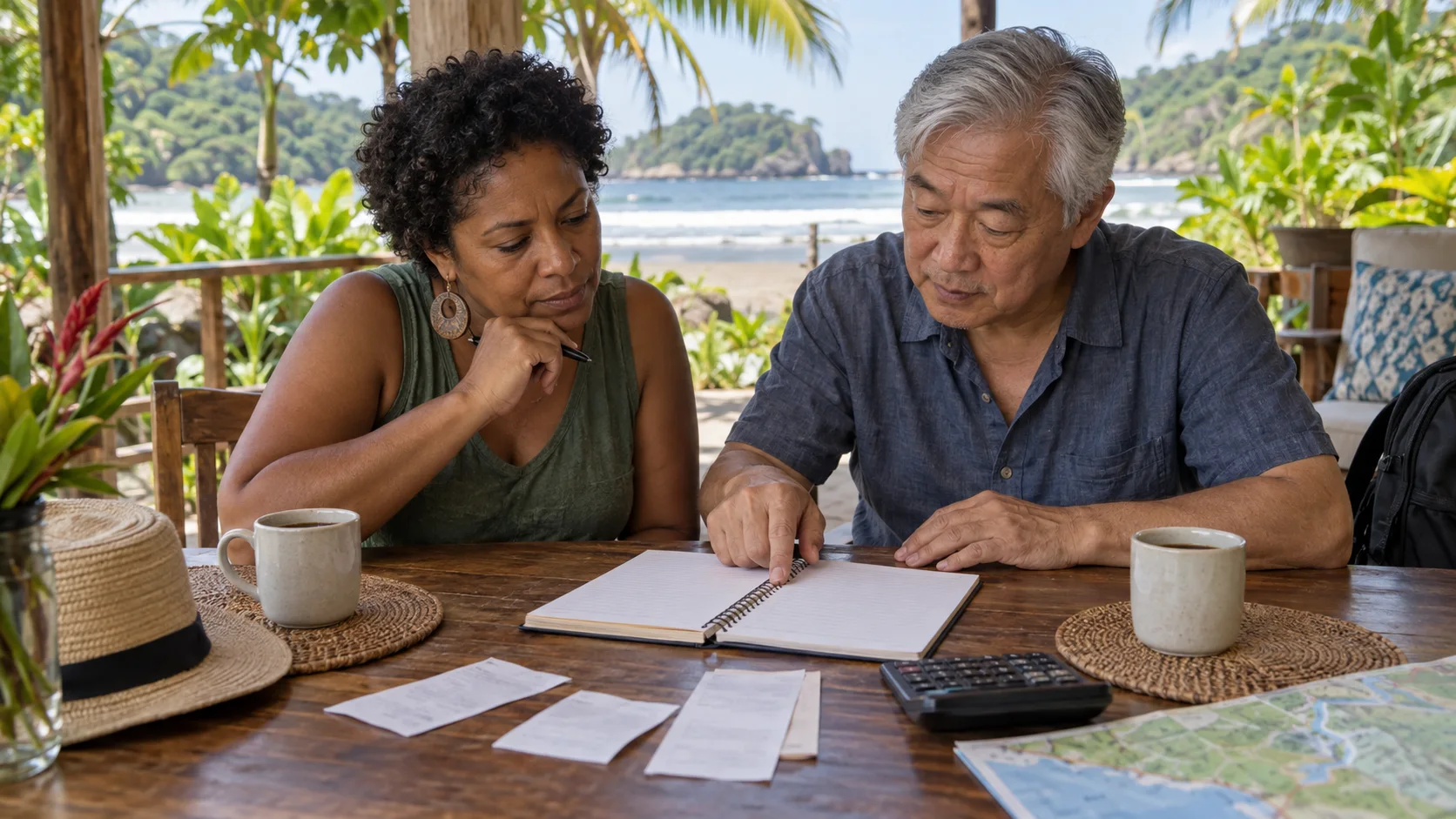
What might a day in Santa Teresa cost for two people? The useful answer is a budget you can adjust. Below, a worked example separates the room, meals and local rides, so you can see how each choice changes the total without mistaking sample numbers for market prices.
What this budget example measures
The example below covers a shared room, three meals and a stated riding pattern for two adults. Keeping those assumptions visible makes it easy to replace each line with your own plans.
This article provides a calculation you can replace with your own quotes. Accommodation and food numbers are deliberately labelled hypothetical. The transport calculations use Bimba's published pricing, checked October 8, 2026.
A sample day for two adults
The following example assumes a shared room and two adults buying three meals. It excludes flights, regional transfers, activities and refundable deposits. The amounts are inputs for demonstrating the method, not recommended price targets.
| Category | Hypothetical input | Daily total for two |
|---|---|---|
| Room | US$100 per night, shared | US$100 |
| Breakfast | US$12 each | US$24 |
| Lunch | US$15 each | US$30 |
| Dinner | US$20 each | US$40 |
| Local rides | Two rides per person, 20 total billed minutes across both rides | US$24 |
| Total | Before excluded categories | US$218 |
The per-person share is US$109 when the room and listed costs are split equally. Changing the room to US$80 reduces the group total by US$20, or US$10 per person. Removing one purchased meal changes the budget only after adding the replacement groceries or accommodation meal cost.
How the transport calculation works
At US$1 per unlock plus US$0.50 per minute, two rides totaling 20 billed minutes cost US$12 per rider. For two riders, the total is US$24. Those minutes are an assumed usage total, not a measured trip between two Santa Teresa locations.
If each person instead takes four rides totaling 30 minutes, pay-as-you-go costs US$19 per rider. A US$15 Daily Pass would be lower for that usage if it is available and its terms fit. Two separate US$15 passes would total US$30; a personal pass applies to Group Ride only if the app confirms it.
The daily pass includes 100 riding minutes in a 24-hour period from purchase. It does not provide a reserved bicycle for the day. Add any taxi or transfer the itinerary still needs for the journeys a riding pass does not cover.
Separate one-off costs from daily spending
Arrival and departure transfers belong in the overall trip budget but can distort the apparent cost of one day. Add them as a separate line, then divide by the number of nights only if you want an averaged trip cost.
For example, a hypothetical US$180 combined transfer expense spread across six nights adds US$30 per night to the group average. Across three nights it adds US$60. The transfer has not changed price; the averaging period has changed.
Use actual written transfer quotes for your route, passenger count and luggage. This arithmetic example is not a quote for an airport or ferry transfer.
Keep deposits separate from spending
A refundable accommodation or rental deposit is not automatically an expense equal to its face value. Track it separately so you know how much cash or card capacity must be available.
Bimba's pricing information notes a possible temporary US$20 card authorization on a first payment. Distinguish that from a settled ride charge when reviewing the statement. The bank controls the release timing of an authorization.
Your budget should therefore have two totals: expected spending and funds temporarily required. Combining them can make the holiday appear more expensive than its final cost while still hiding a genuine payment-capacity issue.
Compare quotes in one currency
Record the original currency and final payable amount for each purchase. If converting for your own worksheet, use a dated exchange rate and keep the original amount beside it. Do not assume a restaurant's displayed US-dollar conversion matches your card issuer's conversion.
Check whether taxes, service charges, delivery and equipment are included. A room or meal total is only comparable when the same additions are treated consistently.
Keep optional purchases separate from essentials. This shows which part of the budget changes if you add a tour, a second coffee stop or a restaurant upgrade.
Change one line and see what happens
Start with the room, because its total may already be fixed by your booking. Divide the stay price by nights, then split between the people sharing only when calculating individual costs. Keep per-person activities separate.
Next, replace each sample meal with an order from a menu you expect to use. Include the drink and additions you want. If breakfast comes with the room, remove the separate breakfast expense rather than counting it twice.
Finally, add the journeys your day needs. A shared-ride pass may change local riding costs, but it does not replace an airport transfer or every evening trip. This turns the example into your budget, one understandable decision at a time.
For the next part of your plan, see our building a full-trip budget and comparing bicycle payment options.
Make the sample calculation reproducible
The table assumes one room at US$100 per night for two people, two breakfasts at US$12 each, two lunches at US$15 each and two dinners at US$20 each. Those room and meal figures are hypothetical inputs, not observed Santa Teresa prices. The food subtotal is US$94 for two, and room plus food is US$194. Each rider makes two Bimba rides totaling 20 billed minutes, so one person's pay-as-you-go calculation is two US$1 unlocks plus 20 × US$0.50, or US$12. For two independent riders, US$24 brings the illustrated total to US$218.
That calculation relies on a precise meaning of “20 minutes”: it is the combined billed time of two rides for each person, not 20 minutes for each of two rides. If each ride lasted 20 billed minutes, transport would be US$22 per person and US$44 for two, raising the sample day to US$238. This distinction is worth writing in your own worksheet. Use actual billed minutes and current app terms rather than a route estimate when reconciling the final cost.
Compare a pass with the same pattern of rides
Bimba's official pricing page currently lists US$1 to unlock plus US$0.50 per billed minute, with 13% VAT included. It also lists a US$15 daily pass with 100 minutes within 24 hours from purchase. The pass is not a continuous rental and does not reserve a vehicle. To compare fairly, calculate pay-as-you-go for the same number of rides and minutes, then check whether a pass covers them within its window and whether the live app offers it on your account.
For one rider with two rides totaling 20 minutes, pay-as-you-go is US$12, below the US$15 daily pass. For four rides totaling 30 minutes, it is US$4 in unlock fees plus US$15 in minutes, or US$19, so US$15 can be lower if the pass terms apply. Two people normally need to evaluate their own usage separately. The pricing page says a personal pass applies to Group Ride only if the app confirms it; never assume one pass automatically covers several riders. The purchase screen gives the final conditions.
Change one input without hiding the others
Suppose the hypothetical room quote rises by US$30 per night. With everything else fixed, the group day becomes US$248, or US$124 per person if all listed costs are shared equally. Suppose instead breakfast is included in the room rate and the room price does not change. Remove the two US$12 breakfast lines; the illustrated total becomes US$194. If breakfast requires grocery shopping or a different café purchase, add that real replacement expense before claiming any saving.
Transport can also change the result. If the group walks one suitable short leg, remove the corresponding unlock and billed minutes from each rider's plan; do not simply subtract a pass price. If dinner ends after dark, budget an actual suitable return mode rather than retaining a bicycle assumption. Ask a driver for a quote based on date, location and passengers. A US$218 worksheet is only as useful as the route it represents.
Replace placeholder prices with dated evidence
For accommodation, record the final quote for the exact dates, room, people and cancellation conditions. Divide by nights only after including the charges that the booking actually shows. For meals, use current menus for the dishes and drinks you are likely to order and note whether tax or service is already included in the shown total. Avoid treating a restaurant's promotional image as a menu. A price copied from last season has no special authority because it looks precise.
Store a link, screenshot or written quote with the date it was checked. Then recheck major variable items shortly before the trip. For the Bimba line, use its current pricing page and the final app purchase screen. Prices and promotions may change; the worked arithmetic remains useful after you replace the inputs. Keep the original currency beside any converted figure so your worksheet can be reconciled with a card statement later.
Add the categories the sample excludes
The illustrated day leaves out flights, long-distance transfers, surf lessons, tours, travel insurance, laundry, shopping and any work-space pass. Add only the ones your itinerary will actually incur. Some costs are one-time: a transfer can be shown on the travel day or averaged across the stay, but not both. Some are per person; others, such as a room or taxi, may be shared. Mark this beside each line to avoid dividing an individual ticket twice or charging the group twice for one vehicle.
Track a refundable deposit or temporary card authorization under “funds required,” not as final spending unless it becomes a settled charge. The official Bimba page notes a possible temporary US$20 authorization on a first card transaction and says the bank controls when it disappears. That can affect available card capacity even though it is not the ride price. If the trip depends on a tight credit limit, this distinction matters.
Adapt the worksheet for one traveler or a family
A solo traveler cannot assume half the room price; use the actual single-occupancy quote. Their meal costs reflect one order each, while transport depends on their own rides. A family may share a room but require larger accommodation, different meals and separate paid activities. For children, use the operator's actual age and rider rules rather than dividing an adult Bimba example across everyone. The model is a structure, not a universal daily target.
Keep “per group” and “per person” columns side by side. When you compare two lodging options, change the room price and any transport differences that the new location creates. A cheaper room far from meals might raise ride or taxi spending. If an option includes breakfast, remove the separate meal only if it truly replaces the one you planned. This makes trade-offs visible rather than hiding them in a single headline daily number.
Review planned versus actual spending
At the end of a day, record actual room allocation, meals, rides and extras in the same categories as the plan. If your meal total differed, identify whether you chose a different venue, added drinks or simply used an outdated price. If transport differed, note whether minutes were longer, an extra unlock occurred or you switched to a taxi. This is more useful than calling the whole trip “over budget.” Adjust the next day's estimate based on what actually happened.
The photos in this article illustrate budgeting and do not portray published local prices. The only live tariff in the calculation is Bimba's published one, checked in October 2026; verify it in the app before purchase. All other dollar amounts remain explicit hypothetical examples. The goal is a transparent calculation you can rebuild with your own quotes, not a claim about the average cost of Santa Teresa.
Frequently asked questions
Are the food prices in this example observed local prices?
No. They are explicitly hypothetical inputs. Use current menus to replace them before relying on the budget.
Does the daily total include flights or tours?
No. Add them separately. The table shows a shared room, three meals and the stated local-riding example only.
Is a refundable deposit part of the trip cost?
Track it as temporarily required funds unless it becomes an actual charge under the agreement. Keep it separate from expected spending.
Summary
Use this daily budget as a worksheet, replacing the illustrative room and meal amounts with your own choices. Add the costs outside the example, including transfers and activities, and track refundable deposits separately. Adjusting one input at a time shows what changes your spending and helps you choose where to save.
Replace every example with your own number
Use the example to identify categories and trade-offs, then insert current quotes for your dates. Keep taxes, transport and a contingency visible instead of hiding them inside one total.