
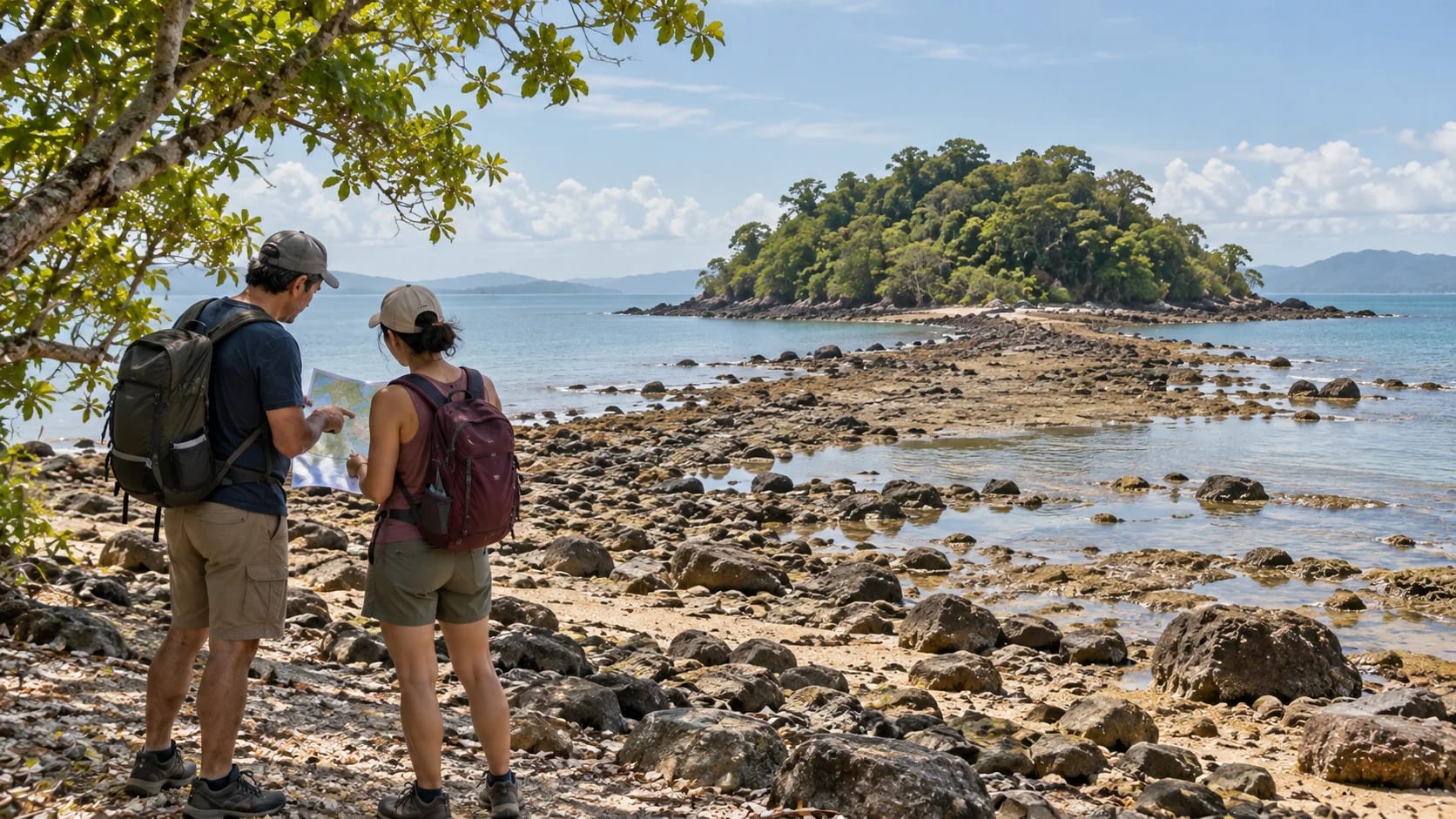
Cabuya's island cemetery belongs to the community that uses it. Visitors come because the shore and island connect around low tide, but families come to remember and bury loved ones. Plan your visit with that purpose in mind. A respectful outing can end with a view from the mainland if the crossing is unsuitable or people need privacy.
The Costa Rican tourism authority places the fishing village of Cabuya between Montezuma and Cabo Blanco on the southern Nicoya Peninsula. It identifies the offshore island as a cemetery still used by residents. That combination of coastal setting and continuing community use distinguishes this visit from a walk around an abandoned monument.
Understand the place before taking a photograph
Give the cemetery the same consideration you would give a burial ground near your own home. Keep your voice low, move around people who are tending a grave and avoid using memorials as props. You can notice architecture, vegetation and the relationship between island and village without turning someone else's mourning into a travel performance.
The island appears in tourism stories that emphasize mystery. Those descriptions can encourage visitors to expect ruins, ghosts or a theatrical setting. Use a more accurate description when explaining the stop to your companions: an island containing the local cemetery, with access affected by the tide. There is enough interest in the place itself without inventing a story.
Accounts of the cemetery's origins vary in travel publications. Avoid repeating a precise founding date, an Indigenous ritual claim or a story about a particular burial unless a reliable source supports it. A resident may share a family memory; listen as a guest and ask before recording or publishing it. Personal testimony deserves context, not conversion into a universal legend.
Treat low tide as planning information
The official tourism article describes a crossing of about 400 meters at low tide. That distance describes the connection in broad terms. It does not tell you how much exposed ground there will be on your date, whether waves will reach the route or how long your group will need to return.
The University of Costa Rica's MIO-CIMAR service publishes tide predictions as well as wave and wind forecasts. These answer different questions. A low-water prediction concerns the tide; wave conditions concern moving water that can affect an exposed shore. Consult the relevant information with a qualified local guide rather than reading one low-tide time as permission to cross.
NOAA explains that astronomical tide tables do not account for all local changes caused by wind, atmospheric pressure and river flow. That distinction supports a practical rule for this visit: use predictions to plan, then assess the actual place. A favorable number on a screen cannot overrule a local warning, an obscured route or conditions that exceed your comfort.
Plan the return before stepping off the mainland
Ask a knowledgeable local guide to assess whether an out-and-back visit is appropriate for your group that day. Give the guide your actual walking limitations and the time you have available. The useful question is whether you can complete the visit and return with margin, not merely whether someone else has crossed.
Wild Sun's local visitor information warns that a rising tide can leave visitors stranded. Do not use a photo stop, an interesting inscription or another group's progress as a reason to extend the visit beyond the agreed return. Keep a watch or phone accessible for timekeeping without depending on a mobile signal.
If you arrive after the suitable window has begun to close, stay on the mainland. Waiting for another opportunity may mean returning on another day. Do not improvise a boat crossing or enter deeper water to preserve an itinerary. A view of the island from shore can still explain the geography and give you a sense of its relationship to the village.
Keep the group together and agree who makes the decision to stop. A confident traveler should not pressure a hesitant companion into following. If your party has different mobility needs, arrange a mainland visit for everyone or a clearly supervised separate plan before reaching the shore.
Prepare for an uneven coastal surface
Ask about the current surface before deciding what to wear. Footwear should stay attached and allow you to place your feet with control. Loose sandals, delicate shoes and bare feet can make an uneven crossing harder to manage. Carry only what you can keep secure while leaving your hands available for balance.
Bring drinking water and protection appropriate to the day's weather, but leave bulky beach furniture behind. This visit involves reaching a cemetery and returning, not establishing a camp. Keep personal items inside a bag that can close. Avoid carrying an open drink or an unpacked camera while concentrating on your footing.
Do not treat the island approach as an opportunity to collect shells or handle animals along the way. Leave coastal life in place and follow the route your guide indicates. Stop to look only where doing so does not block others or interfere with the return. A close photograph of a small creature is not worth losing attention to the wider conditions.
Give families the space they need
A family gathering can change what is appropriate even after you reach the island. Stay outside the gathering, lower your voice and wait for guidance if your path would pass through it. You do not need to approach mourners to explain that you are a tourist. Quietly withdrawing can be the more considerate choice.
Walk between graves where a clear path allows it. Avoid standing on grave covers, moving flowers or adjusting an object to improve a composition. A candle, decoration or piece of fabric may have meaning to a family even if a visitor cannot interpret it. Leave it in the position where you found it.
With children, explain these expectations before arrival. They can observe the gate, trees and sea view while staying close to an adult. Do not turn the cemetery into a scavenger hunt for names or dates. If a child becomes restless, leave rather than requiring the family using the place to adapt to your group's activity.
Keep meals and social breaks for a suitable place in the village. Carry out any litter you brought. If you want to help maintain the cemetery, ask an appropriate community representative about an established way to contribute; do not begin cleaning memorials or changing objects without permission.
Photograph the setting with restraint
A broad view of the island from the mainland can convey the tidal geography without exposing private moments. Inside the cemetery, consider whether an image needs readable personal names or a close view of a fresh grave. Crop or choose another angle if those details add nothing to the story you want to tell.
Ask permission before photographing identifiable people. A person who answers a casual question has not agreed to appear in your video. If a ceremony begins, put the camera away and move aside. Avoid treating silence as consent or asking a grieving family to repeat an action for your recording.
Drone use raises separate permission and disturbance issues. A lack of a sign does not establish authorization. For an ordinary visit, leave aerial filming out of the plan. The ground-level view already shows the sea, the approach and the island without adding noise above people visiting graves.
Use an accurate caption if you share an image. Describe the cemetery and the conditions you observed without claiming that a path remains usable at another time. Avoid labels such as abandoned or haunted that misrepresent the continuing use of the place.
Build the Santa Teresa outing around the tide
Arrange appropriate regional transport to Cabuya and back. Ask your driver to use a route suitable for the day's road conditions; a short line on a map does not establish a usable shortcut. Give the driver the meeting location and your planned return, allowing the crossing decision to remain flexible.
The Montezuma day-visit guide helps if you want to include a meal or a stop there. Put the cemetery's suitable visiting window first, then fit the less time-sensitive stop around it. Do not shorten the return margin because a restaurant reservation is waiting.
The nearby Cabo Blanco visitor plan describes a separate reserve visit. Its opening and walking requirements do not follow the cemetery's tide window. Combining both can create a long day with competing constraints, so choose one as the main activity and leave the other for a date that suits it.
Bimba's local service operates within the live boundaries shown in its app. It does not establish a regional journey to Cabuya or a way to cross coastal terrain. Keep that transport separate from any short trip you make within Santa Teresa before departure.
Keep a worthwhile mainland alternative
If you cannot cross, spend time understanding the view from a suitable public place on the mainland. Notice the distance between the village and island and the part of the approach the water covers. You can explain the cemetery's tidal setting to a companion without testing the crossing.
A booked chocolate workshop in Cabuya can offer a different cultural activity, subject to its own availability. Do not assume that a workshop will accept an unannounced group because another part of your day changed. A quiet meal and a shorter outing may fit better than replacing one fixed commitment with another.
If wildlife conservation interests you, read the Wild Sun visitor-support guide before considering a stop. A nearby rescue organization does not function as an unrestricted attraction. For a wider comparison of regional choices, use the Santa Teresa day-trip guide.
Leave with the place as you found it
A good visit does not depend on reaching the island at all costs or collecting an unusual photograph. It depends on making a sound crossing decision, giving families room and understanding that residents continue to use the cemetery. Share those expectations with everyone in your group before leaving Santa Teresa.
Return at the time agreed with your guide, take your belongings and leave memorials untouched. If conditions or community needs change the plan, accept a shorter visit. You can learn about Cabuya's coastal geography and daily life while respecting the people for whom the island has a personal meaning.
Let the cemetery remain a cemetery
Visit with a locally assessed crossing and return plan, keep photography restrained and give families priority. Accept a mainland view if either conditions or community needs make crossing inappropriate.