
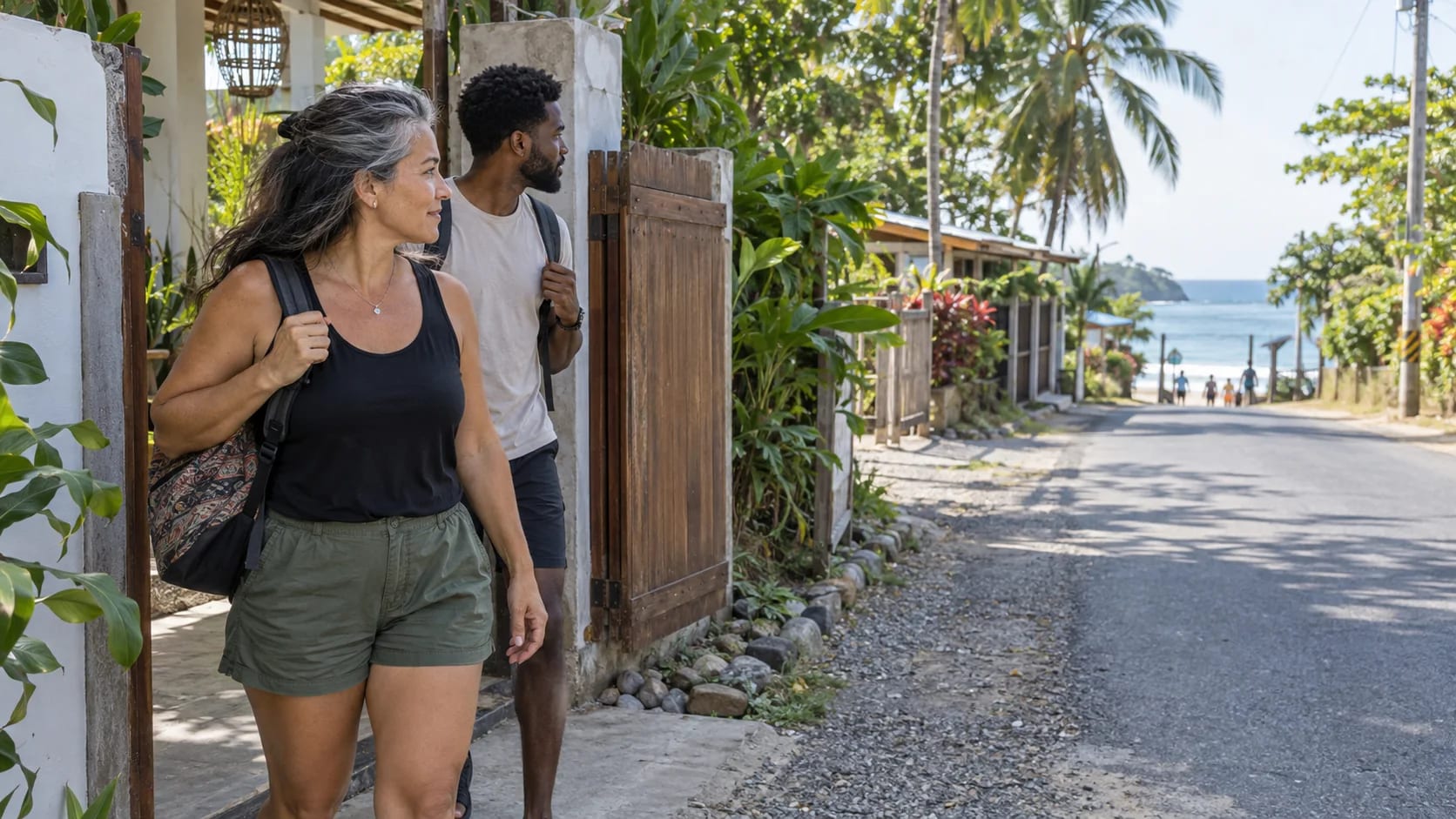
A well-located hotel in Santa Teresa can make everyday plans feel effortless. The key is not simply being close to the beach; it is being close to the places you will actually use. Compare the routes to breakfast, activities and dinner from the property's real entrance.
Start with the trips you repeat
Choose the places you will use most: a surf school, workspace, breakfast stop or family activity. Compare accommodation against those needs before looking at extra features.
Use the Santa Teresa accommodation guide for area context. Then compare individual properties against your own routine rather than treating one neighborhood as the best choice for every visitor.
A walking-needs scorecard
| Repeated trip | Evidence to collect | Why it matters |
|---|---|---|
| Breakfast | On-site service or actual route to a café | Happens before most daily plans |
| Groceries | Entrance-to-shop route with a small bag | Useful even when eating out |
| Main activity | Exact class, school or workspace entrance | Can be repeated several times |
| Beach | Usable public access, not just coastline distance | The nearest sand may not be the access you use |
| Dinner return | Route and transport after dark | Different from a daytime walk |
| Arrival | Vehicle access to reception | Luggage changes the journey |
The scorecard is not a numerical ranking of hotels. It is a way to compare the information that determines whether a property fits your stay.
Check the entrance pin
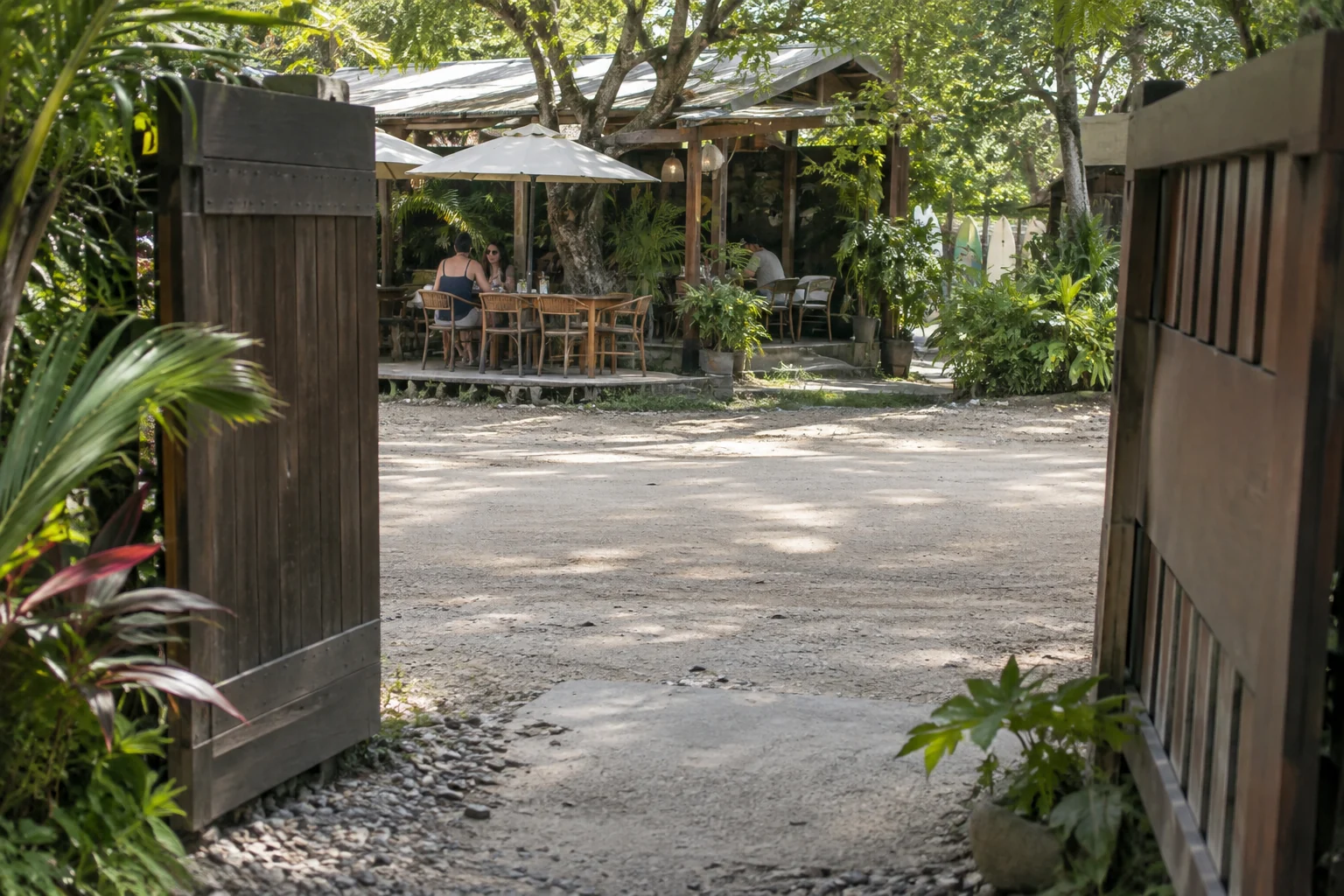
Ask the host for the guest entrance and reception location. Some accommodation pins identify a broader property or the turn from the main road. The final approach may include a hill, stairs or a driveway not obvious at the map's default scale.
Share that pin with your arrival driver and use it when comparing nearby services. A restaurant described as a short walk from the main road may be less convenient from a room farther up the approach.
Ask for current access information if rain could affect the route. A photograph of a dry entrance does not describe every date's conditions.
Compare walking time carefully
A mapped distance is an input, not a complete assessment. The route may involve crossings, narrow edges or a climb. If a host provides a walking time, ask where it starts and ends and whether it assumes the main entrance.
For a family or anyone with specific mobility needs, describe those needs directly. “Easy walk” can mean different things to different people. Ask about steps, surfaces and crossing points rather than relying only on that label.
After arrival, inspect the routine route in daylight before depending on it after dinner. Keep an alternative for trips that are not practical on foot.
Beachfront and walkable are different qualities
A beachfront property may have excellent access to the sand but still be distant from the shops or workspace you need. A property slightly inland may offer a more convenient daily mix. Compare both the beach visit and the non-beach errands.
Similarly, a room with a sea view may be above a steep approach. Enjoying the view and walking comfortably to meals are separate parts of the decision.
Choose according to the activities you expect to repeat. One taxi for a special dinner is different from needing paid transport for every meal.
Calculate the location premium
Suppose one room costs a hypothetical US$20 more per night but removes two transfers you would otherwise buy. Compare the actual transfer quotes with that US$20 difference. The more expensive room may cost less overall—or may simply save coordination time worth paying for.
Do not assume the saving. Use your expected number of trips and current quotes. A couple sharing a transfer has a different per-person cost from a solo traveler, and a group may need a larger vehicle.
Include meals if the room rate provides breakfast or a kitchen. A lower nightly rate with no useful food access is not automatically the lower-cost stay.
Where Bimba can complement walking
Shared riding can extend suitable local trips beyond your immediate walking area. Check Bimba's locations and the live app, but do not use a nearby station as the only reason to book a property. Vehicles and approved return points can change.
The accommodation's final approach still needs to work. Bimba's trip guidance recommends another mode for steep roads, luggage, heavy rain and darkness. Treat shared riding as one option in the daily plan rather than a guarantee of door-to-door access.
Draw three trips before choosing the room
Mark the accommodation entrance, a breakfast option and your main activity. Add somewhere you would be happy to eat in the evening. These few points give you a more useful picture of daily life than a long list of nearby attractions.
Ask the host about the routes between them. A location may be close in distance while the actual approach changes the walking experience. Check the journey home as carefully as the outward one, especially after dark.
Then compare room quotes with the transport each location would need. Paying more for a convenient base may suit you; choosing a quieter or hillside stay may also be worth it. Make the tradeoff with the everyday journeys in view.
For the next part of your plan, see our checking a hillside approach and the details of a monthly stay.
If you are still choosing the destination, see our Santa Teresa versus Nosara comparison.
Start at the room door, not the map pin
A hotel pin may mark reception, the center of a property or a road entrance. Your actual room could be uphill, across a garden or reached by steps. Ask the host for the exact entrance used by guests and whether the room you are considering is on the same level as that entrance. Request a recent, unedited description of the path between the room and the public road. If your plans depend on walking to breakfast or the beach twice a day, a few internal minutes become a repeated cost.
Inspect the route from that entrance to the particular beach access you intend to use. “Near the beach” can describe a straight-line distance while the lawful public entrance lies elsewhere. The same issue applies to a market or café: the relevant destination is its usable entrance, not its center pin. Save the exact two points in a map, then ask whether the route has a sidewalk, shoulder, stairs, a steep section or a crossing you would avoid after dark. Treat map estimates as a first screen; they cannot establish comfort or accessibility for your group.
Count repeated journeys before comparing room rates
Write one ordinary day before opening a booking site. Where will you eat breakfast, buy water and groceries, meet a lesson, reach the beach, have dinner and return? Mark which trips happen daily and which happen once. A property that adds ten awkward minutes to four routine journeys can feel less convenient than one that adds twenty minutes to a single excursion. Put the frequency next to each destination. This makes the scorecard in this guide more useful than a vague claim of a “central” location.
Compare two candidate hotels against the same routine. For each trip, note the route, expected daylight, whether you carry luggage or a board, and a practical fallback if conditions deteriorate. A cheaper room may still win when you enjoy the walk and can change plans freely. It may lose when each dinner return requires a paid transfer. Do not assume a quoted transfer fare or a shared vehicle will always be available; use real options for your dates and allow a contingency.
Test the difficult version of the walk
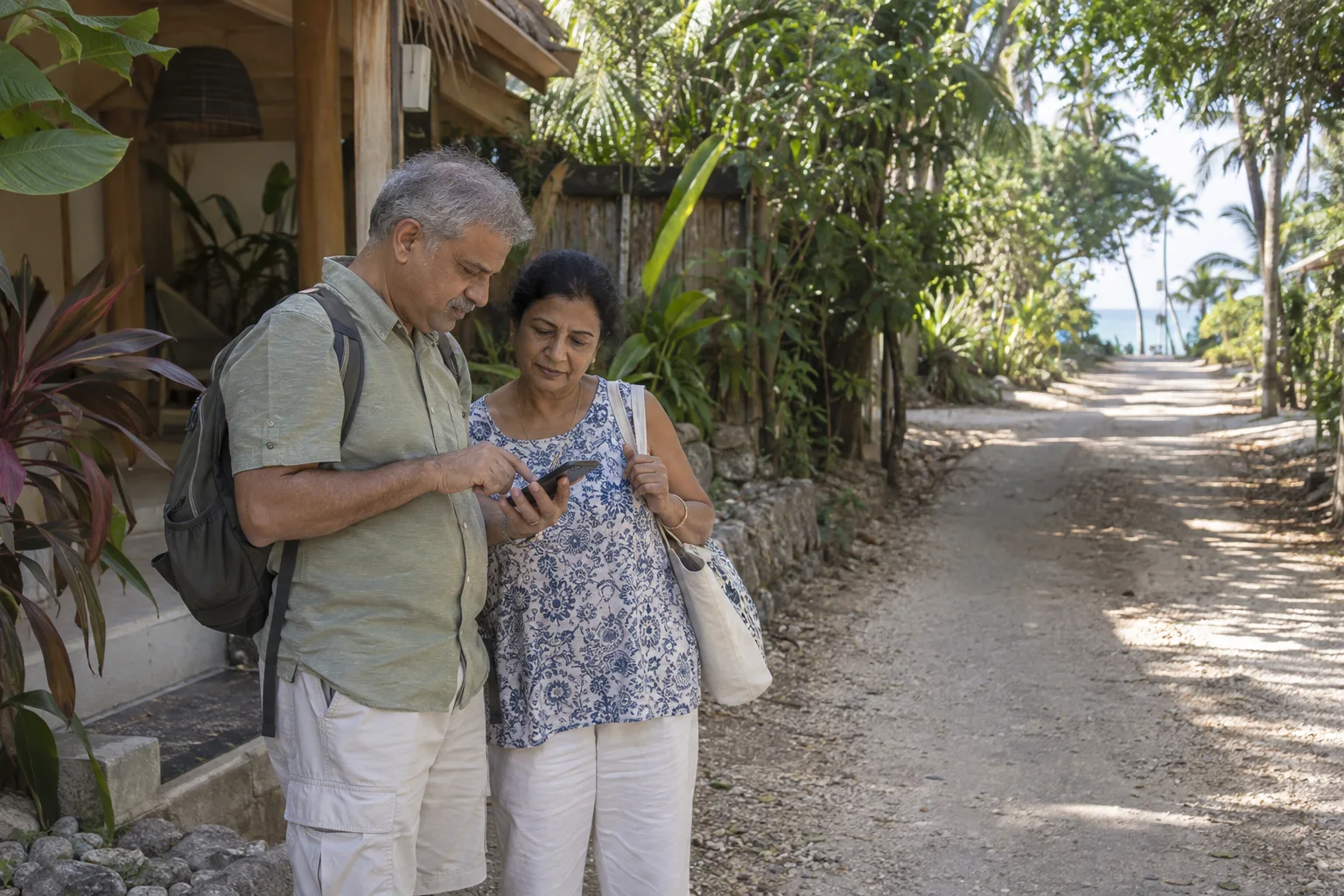
A pleasant morning approach may become tiring with midday heat, rain, shopping bags or a late dinner. Look for exposed stretches and drainage, and consider how the road surface changes with weather. Do not treat a photogenic dirt lane as proof of safe pedestrian access. Ask the lodging what the approach is like during rain and whether taxis can stop at the entrance. If you will arrive with a suitcase, confirm how you get from drop-off to your room without relying on a dry, empty path.
Night return needs its own plan. Check lighting, the last part of the route and a reliable transport option before booking a place that depends on walking back from dinner. A phone flashlight is not a replacement for a suitable route. Travelers with children, limited mobility or a heavy day bag should judge the path against their own pace, not a host's “five-minute” estimate. If steps or uneven ground are a problem, ask about them specifically and get an answer tied to the room category you will book.
Ask the host questions that can be answered precisely
Send a short list: What is the guest entrance's map link? Is the assigned room reached by stairs? Is there a continuous pedestrian route to the nearest grocery and the public beach access? Where can a taxi or shuttle drop off and pick up? What changes after heavy rain? Which parts are lit at night? Can the lodging help arrange a safe evening ride? Ask for recent photos of the access road from both directions if that would affect your choice. Responses such as “very close to everything” are less useful than a point, surface description and practical route.
Check recent guest reviews for recurring comments about dust, hills, noise, steps and transport, while recognizing that one person's easy walk may be another's hard one. Reviews can alert you to questions, but they are not proof that conditions remain the same today. Match the exact room type, season and mobility needs. Before paying a nonrefundable rate, confirm the access details in writing through the booking channel and read its cancellation terms.
Place Bimba in the route only when it fits
A shared bicycle or scooter can sometimes shorten a suitable daytime leg, but it should not be the foundation of a hotel choice. Check the live Bimba app for the current service area, an available vehicle and an approved return point. The final walk from that point to the hotel still counts. Returning a vehicle completes that rental; you cannot assume it will wait for your trip back. Also consider helmets, road conditions, luggage, rain and whether you will be drinking. Walking or an arranged ride may be the appropriate choice instead.
If a hotel advertises a Bimba point or appears near one in a directory, ask whether it is currently operational and verify in the app on the day. A static listing cannot guarantee availability. For a longer stay, assess whether your key errands remain workable on a day when there is no suitable shared vehicle. Good accommodation access should make the routine robust, not dependent on one mode.
Use a simple final comparison
Give each candidate a one-to-five score for the trips you will repeat, the room-to-road approach, rainy-day fallback, night return and full daily cost. Weight the categories that matter most to your group. Two equally priced rooms can then separate clearly: one may have a better beach view while the other makes meals and errands easier. A hillside room can still be the right choice when quiet and views are priorities and transfers are planned. The point is to choose deliberately with the access cost visible.
Do a final confirmation shortly before arrival. Businesses, road conditions and mobility availability can change. Share the precise entrance with your driver and save a contact for the property. The images in this guide are illustrative lodging and walking scenes, not verified views of any listed hotel or a guarantee of current road conditions.
Frequently asked questions
Is a hotel near the beach always the best option without a car?
No. Consider food, activities and the actual entrance as well as beach access.
Should I trust a listed five-minute walk?
Clarify the starting point, destination and route. Treat it as a description to check, not a universal time for every guest.
Can a shared-bike station replace convenient hotel access?
No. It can help with suitable trips, but live availability and the final route still matter.
Summary
Choose a Santa Teresa hotel by the journeys you will repeat: meals, activities and the route home. Check the actual entrance and walking conditions, then compare any room-price difference with transport costs. A location that supports your routine can make every day of the stay easier to organise.
Map one normal day before booking
Plot the accommodation against breakfast, beach and dinner, then ask about the actual walking surface and lighting. Choose a farther hotel only when its transport plan is credible.