
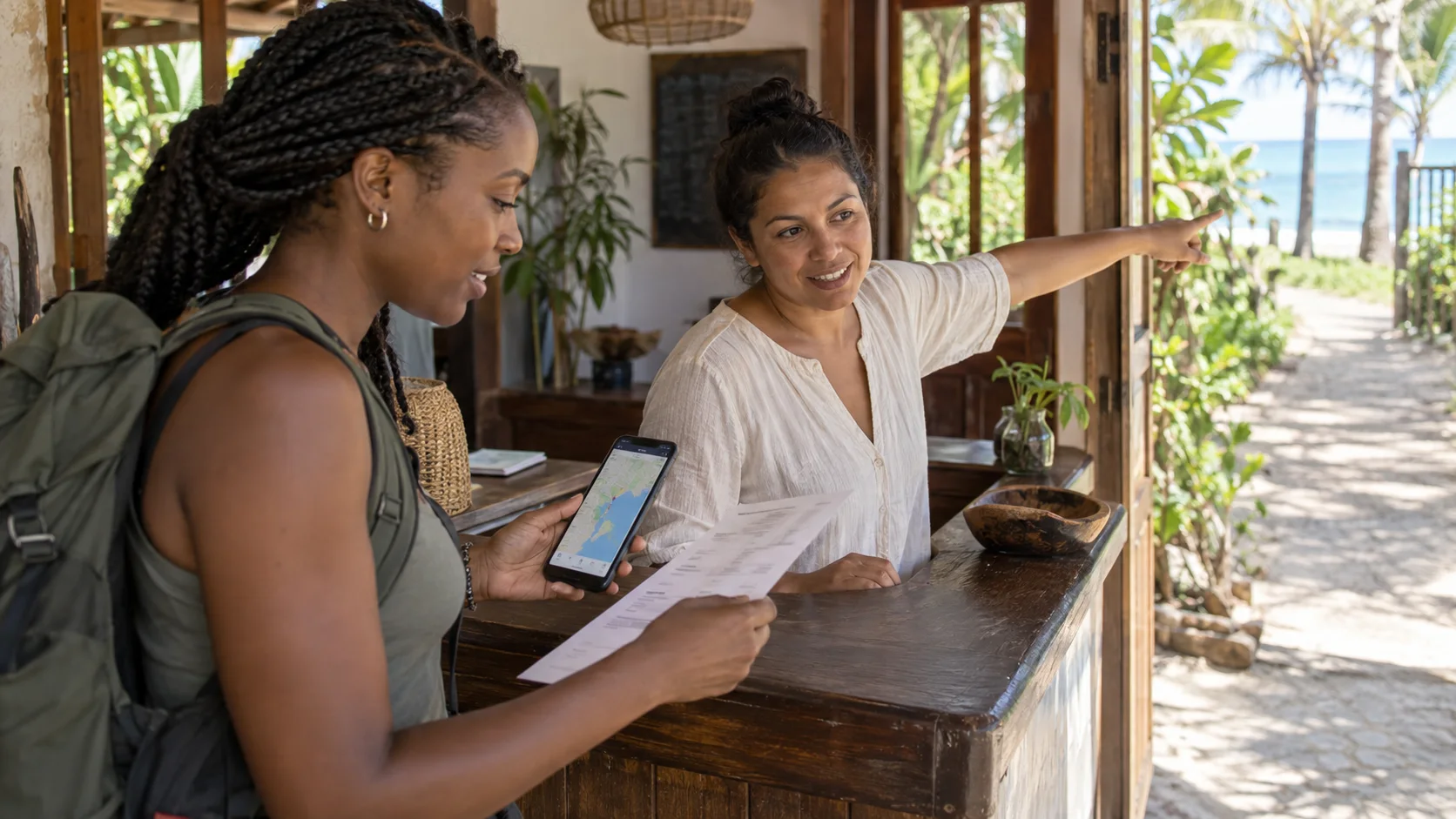
Small planning choices can make a big difference to a Santa Teresa trip. Most are easy to sort out before you pay: the actual hotel entrance, what a rental includes, the full meal price and how you will get home. Here are the details that help a good plan work in practice.
Mistake 1: booking a room from the view alone
Look at the final approach as well as the view. It affects arriving with luggage, walking to food and returning after dinner, so it deserves a place in the room comparison.
Get the entrance pin and current access instructions before paying. Compare the room with the places you will use repeatedly, not only its distance from the coastline. The car-free accommodation guide helps frame those questions.
Mistake 2: treating every transport product as interchangeable
A bicycle rental, shared e-bike pass, taxi trip and regional transfer solve different needs. A daily rental usually gives possession of a vehicle under its agreement; a shared pass provides an allowance under network rules.
Bimba's Daily Pass is published at US$15 for 100 minutes within 24 hours from purchase. It does not provide 24 hours of continuous riding or reserve a bicycle. Understanding that distinction prevents an incorrect cost comparison before the first trip.
| Planning assumption | Better information to use |
|---|---|
| “Daily means unlimited” | Included minutes, validity and additional rates |
| “The map shows a café, so I can return there” | Approved endpoint in the live app |
| “My hotel is nearby” | Actual entrance and route |
| “The tour price includes pickup” | Product-specific pickup terms |
| “A deposit is the final cost” | Rental charge and refundable hold separately |
Mistake 3: comparing incomplete prices
A room base rate, a meal before additions and a rental without tax are not final totals. Ask what is included and compare the same service: room occupancy, meal components, vehicle type or transfer capacity.
Keep refundable deposits separate from expected spending, while still allowing enough funds or card capacity for them. Record original currencies when making a budget instead of silently mixing colones and US dollars.
For local rides, calculate the actual pattern you expect. More unlocks can change whether a pass is worthwhile even when the total riding time stays similar.

Mistake 4: relying on old schedules
Restaurant hours, class calendars and excursion dates can change. Old retreat pages and menu PDFs may remain searchable long after their original dates. Use the provider's current page and a confirmation for your actual booking.
A recurring event listing is a lead, not a guarantee that the program runs on your chosen evening. Confirm the date, time and any reservation requirement before arranging the rest of the day around it.
For a late arrival, check kitchen service separately from a restaurant's closing time. A business being open does not prove that every menu item can still be ordered.
Mistake 5: planning the outbound journey only
The return can differ from the arrival: it may be after dark, in different weather or with groceries. Arrange the evening transfer or practical walking route before relying on a daytime bicycle plan.
After ending a shared ride, the same vehicle is not reserved for you. Check current availability when ready to leave. For a fixed lesson or transfer connection, leave another practical option rather than depending on one vehicle remaining in place.
The local transport guide helps compare methods for different journeys.
Mistake 6: carrying equipment the activity already supplies
Before renting a surfboard or bringing a yoga mat across town, ask what the booked session includes and where equipment is handed over. A lesson with a board at the beach can remove a difficult transport problem.
Conversely, do not assume that a package includes gear simply because a photograph shows it. Confirm the exact inclusions, meeting point and return procedure in the booking.
For luggage between checkout and a later transfer, arrange storage with the accommodation. Arrange the bag drop before heading to a café or lesson so you can enjoy the time without carrying everything.
Mistake 7: overloading a short itinerary
Several activities can look close on a map while still requiring preparation, waiting and transfers. Count the whole appointment: travel, check-in, equipment, activity and return.
Choose one main outing for a day that includes regional travel. Keep meals near the route and leave room for changes. For local days, group practical stops in one area instead of repeatedly crossing town.
If the weather changes, remove or move an optional stop rather than forcing the original plan. Use the Costa Rica Tourism Board's climate information for seasonal context and current local information for the day itself.
Use one final message to close the gaps
Before a significant booking, collect the details in one place: date, people, total price, included services, meeting point and cancellation terms. Ask the provider to clarify anything that is still unclear.
For transport or an activity, add the finish point and return arrangement. For accommodation, add the entrance and check-in process. You can then share a useful confirmation with your travel companions instead of a series of partial messages.
Keep the plan light enough to change. If every hour depends on the previous booking ending exactly on time, remove one commitment. The aim is to spend the trip enjoying what you chose, with enough room for ordinary delays and a change of mind.
For the next part of your plan, see our building a complete trip budget and planning a flexible week.
Make one prepayment checklist
Before committing money to a room, activity or transport, record the exact product, date, people covered, starting location, what is included and when it can be changed. A confirmation email should answer those questions without relying on a vague social post or remembered conversation. Check the property's actual entrance, the guest room category and its cancellation deadline. For an activity, confirm the meeting point, equipment, pickup and weather policy. For a transfer, confirm passenger and luggage capacity, full fare and final destination.
Put the most difficult-to-change reservation first. A fixed lesson or flight can constrain the day, while an ordinary lunch choice may remain flexible. Avoid prepaying several dependent items when the first has not been confirmed. If you must reserve them together, check whether each can move when an earlier part changes. Save receipts and provider contacts offline so you can resolve a question without searching through apps at the roadside.
Turn advertised prices into payable totals
Start from the final checkout price for the same date, group and service. Accommodation may add taxes or fees; a tour may exclude pickup or equipment; a meal may change with drinks and service charges. Ask what is mandatory and what is optional. Note the currency in which you will actually be charged and the exchange method your payment provider uses. The cheapest headline number is not necessarily the cheapest usable plan.
Keep deposits and card holds in a separate column. They may be refundable, but they temporarily reduce available funds and should have written release terms. For a rental, record the rate, allowed duration, late return terms and damage responsibility separately. For shared mobility, read the current pass allowance, validity period and excess-minute price. Bimba's official pricing page is the current source for its published terms; the live app controls availability and eligible return points. Recheck both before purchase.
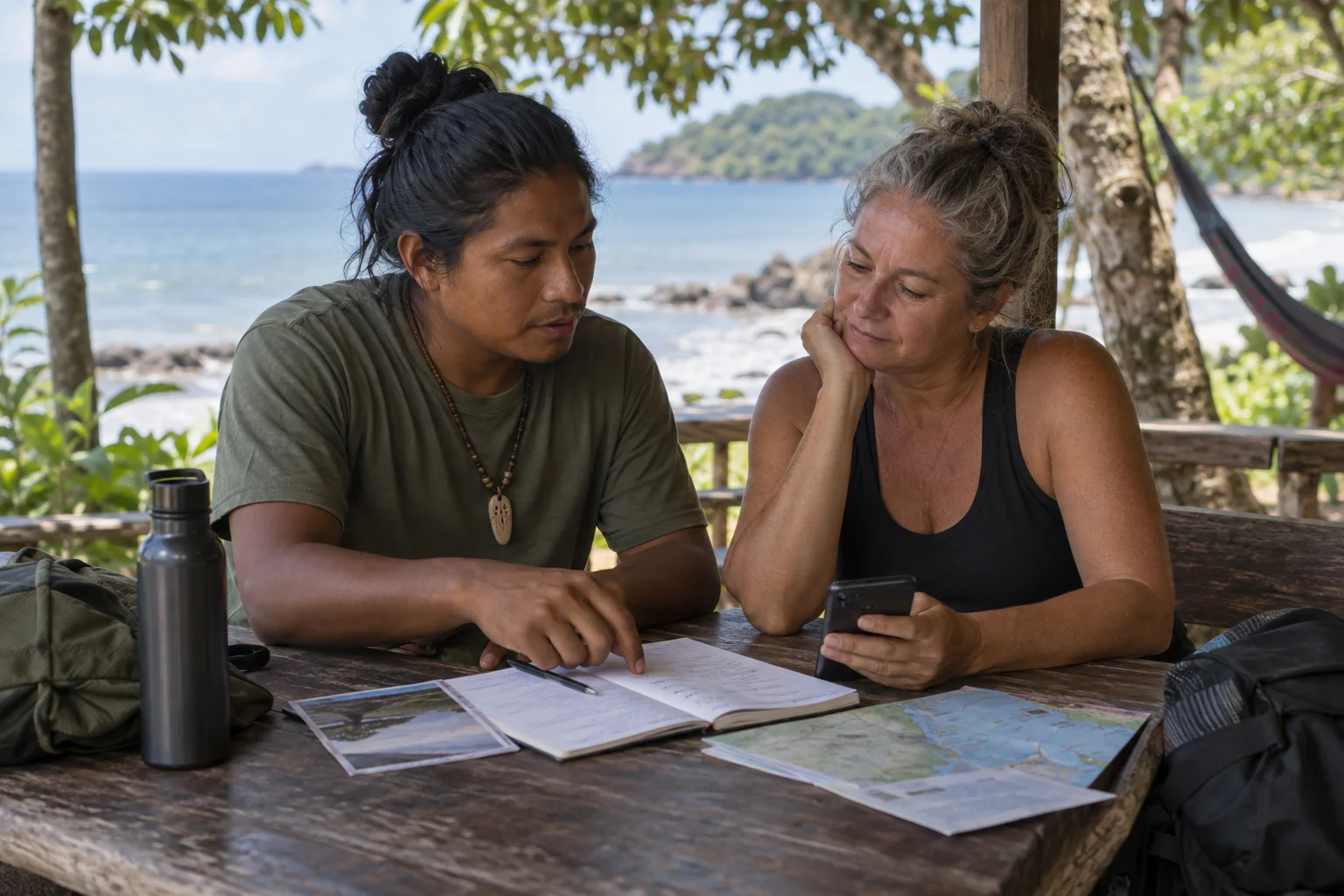
Draw the return trip before the outward trip
People often know how they will reach a beach, restaurant or lesson but leave the return vague. Set the finish time, exact pickup point and a fallback if rain, darkness or delay makes walking or riding unsuitable. Ask whether the accommodation can be reached by the vehicle you plan to use, especially if the final approach is steep or unpaved. Share the location with your group and keep the driver's or provider's contact.
A shared Bimba vehicle is a possible local option only when the route, conditions and approved endpoint fit. Returning it ends that rental; it is then available to others. A pass does not reserve a vehicle for your way back. If an evening meal involves alcohol, arrange other transport. Regional tours and airport transfers need their own suitable service. Treating every vehicle as interchangeable creates avoidable gaps in the plan.
Give the plan room for weather and timing
Check the forecast close to the day, then ask the activity provider what happens in the actual conditions. Rain can affect a road, outdoor class or pickup without automatically cancelling everything. Build a realistic interval between a lesson's expected end and the next paid reservation. If a transfer arrives late, knowing the second provider's change policy matters more than an ambitious minute-by-minute itinerary.
Protect one flexible activity in each day. If a surf lesson moves, choose a nearby meal or rest rather than racing across town to recover an overfilled schedule. Keep water, charged phone and the property's contact accessible. If you have limited mobility, young children or heavy equipment, plan around those needs from the start. The right route is the one your group can complete under ordinary imperfect conditions.
A sample booking audit
Imagine a three-night stay with an early surf class and one regional excursion. First confirm the guest entrance, room type and total rate. Then ask the school for its exact meeting point, board inclusion and weather rule. Ask the excursion operator whether it collects from your lodging or a separate point, and confirm the return. Add the arrival and departure transfers with luggage. Only after those pieces are known can you decide whether a shared local pass offers value for the remaining short daytime trips.
This audit reveals gaps before they cost time: perhaps the lodging is farther from the school than its beach view suggested, or the excursion pickup is outside walking range. You can then choose another room, a different class time or a booked ride. The exercise is not an argument to buy more transport; sometimes moving one booking solves the problem at no extra cost.
Keep facts current and images in context
Prices, opening hours, schedules and service areas can change. Verify consequential details with the primary provider near your travel date. The article's photos illustrate travelers checking access and budget; they do not depict a named hotel, a particular Bimba vehicle or proof that a route is currently open. A good final check is simple: can you state what you paid for, where you need to be, what you carry and how you will get home? If yes, the plan is ready to use.
Frequently asked questions
What is the first thing to confirm after booking accommodation?
The actual entrance, arrival procedure and the vehicle needed to reach it with your luggage.
Are all Santa Teresa activities suitable for a shared-bike trip?
No. Check the route, conditions, load and approved endpoints. Regional excursions and luggage transfers need separate transport.
Should I buy every pass and activity before arrival?
Book the fixed commitments you need, but understand validity, cancellation and availability. A prepaid allowance is only useful when it fits the trips you will take.
Summary
Good Santa Teresa planning comes down to a few concrete checks: the entrance, complete price, booking terms, included equipment and return journey. Resolve those details before making the commitments that depend on them. Keep room for ordinary delays and changing plans so you can spend more of the trip enjoying what you chose.
The five-minute prevention check
Before paying, confirm the exact pin, final price, cancellation terms, arrival method and return plan. Save the confirmation offline and ask immediately when two sources disagree.