
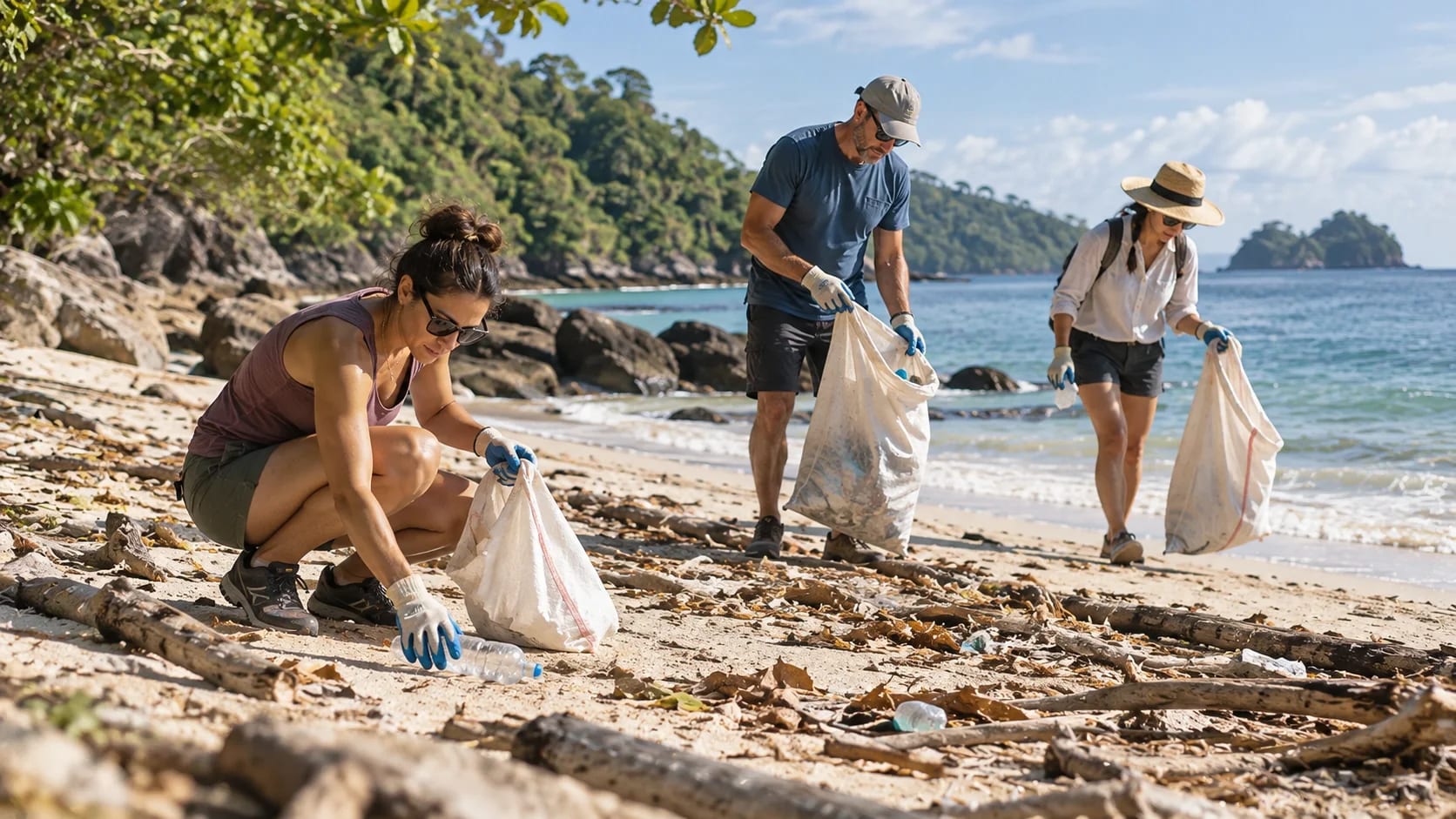
Joining a beach cleanup in Santa Teresa can fit into a short visit, but the useful part is more than filling a bag. Someone has to identify the meeting point, decide which material can be handled, separate it and arrange its next destination. Nicoya Peninsula Waterkeeper publishes a route for visitors to get involved. Starting there connects your time with an existing operation and reduces the chance of leaving a pile that another person must deal with later.
This guide focuses on participation, rather than everyday household recycling. The two activities overlap at the sorting stage, but beach debris has a different history from a clean bottle in an apartment kitchen. Sun, salt, sand and contamination can affect what happens next. If you mainly need to separate waste during your stay, use our guide to recycling in Santa Teresa. For an organized cleanup, follow the event’s own instructions.
The current contact route
Nicoya Peninsula Waterkeeper’s participation page invites visitors to contact the organization for the next cleanup. Its work page lists ariadnawaterkeeper@gmail.com for joining or organizing an activity. These were the published contact instructions when checked on October 21, 2026. Send the dates you will be in town, the number of people and whether children are joining. That gives the coordinator enough information to suggest a suitable opportunity.
The message should ask for the precise beach access, meeting time, expected duration and equipment arrangements. Santa Teresa is not a single meeting point: a beach name alone may leave you at the wrong entrance. Request a location pin or a clear landmark and keep it available offline. If you need transport, arrange it around the confirmed meeting instructions rather than a general search result for the beach.
Offer the time you can actually give. A person who can stay for one hour should say so, especially if the activity includes sorting and loading after collection. Arriving late or leaving with the only available vehicle can disrupt the final stage. There is no need to promise a whole day to make your participation sound worthwhile. A clear, limited commitment is easier to incorporate into a working plan.
Regular collection is different from a volunteer event
The Nicoya Peninsula Foundation describes a beach-cleaning project covering Malpaís, Carmen, Santa Teresa, Hermosa and Manzanillo. Its published process includes collection, sorting, weighing and material recovery. This helps explain the ongoing work behind beaches that visitors enjoy for a few days. It does not mean that every collector’s shift is a public event with a volunteer meeting point.
Santa Teresa Lifeguards also has a published announcement describing Saturday cleanups in collaboration with Proyecto L-Eco and Waterkeeper. The page is evidence of a collaboration, but it does not provide a dated appointment for your travel week. Treat it as a reason to contact the organizers, not as a guarantee that you can arrive at a particular tower next Saturday. Older event posts often remain visible long after arrangements change.
Waterkeeper separately advertises volunteer Thursdays at its recycling center in Cóbano. That is another kind of contribution, involving a different location and task. If your preferred beach event does not align with your stay, ask whether an appropriate center session is available. Do not substitute one location for the other without agreement; the people supervising the work and the materials involved may differ.
Prepare for collection rather than a beach swim
Wear footwear suitable for walking on uneven ground and handling a task near scattered debris. Bring drinking water in a reusable container, sun protection and clothing you can move in. Ask whether the organizer provides gloves, collection tools and bags. If you have your own suitable reusable equipment, describe it before bringing a large quantity. The coordinator may have a specific system for keeping materials separate.
Keep the equipment simple enough to carry while both hands are occupied. An open tote full of personal belongings becomes awkward when you also have a collection bag. Leave valuables securely stored and carry only what you need for the agreed period. Our Santa Teresa packing guide can help with ordinary travel essentials; the cleanup organizer should determine any task-specific items.
Think about the return journey before you begin. Will your shoes be sandy, will the group return to the same access and who will carry the collected material? A driver hired only for passengers may not be prepared to transport bags of debris. Do not place leaking or sharp waste in a rental vehicle to solve a problem that could have been planned earlier. Ask the coordinator which vehicle, if any, is assigned to the final collection.
Use the briefing to define the job
Before spreading out, establish the area, the return time and the person responsible for unusual finds. A narrow, clear section of beach is often easier for a visiting group to finish properly than a long walk that ends far from the sorting point. Stay within the agreed area and use established access routes. A cleanup is not permission to enter private land, climb coastal structures or cross a stream to reach one visible object.
NOAA’s marine-debris handling guidance provides a useful general boundary: unknown or potentially hazardous objects should be left alone and reported. This includes containers that may hold chemicals, fuel equipment and large debris that volunteers cannot safely move. Its United States reporting contacts do not apply to this Costa Rican outing; use the local organizer and appropriate local responders. The handling principle still matters.
Do not reach blindly into a pile or compress a collection bag with your hands. Let the organizer decide how sharp items are managed. If a bag is becoming too heavy, stop filling it and request another container or help. The aim is to remove manageable litter, not demonstrate endurance. A bag that breaks on the return walk can scatter the same material across the area you just cleaned.
Recognize the difference between litter and habitat
A tidy photograph is a poor guide to what belongs on a beach. Leave naturally occurring wood, shells, vegetation and living organisms in place unless the responsible site manager gives a specific instruction. Focus on identifiable human-made litter. If you cannot tell what an object is, ask rather than removing it for appearance’s sake. A cleanup should not become informal landscaping of the coastal environment.
Do not enter the water to retrieve an object that has drifted beyond reach. Waves and currents do not become safer because the purpose is environmental. The same applies to debris caught near a river mouth or lodged in unstable rocks. Record the position from a safe place and tell the coordinator. Our sea turtle conservation guide explains another reason to respect coastal wildlife and organized project boundaries.
If you encounter an animal caught in litter, do not pull the material or attempt a release without qualified assistance. Moving it may worsen an injury or expose you to bites and other hazards. Keep people back and report the location. The local rescue context described in our Wild Sun Rescue support guide is useful background, but a planned cleanup is not an animal-treatment assignment.
Sorting is part of finishing
Ask how the event separates ordinary recyclables, mixed beach plastics and nonrecoverable waste. Waterkeeper says it can help groups organize sorting so that suitable material reaches its Cóbano recycling operation. The Foundation also describes a separate recovery route for problematic plastics through Pedregal in Heredia. These published processes show why one undifferentiated bag is not always the best collection method.
Those descriptions are not permission to put every beach object in a household recycling bin. Acceptance depends on the actual program, material and condition. Bring uncertain pieces to the agreed sorting area and let the responsible person classify them. Avoid rinsing unknown residues into a beach drain or stream. If cleaning is required, it should happen through the organizer’s system rather than an improvised wash at the shoreline.
Stay for the handover if you can. Confirm which bags are ready, where they belong and who will remove them. A pile beside a public bin can be torn open, overlooked or washed away. If you have collected independently, the disposal plan must be in place before the bag fills. Do not assume a café, hotel or lifeguard station has agreed to receive your collection simply because it is nearby.
Make the task workable for families and friends
For children, ask the organizer about the particular event rather than assuming every cleanup is suitable. Agree on supervision and select a limited task with obvious, easy-to-identify litter. An adult should control the collection container and make decisions about uncertain objects. Give children permission to point out an item without picking it up. The contribution can be noticing and learning, not handling everything they find.
A private group should appoint one coordinator to communicate with Waterkeeper and relay the same instructions to everyone. Split practical responsibilities before arrival: transport, drinking water, supervision and the final count of participants. Avoid making the cleanup depend on one person also filming the entire event. If you want photographs, ask permission and take them after the working arrangements are settled.
For families balancing activities across a stay, our Santa Teresa family guide provides wider planning context. Leave enough space after the cleanup for washing, food and rest. A short, completed contribution is preferable to an overfilled morning that forces your group to leave just when sorting begins.
Use what you notice on the next shopping trip
Pay attention to recurring objects without claiming that your handful of bags represents the whole coastline. Repeated takeaway packaging might prompt your group to carry reusable containers or eat at the business instead. Bottles may encourage a better refill plan. These are practical observations from your own activity, not a scientific waste audit unless the organizer is using a defined recording method.
Support can also continue through an official donation or by sharing the next confirmed event. Avoid posting an old meeting time as if it were permanent. Our recommendation is to join an existing activity when possible, work within its boundaries and finish the disposal stage. The most useful result is a manageable quantity of litter with a responsible destination, plus fewer avoidable items entering your own holiday routine.
Join a coordinated cleanup
Contact Waterkeeper for a dated meeting point, follow its sorting system and leave time for handover. A small contribution with an agreed disposal route is more useful than an abandoned pile of bags.