
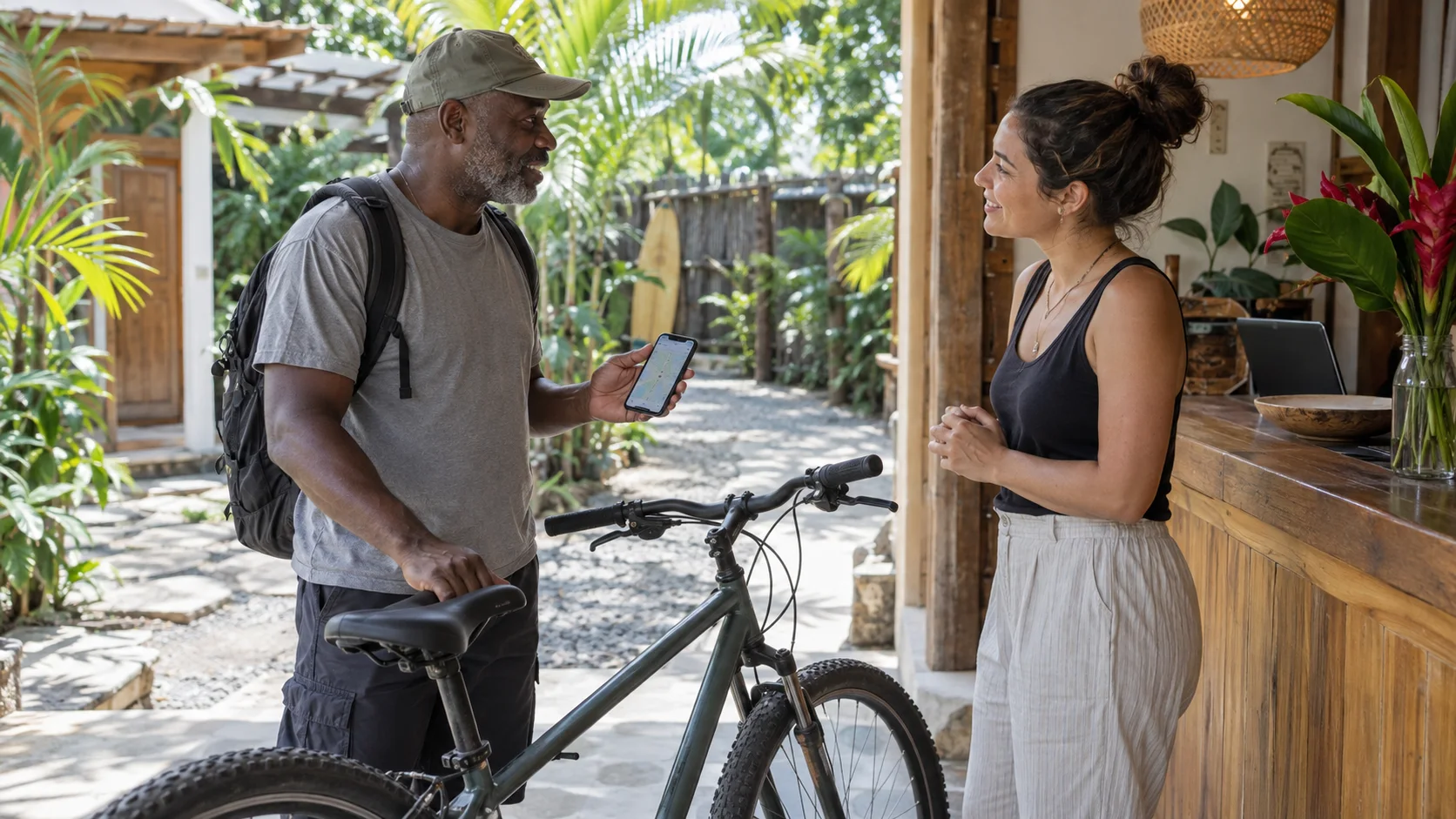
A bicycle from your hotel and a Bimba shared e-bike can look like similar ways to get around Santa Teresa. The biggest difference is what happens between rides. With a hotel rental you may keep one bike; with sharing, you finish the ride and check availability when you next need one.
What is included in a hotel bicycle rental?
The term can mean several arrangements: a bicycle owned by the hotel, a rental supplied by an outside company or a third-party booking made by reception. Ask who supplies the bicycle and who handles payment, maintenance and damage questions.
Armonia advertises bicycle rentals at US$15 per day. That is a named accommodation's published offer, not a standard hotel rate across Santa Teresa. Confirm the bicycle type, final total, guest eligibility and availability directly.
How Bimba sharing differs
With Bimba, a ride begins with an available vehicle in the app and ends at an approved location. After completing the return, you do not retain that bicycle. The next journey starts with another availability check.
Published Bimba prices are US$1 per unlock plus US$0.50 per minute, or passes including a US$15 Daily Pass with 100 minutes over 24 hours from purchase. The pass is an allowance, not an exclusive 24-hour bicycle rental. Final availability and terms appear in the app.
Side-by-side comparison
| Feature | Hotel rental | Bimba sharing |
|---|---|---|
| Collection | Hotel or agreed supplier handover | Available vehicle shown in the app |
| Bicycle type | Must be confirmed | Shared electric bicycle or scooter selected in the app |
| Keeping the vehicle | Usually retained during the rental period | Not retained after ending the ride |
| Return | Hotel or supplier's agreed point | Approved in-app endpoint |
| Overnight responsibility | Depends on rental and storage agreement | No vehicle to store after a completed return |
| Assistance | Hotel or named rental supplier | Bimba support under the service terms |
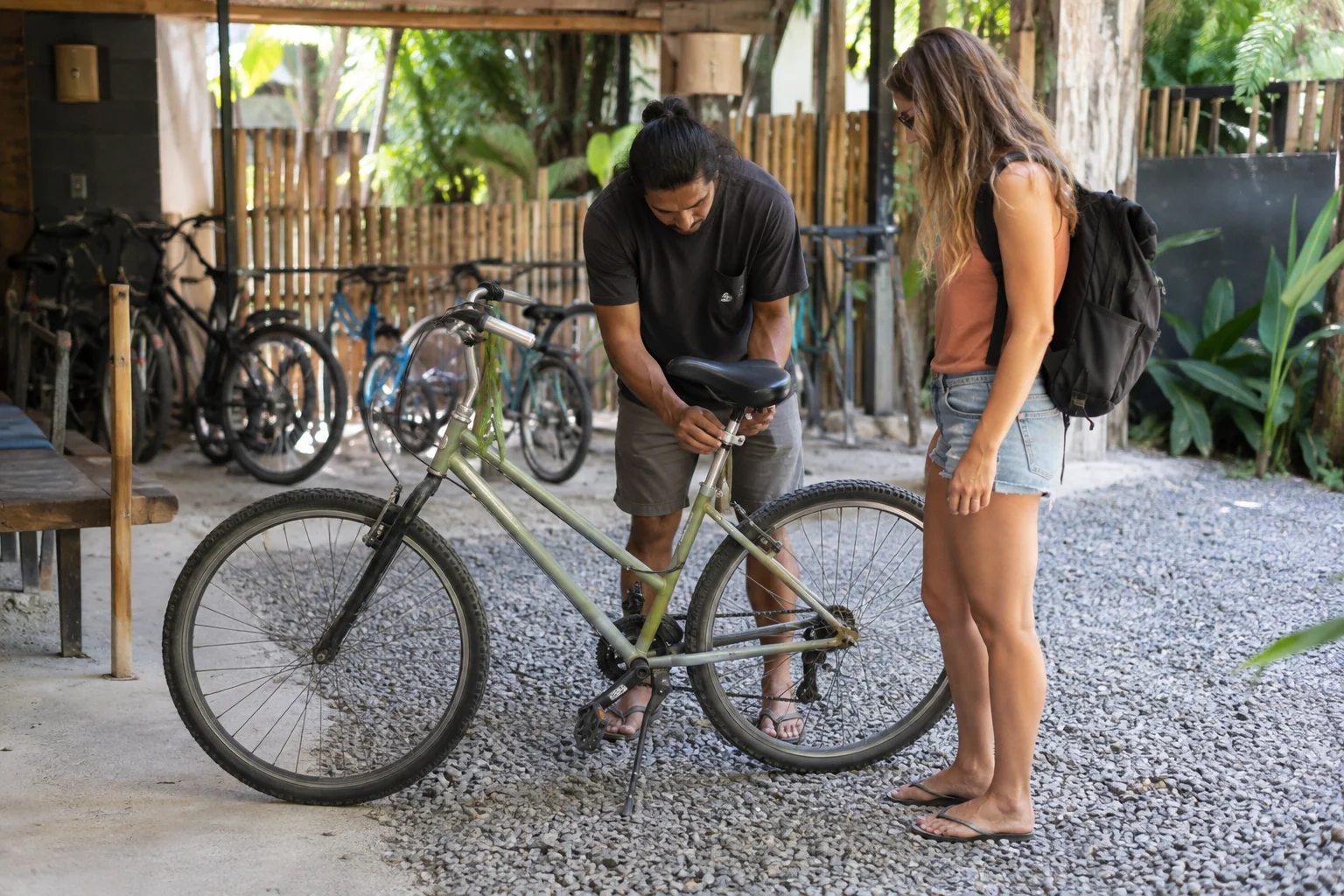
Equal prices can buy different things
A US$15 daily rental and a US$15 shared pass can have the same headline amount but different utility. The rental may let you keep a conventional bicycle throughout the day. The pass provides a limited amount of riding on shared vehicles during its validity window.
Electric assistance is another difference. Do not compare a conventional hotel bicycle with a shared e-bike as if both require the same effort. Equally, do not assume a hotel bicycle is electric because the listing says “bike rental”.
For a fair comparison, write down the final total, bicycle type, duration and return arrangement. Then compare them with the journeys you actually intend to make. See the bike rental guide for other local rental formats.
When the hotel option is convenient
Keeping a bicycle at the accommodation can simplify repeated departures. You do not need to locate another shared vehicle each time, provided the rental agreement allows you to retain it and you have suitable storage.
This can fit a guest who plans to cycle regularly and values possession of one fitted bicycle. Confirm saddle adjustment, lock provision and what happens if it develops a problem. Reception being nearby does not automatically mean mechanical assistance is available at all hours.
If the hotel uses an outside supplier, request the supplier's contact and return instructions. Check whether the last rental day ends at checkout or at another time.
When sharing is convenient
Sharing can fit a visitor who wants a few separate daytime trips and does not want to keep a bicycle overnight. It is also useful when a one-way trip ends near an approved point and the return will use another transport method.
Check the Bimba network before relying on this convenience. A hotel outside a practical service area may need an additional connection. A nearby café listed on a map is not automatically an approved endpoint.
For pay-as-you-go, two rides totaling 20 billed minutes cost US$12 at the published rate. Four rides totaling 30 minutes cost US$19, compared with US$15 for the daily pass if its allowance and validity fit. These are arithmetic examples, not route-time estimates.
Questions for reception before booking
Ask for the exact bicycle type, the total price, the rental period and the handover arrangements. Then establish who provides the lock, where the bicycle must be stored and who to contact after a puncture or other problem.
Confirm whether a refundable deposit is required and distinguish it from the hire charge. If delivery is included, ask whether collection at the end is included too. Keep the booking terms rather than relying on a verbal description of “a bike for the day”.
Ask what happens while you are at lunch
If you hire a bicycle through the hotel, ask whether it stays with you for the whole rental period and how to secure it between trips. Also confirm who handles maintenance or problems: reception or a separate rental provider.
With Bimba, completing a return frees you from storing the bike, but the next ride depends on availability. That may work well for flexible outings and less well if you need the same bicycle waiting after every stop.
Two offers with the same daily headline price can therefore buy different convenience. Compare the bike, included time and handover arrangement before deciding which fits your day.
For the next part of your plan, see our bike share versus daily rental and choosing an e-bike or standing scooter.
Start with what happens between rides
Write out a day before comparing prices. Will you leave the accommodation once and keep cycling between stops, or make two short journeys separated by several hours at a café or beach? A hotel rental commonly gives possession of one particular bicycle for an agreed period. A shared Bimba trip ends when you complete the return in the app at an approved point; the next trip requires another available vehicle. Ask the hotel whether its offer really allows continuous possession, since a hotel can also work through a third-party supplier with its own rules.
For a traveler who wants one familiar saddle and several spontaneous departures, keeping a hotel bike may feel simple if there is secure storage. For someone who wants only a couple of suitable one-way rides, shared mobility can remove the need to lock and watch a bike during every stop. Neither benefit is universal. The answer depends on where your day begins and ends, how long you stay at each place and whether the relevant vehicles are available at the times you need them.
Get the hotel's complete rental offer
Ask who owns and maintains the bicycle, whether the rate is per calendar day or a measured period, the pickup and return times, and whether collection at the hotel is required. Armonia's official site currently advertises bicycle rental at US$15 per day. That public number does not identify the bike model, included accessories, guest eligibility, deposit or availability for your date. Request a written total and description. Do not assume every hotel charges the same amount or includes a bike with the room.
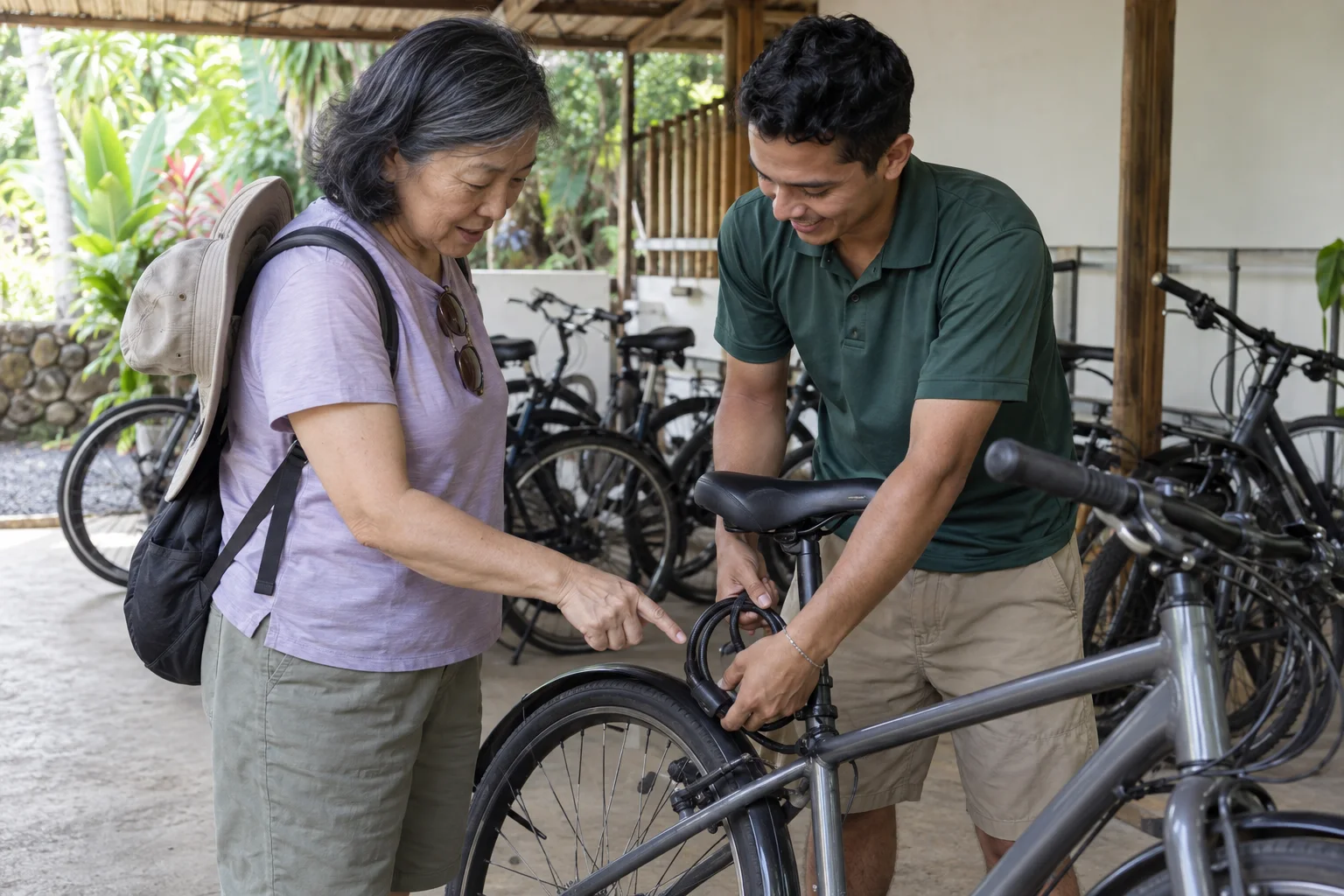
Inspect the offered bicycle at handover with staff. Check brakes, tires, lights where needed, seat adjustment and the condition of any lock. Ask what to do if it develops a problem, which number responds outside reception hours, and who is responsible for repairs or damage under the rental terms. If an outside company supplies it, get that company's contact and return instructions. A front desk that accepts payment might not be the party responsible for mechanical support.
Read the shared offer as minutes, not possession
Bimba's official pricing currently lists US$1 per unlock plus US$0.50 for each billed minute, with a US$15 Daily Pass containing 100 minutes during a 24-hour window. The published terms say the pass is not a continuous rental and does not reserve or guarantee a vehicle. The app's terms at purchase are final. A pass can be useful across separate rides only if the included minutes and window match your plans and a vehicle is available when you return.
Check the live map for an available vehicle near the start and an approved ending location near the destination. If you end the ride at lunch, you do not keep that unit for the return. If you want the same bike waiting throughout a long beach visit, sharing may not supply that certainty. Conversely, a hotel bicycle cannot simply be dropped at a Bimba approved point because it belongs to a different agreement. Return it where its supplier requires.
Compare a real journey pattern
Consider two separate rides totaling 20 billed minutes. At the published pay-as-you-go rate, two unlocks add US$2 and 20 minutes add US$10, for US$12. Four rides totaling 30 billed minutes add US$4 in unlocks and US$15 in minutes, for US$19. Those are arithmetic illustrations, not estimates for any Santa Teresa route. A US$15 pass could be cheaper than the latter only if its included minutes, time window and other app terms cover those rides. Verify the live price before purchasing.
Now compare with a hotel rental for the same day. If it costs US$15, the headline may match the pass while buying something different: continuous possession of a particular conventional bicycle, subject to the hotel terms, versus capped shared riding time with no guaranteed unit. Include any hotel deposit, lock charge, delivery or damage conditions in the comparison. The lower numeric price alone cannot tell you which plan makes the journey easier.
Check the vehicle type and rider fit
A hotel may offer a conventional bicycle, an e-bike or more than one type. Ask about the exact bike, frame size, seat adjustment and whether electric assistance is included. Do not infer the type from the word “bike.” Bimba's app may show available shared electric bikes and standing scooters under its service rules. They are not interchangeable choices for every rider. Choose a vehicle you can operate comfortably on the actual route and conditions; a cheaper option is not useful if it does not fit your ability.
Ask about a helmet, lights and any accessory you need under the applicable provider rules. For a hotel bike you keep, find out where it may be secured at the property and at destinations. For a shared ride, confirm the approved ending point before starting; merely finding a fence or café entrance does not authorize ending there. Neither arrangement turns a bicycle into transport for a second passenger or a large suitcase.
Account for the bicycle when you stop
Possession during a hotel rental creates an overnight and between-stop storage task. Ask whether the property offers a designated area and whether the bicycle must be locked even there. Clarify what happens if it is missing or damaged when unattended. If you plan to spend hours at a beach or restaurant, find a permitted secure place before leaving the bike. A hotel rental can be very convenient when that arrangement is simple; it can be burdensome when every stop requires uncertain storage.
With sharing, finish and verify each return in the app. Follow the service's approved parking rules and check that the ride has actually ended. Then you are free to continue without storing that particular vehicle. The tradeoff is uncertainty later: the next ride requires availability at a useful point. Build a backup walking or taxi plan for time-sensitive returns, rather than expecting the same shared unit to remain nearby.
Choose by three sample days
For a day of repeated departures from one hotel, a confirmed fitted rental with a safe storage place can save repeated searches. For two short local daytime errands that each end near an approved Bimba point, sharing may fit if availability is good when you check. For a one-way visit followed by a booked taxi or another activity, sharing can avoid paying to retain a hotel bike you do not need. In each case, estimate actual ride time and confirm the end point.
If the accommodation is outside a practical shared service area, add the time and cost of reaching the first vehicle. If a hotel bike must be returned before reception closes, check whether your day allows it. If rain, darkness or a steep section changes the safe transport choice, use another mode. No day pass or hotel agreement makes an unsuitable route appropriate to ride. Compare a workable full day, not a promotional photograph.
Send a short comparison request
Ask reception: “What type of bicycle is available for my dates, what is the full price and rental period, where do I keep and return it, what lock is included, and who handles a problem?” Then open the current Bimba app to check the network, vehicles and pass terms for the journeys you have in mind. Write down the two complete arrangements side by side. If either has an unanswered question central to your plan, resolve it before paying.
The images here illustrate a generic hotel bicycle and handover; they do not claim to show Armonia's current fleet or any Bimba model. The factual comparison comes from the published terms and the provider's live answers. Choose the option that gives you the right possession, riding time, fit and return process for the day you actually plan.
Frequently asked questions
Are hotel bicycles always included in the room price?
No. A property may charge separately or arrange an outside rental. Ask whether the advertised facility is complimentary or paid.
Can I leave a rented hotel bicycle at a Bimba station?
Do not assume so. Return a rental under its own agreement. Bimba return points serve the shared service and are not a general drop-off arrangement for other bicycles.
Does Bimba guarantee a bicycle near my hotel?
No. Check the live app. Buying a pass does not reserve a vehicle or guarantee a particular location's availability.
Summary
Choose hotel bike rental when keeping a particular bicycle suits the day, and Bimba when separate rides within the network fit your plans. Compare bicycle type, possession time, return rules and the full cost. Check the actual journeys first so the payment option follows the way you intend to travel.
Compare access, not just price
Choose the hotel option for simple on-site availability when the bike and rules meet your needs. Choose Bimba for app-based access and flexible eligible trips within the live service area.