
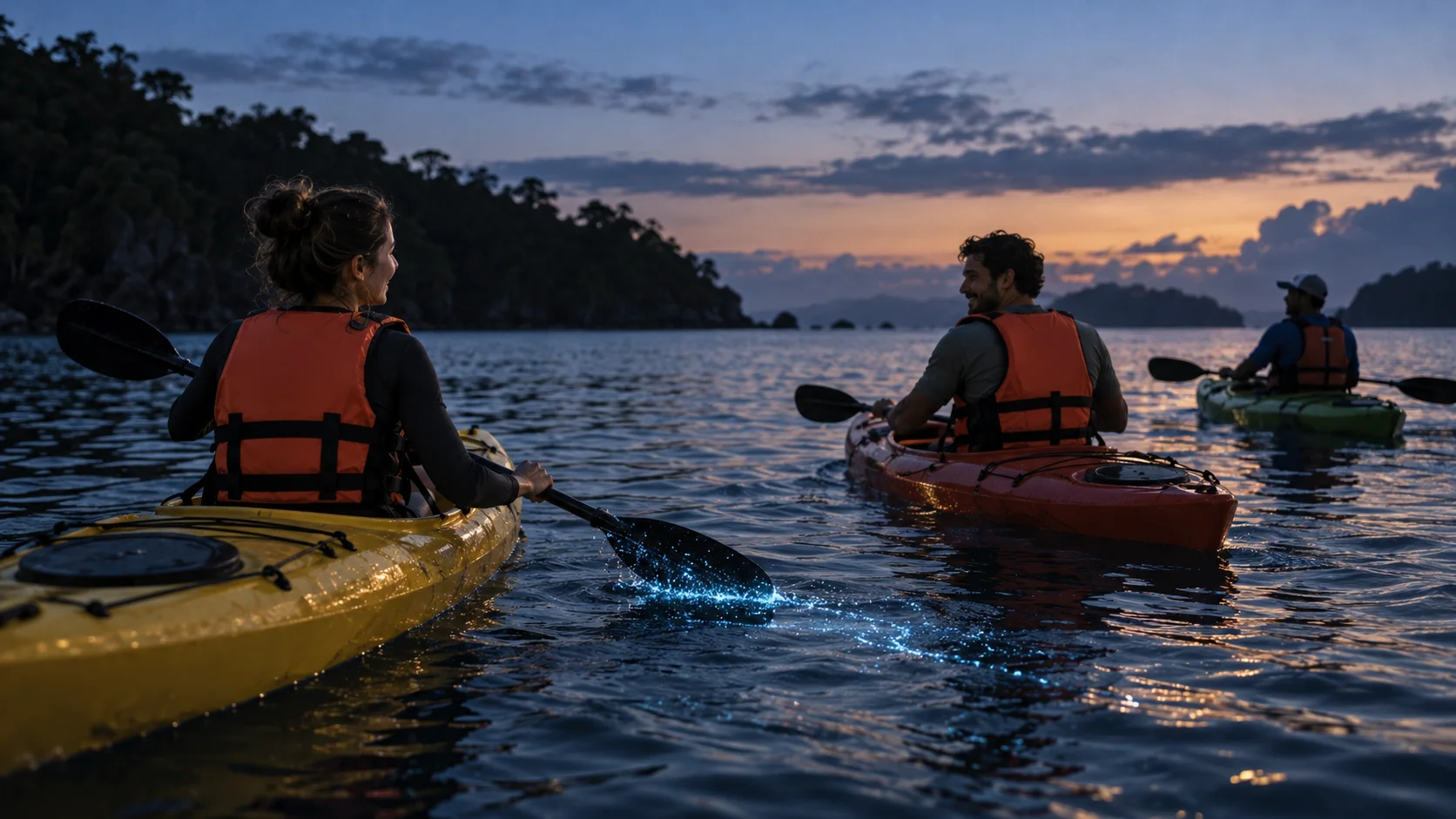
A bioluminescence excursion from Santa Teresa means traveling to the Paquera area for time on the water after dark. Your first decision is how you want to spend that evening: controlling a kayak beside the guide or watching from a boat. Your second decision is how you will get home once the tour ends. Make both before reserving a departure.
The experience centers on living organisms that emit light. NOAA explains that bioluminescence comes from a chemical reaction in an organism or material it releases. In Paquera, guides look for visible sparks in the water as movement disturbs marine plankton. Expect a natural observation with changing intensity, rather than a bay that glows at a constant brightness from shore to horizon.
Two formats for the same evening interest
Bioluminescence Costa Rica publishes a boat outing near the Paquera ferry area, with a guide, life jackets and an estimated one-and-a-half to two hours on the water. Its page states a four-person minimum for a departure. These details, checked on 21 October 2026, describe that provider's product; they do not establish the requirements of every Paquera operator.
The Paquera Costa Rica kayak listing offers single and double sea kayaks with a bilingual guide. It lists an early evening option and a later night option, the latter finishing around 9:30 p.m. Use those formats to decide what suits your group, then obtain the exact check-in and end time in your confirmation. Different sites distinguish check-in from departure in different ways.
Kayaking gives you an active role. You hold a paddle, stay with the group and manage your own craft or share it with a companion. A boat lets you concentrate on observing while the crew handles propulsion. Both require boarding, wearing the provided safety equipment and following instructions in a marine setting.
Choose a kayak for participation
Choose kayaking because you want to paddle, not because an image makes the water look effortless to cross. Tell the operator how much experience you have and whether you have paddled after dark. A beginner can benefit from an instructional briefing, but the provider must assess the particular group and conditions.
In a double kayak, discuss who will share with whom. Two friends who enjoy traveling together may have different expectations about effort and pace. Ask the guide how they assign seats and how to communicate during the outing. Avoid deciding that a stronger paddler can compensate for another person's concerns without telling the operator.
Consider whether you can get into and out of the kayak in the setting described. Knee flexibility, balance and confidence around water affect that movement. Explain the task that concerns you instead of asking whether the activity is “easy.” The provider can respond to a concrete boarding question with more precision than a general statement about fitness.
After launch, prioritize keeping the kayak where the guide asks. You can enjoy a bright patch without chasing it away from the group. Leave route selection to the guide, who can change the viewing area according to conditions. A desire for a better photograph does not justify paddling toward an isolated section of coastline.
Choose a boat to remove the paddling task
A boat can suit mixed-age groups or companions who want to observe without coordinating paddle strokes. It also lets you keep conversation with the guide separate from the effort of moving. Ask about seating and boarding, since a boat option does not imply a dock, level access or unrestricted movement once aboard.
A solo traveler or couple should ask how the provider handles its minimum departure size. You may join an existing group, choose another date or receive a different quote. A published minimum is a booking condition, not a reason to pay for empty seats without a clear agreement. Request the total you would owe if nobody else joins.
Tell the crew if you need to remain seated or prefer to avoid leaning over a side. Ask how they help passengers observe the water from the available seating positions. Judge the outing on whether it accommodates your needs, rather than assuming the word “family” in a description settles the question for your family.
Understand darkness without promising a display
Visit Paquera's local tourism information explains the importance of surrounding light, including moonlight, when viewing bioluminescence. Lower background light can make small flashes easier to distinguish. This does not mean that a calendar marked “new moon” guarantees a particular display or that another lunar phase makes a tour pointless.
Ask the operator how it selects a route for the evening you are considering. Its response should distinguish a natural visibility variation from conditions that prevent safe operation. A tour can run as planned while the glow remains less conspicuous than a promotional photograph. Decide whether you would still enjoy the guided bay outing in that situation.
Keep bright screens and lights out of other visitors' viewing space, following the guide's instructions. Carry any light the operator requires for access, but let the crew explain its use during observation. Sudden flashes can interrupt the atmosphere and make it harder for nearby passengers to focus on faint movement in the water.
Do not infer water quality or permission to swim from the presence of bioluminescence. Some advertisements show people in the water; that image does not describe the conditions or rules for your departure. Plan to observe from the craft unless the responsible operator gives a different, appropriate instruction. Never enter the water to reproduce a photograph.
Decide how much of the evening belongs to the camera
Low-light photography from a moving craft presents a practical conflict: cameras may need stability while you and the water keep moving. A bright processed image can show an effect that your phone cannot record in the same way. Visit Paquera acknowledges the difficulty of photographing the glow. Treat your own view as the central experience.
Choose one person to attempt a photograph while the other manages the shared kayak as directed, or put the phone away until the guide offers a suitable pause. Do not use that arrangement to ignore the guide's paddling instructions. On a boat, keep equipment secured and avoid standing or changing sides without the crew's permission.
Ask whether the operator offers images and whether they come from your own outing. A general promotional photo does not document the evening you attended. If you share a photograph later, identify it honestly and avoid presenting heavy editing as a measurement of what everyone saw.
Arrange the road return before sunset
The boat operator says it can arrange transportation on request at an additional cost, subject to availability. Send your Santa Teresa accommodation location and group size when requesting that service. Ask for the return to the same property, not merely a drop-off somewhere along the main road.
Compare an early departure with a later one using the whole evening. The later kayak option may suit someone staying in Paquera, while a Santa Teresa visitor may prefer the earlier finish. Add time for getting out of wet clothes and meeting the driver. Avoid assuming that the end of the water activity equals the moment the vehicle leaves.
Arrange a meal that fits the chosen departure. Eat before check-in if that suits you, or identify an option after the outing without assuming a kitchen will remain open for a delayed arrival. Keep any food arrangements separate from the equipment area. A bag of leftovers does not belong loose in a kayak.
This is regional night transport. Bimba's short local rides within live app boundaries do not provide a route to Paquera or the return after a marine excursion. The day-trip planning guide helps compare the time commitment, while the day-bag guide helps you reduce belongings for the water portion.
Consider an overnight stay for the evening itself
Staying near the departure area can make sense if a late return would dominate your enjoyment. Compare the cost and effort of an extra room with the road transfer, including where your luggage will remain and how you continue the next day. Do not book accommodation only because a map pin appears close to “Paquera”; use the tour's actual meeting point.
A daytime activity plus bioluminescence can make a long itinerary. The Curú forest-visit guide and Quesera access comparison describe separate regional outings. Combine one with a night tour only when providers confirm the connections and your group wants that much activity. Preserve time to eat and change clothes between them.
If your main interest is a daytime boat excursion, compare the Tortuga Island tour plan before adding a night departure. Seeing the gulf during daylight and watching bioluminescence answer different interests. You do not need both in one day to make the regional journey worthwhile.
Choose a departure your companions want
Talk to children about being on the water in darkness before making the booking. Describe the actual plan: wearing a life jacket, listening to the guide and returning after the sky gets dark. Avoid promising blue water everywhere, which can create disappointment even during an interesting tour.
Ask the operator about age requirements, child-sized equipment and adult supervision. A double kayak does not eliminate the need for an appropriate fit or a participation assessment. The Santa Teresa family-planning guide can help you leave a slower morning after the excursion instead of stacking another early departure onto a late night.
For adults, discuss comfort with darkness and small craft without minimizing anyone's hesitation. One person may choose a boat while another prefers a kayak; separate departures may not allow a shared return. If the group wants to stay together, choose the format that meets the least comfortable person's needs.
Keep a clear record of the evening you booked
Save the provider name, exact departure, check-in point and emergency contact supplied with the booking. Include the stated cancellation and weather policy, plus what the provider promises if the departure cannot operate. A general claim of year-round tours is not a confirmation for your date.
Reserve the format you would enjoy even if the glow varies. A kayak offers active time close to the surface; a boat offers observation without paddling. With a confirmed return and realistic expectations, you can give your attention to the guide and the water rather than spend the night solving transport.
Choose the whole evening
Pick a kayak if paddling is part of the experience you want, or a boat if you prefer to observe without it. Book only after the provider confirms your departure and late return arrangements.