
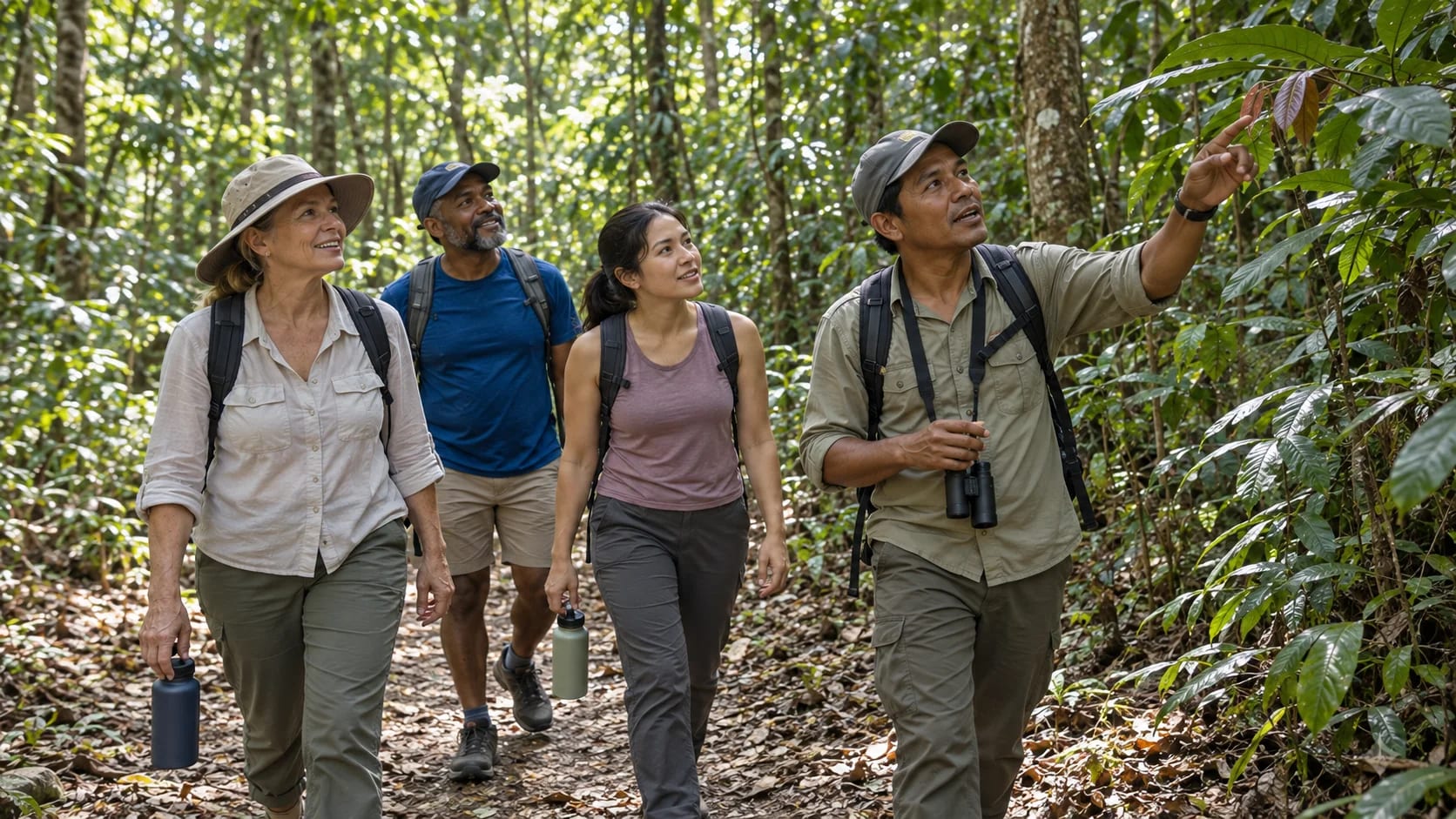
A day at Curú works best when you decide what you want to notice in the forest before choosing how far to walk. A visitor hoping to identify birds needs time to stop. A family may want a short route with a clear return point. A strong walker may prefer a longer outing, but still needs permission for the chosen trail and enough time to leave before the refuge closes to day visitors.
Curú sits on the southern Nicoya Peninsula, away from Santa Teresa's local beach corridor. Arrange the regional journey as part of the outing. The broader day-trip comparison from Santa Teresa helps you decide whether to devote a day to wildlife, another reserve or a boat excursion. Once you choose Curú, concentrate on the time you will spend inside its forest.
Choose an observation goal before a trail
Start with one sentence: “I want to learn to identify a few birds,” “we want an introduction to the forest with our children,” or “I want a sustained walk with pauses for wildlife.” Share that sentence with the person arranging your visit. A route that satisfies one of these goals may frustrate someone pursuing another.
Curú's own trail descriptions distinguish easy walks from strenuous routes. They identify Finca de Los Monos for birds and small mammals, Cangrejal near the estuary, and a short route toward the estuary bridge. Use those names to discuss options with staff. Do not turn a published difficulty label into a guarantee that a route suits a specific visitor.
Ask about the surface and the return route. A short walk over wet roots can demand more attention than a longer level path. Someone who wants frequent seated rests should ask about places to stop before paying for a guided walk. Someone carrying a camera may prefer fewer trail junctions and more stationary observation. Describe the experience you need instead of saying that your group is “fairly fit.”
Decide what you want a guide to do
A guide can help you interpret a sound, locate an animal without crowding it, or compare signs left along a trail. Ask whether the offered visit focuses on general natural history or a particular interest such as birds. A general walk can be satisfying for beginners; a specialist may suit someone bringing a species wish list.
State the language your group wants for explanations. In a mixed-language group, agree how the guide will divide attention so that one person does not spend the whole walk translating. Discuss group size and whether strangers will join. A private booking gives you more influence over pauses, but it does not grant extra access or special permission to approach animals.
Ask what happens if the group sees little wildlife. You should still expect useful interpretation of the forest, with time to examine plants and habitat from the authorized path. Treat promises of particular animals with caution. A written species list describes what observers have recorded in an area; it cannot tell you which animals will appear during your booking.
Read the current trail information at arrival
Check in before entering a trail and ask staff to mark the route they recommend that day. At the 21 October 2026 check, Curú listed Killer and Avispero as closed after landslides, along with the Mirador connection to Poza Colorada. The office requires a reservation for Quesera; its published phone and WhatsApp contact is +506 6210 1724. A screenshot taken while planning cannot replace the instructions staff give when you arrive. Choose an alternative at the office, where you can ask questions, rather than improvising at a closed junction.
Confirm whether a distance describes one direction or the whole route. Then ask where your walk ends. A trail that finishes elsewhere can require another walk to the meeting point, even if the headline distance looks short. Write down the expected return point and the time your driver or guide expects you there.
Leave Quesera out of an introductory wildlife walk unless you have booked that route as your main activity. The Quesera walking-versus-boat guide addresses that separate access decision. Adding a demanding beach hike after a slow forest visit can remove the time you wanted for watching wildlife and leave little room for the return journey.
Watch wildlife without building a crowd
Keep food closed inside your bag. Watch from the path, keep the animal's escape route open, and let your guide set the viewing position. If an animal approaches, resist the urge to turn the encounter into a close photograph. Move as staff instruct and give it space. Visitors do not need to feed, touch or call animals to have a worthwhile observation.
Share a sighting with the people beside you in a low voice. Point to a branch or another fixed landmark rather than waving at the animal. “Above the fork in the pale trunk” gives your companion something to locate. Let the whole group look before stepping into the best viewing position with a camera.
Binoculars can help you study a distant animal without moving closer. Practice focusing them before the walk, and adjust the strap so they remain accessible. If you bring a long lens, decide whether you can carry it for the full route. Leaving heavy equipment with someone else midway through the walk changes that person's experience.
For a trip centered on species identification, compare birdwatching habitats and guide choices near Santa Teresa. A general wildlife walk and a birding session can use the same forest while requiring different expectations about pace, silence and how much ground the group covers.
Give the forest the largest part of the outing
Build the day around the refuge's permitted visiting window, then work backward to departure from Santa Teresa. Confirm the exact meeting place inside or outside the entrance. A driver who drops you at a road gate and a guide who waits near a trailhead may describe both places as “Curú,” while you still need to cover the distance between them.
An illustrative plan could include check-in, one guided forest walk, a meal or rest, and a short optional walk before collection. This is a planning sequence, not an operator itinerary. Keep the second walk optional so you can stay longer at an interesting sighting, take a slower lunch, or finish early if a child gets tired.
Do not build your return around dusk without discussing the visitor rules. Curú states that day visitors must leave by 4 p.m.; only cabin guests may remain after that cutoff. A photograph of sunset taken by an overnight guest does not establish permission for a day visitor. If late observation is central to your plan, ask about accommodation and the activities allowed during a stay.
Keep your regional transfer separate from short rides around Santa Teresa. Bimba's local service does not establish transport to Curú or permission to ride reserve trails. The Cabo Blanco visitor plan provides another forest option if you are still comparing destinations, but neither reserve belongs in an improvised local bike loop.
Pack for stopping as well as walking
Take shoes you can walk in on the surface staff describe, drinking water and weather protection that you can reach without emptying your bag. Keep your phone and documents in a closed protective pouch. A light layer can serve as cover during a pause, but choose clothing for the forecast and your comfort rather than copying someone else's dry-season packing photograph.
Carry a snack only where the refuge permits it, and ask where you may eat. Put wrappers and fruit scraps back in your bag. Food that seems harmless to you can still attract wildlife to visitor areas. Ask about meal availability before departure if your group needs a full lunch; do not assume a kitchen can serve an unannounced group at the moment you finish walking.
The Santa Teresa day-bag guide covers general packing. For Curú, prioritize access to the items you use while observing: binoculars, a small notebook and a camera you can put away with both hands free. Extra clothing can stay with your transport provider only if you have agreed on secure storage.
Plan a walk the whole group can enjoy
For children, choose a simple observation task such as comparing leaf shapes or noticing where birds perch. Let a guide explain what the group can examine from the trail. Avoid turning the visit into a competition to spot the most animals. A child who misses a fast-moving animal can still enjoy hearing a call or finding a patterned leaf.
Adults should agree who stays with anyone who wants to stop. A group can shorten its walk together, or divide only if the refuge permits it and each subgroup has a clear plan. Do not leave one person waiting at an unfamiliar junction while the others finish a route. The family guide to Santa Teresa can help you leave recovery time in the rest of the holiday.
For companions with different interests, ask the guide for a route that supports both observation and movement. One person may want long explanations while another prefers walking. Agree on that balance before the visit. A smaller, well-matched outing can offer more satisfaction than trying to fit every listed trail into a single day.
Send one useful request to the refuge
Include your preferred date, the number of visitors, your accommodation area and the walk you hope to do. State any mobility requirements in practical terms, such as a need to avoid stairs or an inability to stand for long periods. Ask the office to recommend an open route, explain guide arrangements and identify the meeting point.
Request the full admission and guiding total for your group, payment instructions and the policy for weather-related changes. Confirm your driver separately if the refuge does not arrange transport. Save the responses together so a companion can find the information without searching through several conversations.
After the walk, record the animals you identified with confidence and the ones you could not name. Ask the guide about an uncertain sighting before adding it to a personal list. You can leave Curú with a better understanding of one forest, even if you walk fewer trails than you expected.
Choose one forest objective
Book a Curú day around one open route and a clear observation goal. Leave a second walk optional, and agree on the pickup point before you enter the refuge.