
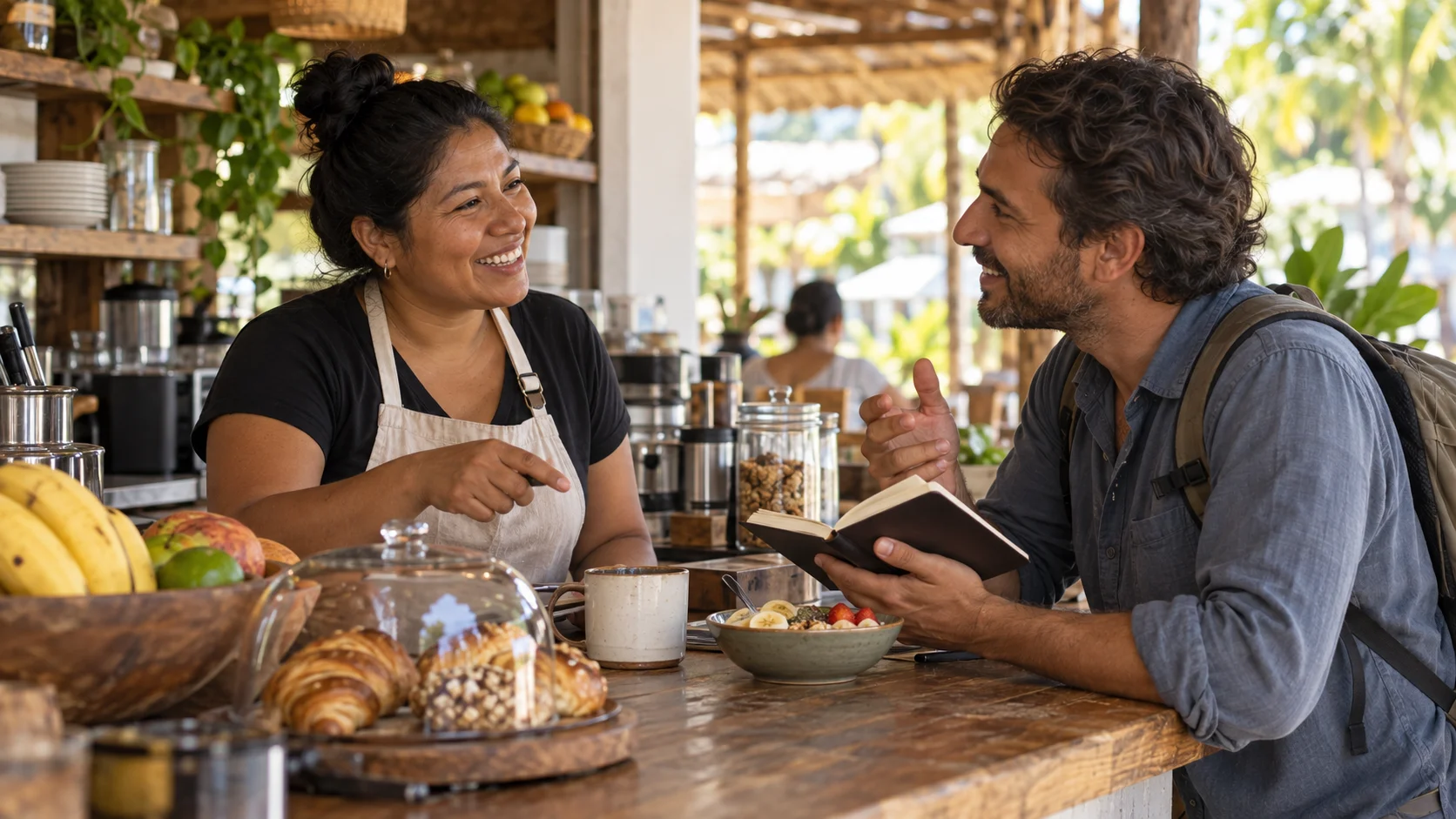
Useful Spanish for a Santa Teresa visit begins with a greeting and a question you can follow through. You do not need to sound local to arrange a lesson, explain a food preference or find the correct entrance. You need to understand the reply well enough to act on it. Keep a few phrases on your phone, practise saying them aloud and include a way to ask for clarification.
Costa Rican Spanish also varies between speakers and regions. The University of Costa Rica's linguistic research describes that variation and the use of both usted and vos. Treat a phrasebook as support for conversation, not a script that every person will follow. The examples below are original practical models. Replace their names, dates and numbers with your own details rather than copying a fictional reservation into a real message.
Greet first and choose a comfortable register
“Buenos días” works as a morning greeting; “buenas tardes” suits the afternoon and “buenas noches” the evening. Follow with a brief request: “Disculpe, ¿me puede ayudar?” means “Excuse me, can you help me?” Pause for a response before explaining the problem. When someone is serving another customer, wait your turn rather than beginning a long question over the existing conversation. Courtesy is useful without requiring an elaborate introduction.
You may hear usted in situations that sound friendly as well as respectful. UCR's account notes that this form can express both respect and affection; it does not always signal distance. Vos also appears in Costa Rican usage, with forms such as “¿vos tenés...?” A learner can stay with familiar usted constructions such as “¿usted tiene...?” when speaking to someone new. You do not need to switch pronouns mid-sentence to demonstrate local knowledge.
If you already speak another variety of Spanish, keep the forms you can use naturally and listen to your interlocutor. Avoid treating an unfamiliar pronoun as a correction of your own Spanish. For learners, a simple “¿Puede repetir, por favor?” is more useful than forcing a new verb form under pressure. The goal is a conversation in which both people understand the request, not a performance of a national accent.
Understand a few expressions without overusing them
Pura vida can do several conversational jobs, including greeting, thanks and a positive response. Research published through UCR examines how context changes its meaning. If someone uses it after you thank them, you can acknowledge the exchange and continue. Do not assume that the phrase alone confirms all details of a booking. A warm response and a precise agreement serve different purposes, so make the date and service explicit when needed.
ASALE's Dictionary of Americanisms records tuanis as a colloquial positive description, roughly very good or excellent, including Costa Rican usage. You might recognise it in a reaction to a plan or experience. It is optional vocabulary for a visitor. “Muy bien, gracias” is a perfectly usable response when that expresses what you mean. Learning to recognise a word does not oblige you to use it with every person you meet.
Listen for tone and context before repeating unfamiliar expressions. If a word matters, ask “¿Qué significa esa palabra aquí?” or “¿Me lo puede decir de otra manera?” These mean asking what the word means here or requesting a different explanation. Avoid translating a whole conversation through a single piece of slang. A friendly exchange can remain friendly while you ask for information in ordinary, specific language.
Turn approximate timing into a clear arrangement
Ahorita deserves attention because it can leave a learner uncertain about timing. ASALE includes a Costa Rican use referring to a moment later or later on. Instead of arguing about a universal translation, ask the question that your plan requires: “¿A qué hora exactamente?” or “¿En cuántos minutos?” The first requests an exact time; the second asks how many minutes. Use a calm tone and explain if another commitment makes the timing important.
Repeat the time with morning or afternoon when confusion is possible. “Entonces, nos vemos a las tres de la tarde” means “So, we meet at three in the afternoon.” For a message about a future date, write the month in words rather than relying on a numeric date format. A hypothetical confirmation might say, “Confirmo para el 8 de diciembre, a las nueve de la mañana.” Replace that illustrative date before sending anything.
Distinguish a request from an accepted reservation. “¿Tienen espacio mañana?” asks whether space is available tomorrow; it does not book it. After receiving the options, state what you want and ask for confirmation. The restaurant reservation guide explains the practical details behind that exchange. Save the reply that actually confirms the date, party size and service, instead of relying on your first message in the conversation.
Ask for the entrance and the meeting point
“¿Me puede enviar la ubicación?” asks for a map location, but a pin alone may not identify the entrance. Add “¿Cuál es la entrada?” and, when useful, “¿Nos encontramos afuera o adentro?” The latter asks whether you meet outside or inside. These questions work for accommodation, a restaurant or an activity. They help distinguish the named place from the specific spot where someone expects to find you.
When explaining where you are, name a visible landmark without inventing one from memory. “Estoy frente a...” means you are in front of something; “al lado de...” means beside it. Send a brief written description with the pin if the route is unclear. Avoid saying “ya llegué,” meaning “I have arrived,” when you are still approaching. “Estoy cerca, pero no encuentro la entrada” explains that you are nearby but cannot find the entrance.
For a surf lesson, ask “¿La tabla estará en el punto de encuentro?” to establish whether the board will be there. The guide to reaching lessons without carrying a board explains why that detail matters. If a pickup is involved, confirm who collects you and where. Do not let a vocabulary exercise replace the actual arrangement for equipment, passengers or luggage.
Write a short booking message that is easy to answer
Use a greeting, the service, the date and the relevant number of people. An illustrative message is: “Hola. Quisiera reservar una clase para dos personas el 8 de diciembre. Somos principiantes. ¿Qué opciones tienen?” It asks about a class for two beginners on a particular date. This gives the provider enough context to reply without making the message long. State your real ability rather than choosing a level because the Spanish word is familiar.
When an offer arrives, ask what is included: “¿Qué incluye el precio?” Follow with the missing detail, such as equipment, transport or duration. “¿Cuánto dura la actividad?” asks how long the activity lasts. If you do not understand the conditions, request a written explanation before paying. Translating only the headline price can leave you unaware of the parts that determine whether the booking fits your day.
For a change, identify the original reservation first. “Tengo una reserva a nombre de Ana para mañana. Necesito cambiar la hora” is an example of explaining a time-change request. It does not imply that a change is permitted or free. Ask what options are available and wait for acceptance. Keep messages together so the person helping you can see the earlier agreement without searching several separate conversations.
Order food by explaining the need
For an ordinary order, “Quisiera...” followed by the item is a useful, polite construction. “Para llevar” means to take away, while “para comer aquí” means to eat there. If an ingredient matters, ask directly: “¿Este plato lleva leche?” asks whether the dish contains milk. The Costa Rican food glossary helps with dish names, but the person preparing the food must answer questions about that particular kitchen's ingredients.
Separate preference from allergy when describing your needs. “Prefiero sin...” states a preference; “Tengo alergia a...” communicates an allergy. Do not use an allergy claim simply to strengthen a preference. If cross-contact or preparation is important, explain that specifically and ask the staff to confirm what they can accommodate. A phrasebook can help you state the issue, but it cannot establish that a meal is suitable for you.
Before a group orders, clarify how the bill will work. “¿Podemos pagar por separado?” asks about separate payment; it does not guarantee that the restaurant offers it. Ask before the orders become complicated. When you need the bill, “La cuenta, por favor” is sufficient. If you want a little more time, “Todavía no hemos terminado” explains that you have not finished. Clear requests avoid relying entirely on gestures.
Confirm amounts and payment methods
“¿Cuánto es en total?” asks for the total. Follow with “¿En colones o en dólares?” if the currency is not clear. Ask “¿Incluye impuestos y servicio?” when those components matter to the quote, without assuming the answer. The aim is to identify the complete amount before approving payment. A numeral on a screen is easier to verify when both people have named the currency and what the charge covers.
“¿Aceptan tarjeta?” asks whether cards are accepted; “¿Puedo pagar en efectivo?” asks about cash. Neither phrase establishes the business's current policy until someone answers. If change is relevant, ask before handing over a large note. Keep the conversation focused on the transaction at hand. There is no need to infer national payment customs from one shop or to argue about a policy you have not yet understood.
If something appears wrong, describe the discrepancy neutrally: “Creo que hay una diferencia entre la cotización y el total. ¿Lo podemos revisar?” This asks to review a difference between the quote and total. Show the relevant message or receipt. A specific explanation is easier to resolve than an accusation. Keep a copy of the final agreement and ask for the receipt you need.
Repair a misunderstanding before it grows
A useful repair phrase is “Entendí que..., ¿es correcto?” meaning “I understood that..., is that correct?” Put your understanding into one short sentence. If you missed a number, ask for that number again rather than restarting the entire discussion. “¿Lo puede escribir?” asks for it in writing. This is especially useful when a date, entrance name or payment amount changes what you need to do next.
If you are using a translation tool, tell the other person and show a short message. Remove unnecessary personal details before handing over the screen. Download or save the phrases you need if you may lack a connection; the SIM and connectivity guide helps with the broader phone setup. Do not assume a translated paragraph preserves every condition. Confirm the important point in a simpler sentence afterward.
Leave with the detail you need
Before ending an exchange, repeat the next step: “Entonces, mañana a las nueve, en esta entrada” or “Espero la confirmación por mensaje.” These examples summarise a meeting or say that you are waiting for written confirmation. Add thanks and let the other person return to their work. You can be concise without sounding abrupt when the request and acknowledgment are clear.
For your first evening in Santa Teresa, save a small personal note with your lodging name, entrance instructions and any confirmed reservation. Keep the phrases for asking again beside those details. After each conversation, add one useful word you actually heard and understood. That makes your Spanish more practical over the course of the trip, while precise dates, places and totals keep the arrangements dependable.
Practise clear questions and confirmation
Learn to greet, ask again and confirm the next step. Recognise local expressions in context while keeping reservations, meeting points and payments precise in language you understand.