
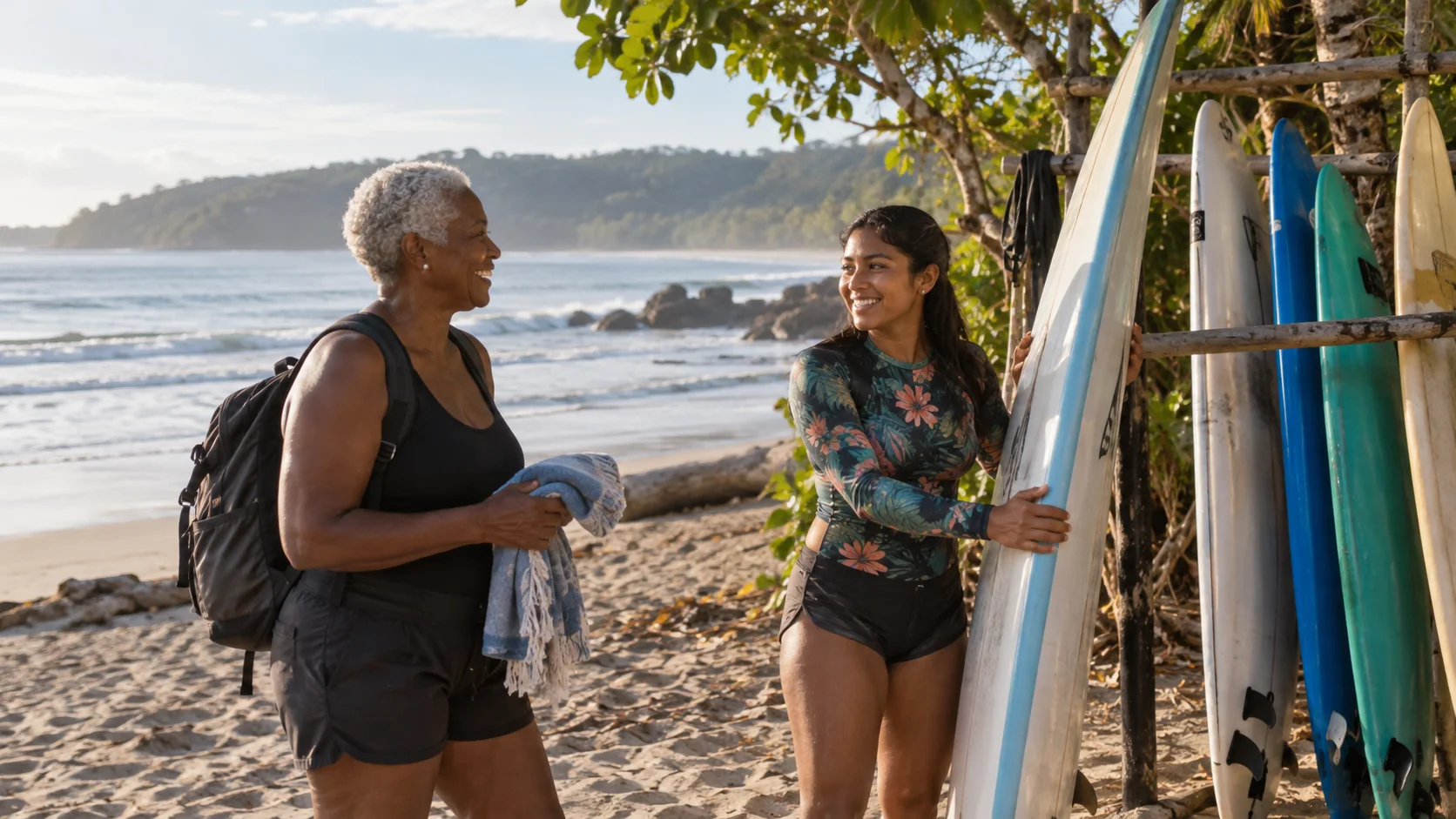
Getting to a surf lesson in Santa Teresa can be much simpler when the school provides the board at the meeting point. Ask about equipment before organizing the journey. You may be able to arrive with a small personal bag and let the instructor handle the board arrangement.
Start with equipment at the lesson location
The simplest arrangement is a lesson package that includes the board where the session begins. Ask whether the board is handed over at the beach, collected from a school or transported by the instructor. Those are different pickup plans.
Do not rent a separate board before checking the lesson package. A beginner lesson may use equipment selected by the instructor for the session, and an independently hired board may be unnecessary or unsuitable for that plan.
Use the beginner surf guide for the broader lesson decision. Once you have chosen a lesson, settle where you meet and how the board gets there.
What to ask your surf school
| Question | What you need to know |
|---|---|
| Is a board included? | Whether equipment is part of the lesson price |
| Where do we meet? | Exact pin and named beach access |
| Who carries the board? | Instructor, school transport or student |
| Is pickup included? | Your accommodation or a central point |
| Can the location change? | How and when the instructor will tell you |
| What happens afterward? | Board return and your own return transport |
The beach name alone may be insufficient. A lesson at Playa Santa Teresa can use a specific section and access. Save the actual meeting pin and instructor's contact.
Three common lesson formats
Meet at the beach with equipment supplied: travel with personal essentials, meet the instructor and collect the board there. Confirm what time you must arrive before the lesson starts.
Meet at a surf school: the group may collect equipment and then continue to the chosen beach. Ask whether that onward journey is included and how you return to the school afterward.
Accommodation pickup: the provider collects you and handles the lesson journey. Confirm whether the vehicle reaches your entrance and whether the price includes the return.
A quoted lesson duration may refer only to instruction. Add the meeting, equipment handover and any transfer time before making another booking immediately afterward.
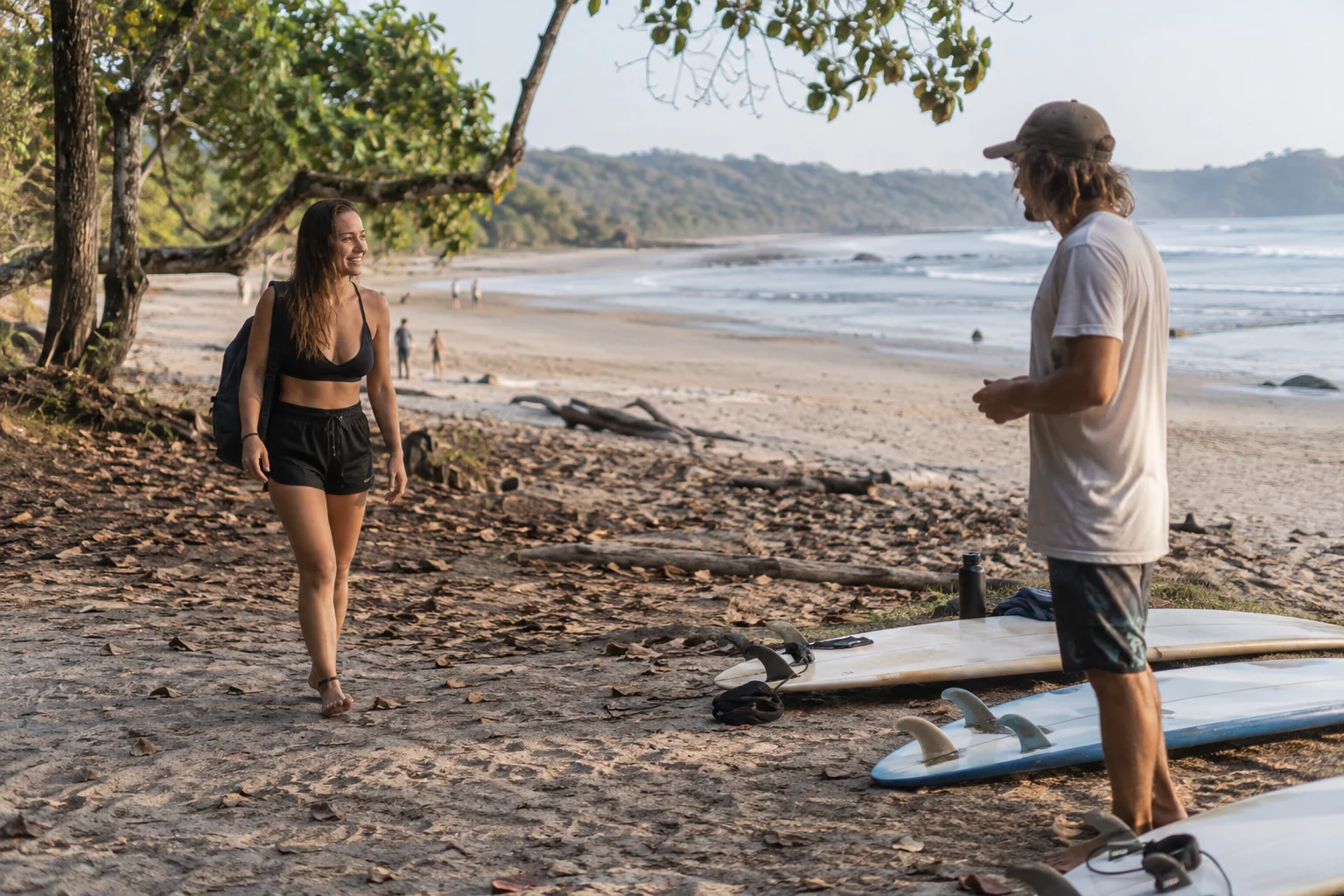
Can you take a Bimba to the lesson?
A Bimba can fit a suitable short daylight journey when you are carrying only a secure light load and there is an approved endpoint near the meeting point. Check the live app before setting off and allow for the final walk.
Do not improvise a way to carry an unsecured surfboard on a shared vehicle. The approved model, carrying rules and route matter; an image of a different bicycle with a rack is not permission to use one.
Read Bimba's riding guidance and use the location directory for orientation. Complete the return and confirm the trip is closed before walking to the instructor.
Keep the day bag small
Bring the items the school requests, plus protected personal essentials. Ask whether there is somewhere to leave the bag during the lesson and what the school accepts responsibility for. Do not assume that a beach meeting includes secure storage.
If you are checking out of accommodation that day, arrange luggage storage separately. A lesson is not a practical place to bring suitcases while waiting for an afternoon transfer.
For a rented board used outside the lesson, establish a separate storage and transport arrangement. The school transporting its own lesson equipment does not automatically include moving your personal or rental board all day.
Get the equipment answer before the transport answer
Start with: “Where do I meet you, and will my board be there?” If the answer is yes, you can plan your own journey without adding a board rental or carrying arrangement.
If equipment collection happens elsewhere, ask whether the school moves it to the lesson or expects you to transport it. Resolve that before choosing a vehicle. It can change both the cost and how early you need to leave.
Keep the instructor's contact handy in case the meeting point changes with conditions. If it does, reassess the route and pickup rather than following the old pin. The best arrival plan is the one matched to the actual session.
Plan the return after the lesson
If you ended a shared ride before class, check availability again afterward. That bicycle is not reserved for you. If the provider includes a return transfer, confirm where it drops you and whether stops are allowed.
Avoid booking a tight onward connection based only on the advertised lesson duration. Equipment return, changing and the trip back all take additional time. For a regional departure later that day, a larger buffer is more useful than an optimistic minute-by-minute plan.
For the next part of your plan, see our choosing a lesson or camp and rental boards and transport.
Confirm the exact equipment arrangement
Some Santa Teresa surf schools explicitly include a board and rash guard with lessons; for example, the official pages of Teresa Surf Co. and Salt Water Surfing Co. describe equipment provision. That is evidence that a board-free journey can be practical, but it is not a guarantee for every school or package. Ask your chosen operator what is included in your booking, where the board will be handed to you, and who moves it between the school and the water. A package that includes equipment at the shop still leaves a possible walk to the beach.
Do not buy or rent a board separately before receiving that answer. The instructor may select a board for your level and conditions. If you already have a rental, ask whether the lesson requires its own equipment or accepts yours. Confirm who is responsible for returning it after the session and whether you can continue using it independently. These details change both the price and the trip home; a lesson board may be returned to the instructor immediately rather than remain yours for the afternoon.
A beach name is not a meeting point
Santa Teresa is a long stretch of coast with several access paths. Ask the school for a precise pin, the name or description of the public entrance, the meeting time and the person to contact if you cannot find them. Save this information offline or as a message before setting out. If a school meets guests at its shop first, use the shop pin rather than heading directly to the sand. If pickup is included, clarify whether it is from your accommodation door or a shared roadside point.
Ask whether the meeting location can change with conditions and when the school will notify you. The instructor, not an old blog photograph, should guide the lesson site on the day. Check your messages shortly before departure while you still have time to change route. Send the updated location to anyone traveling separately. A driver or companion given only “Playa Santa Teresa” may choose a different access from the one the lesson uses.
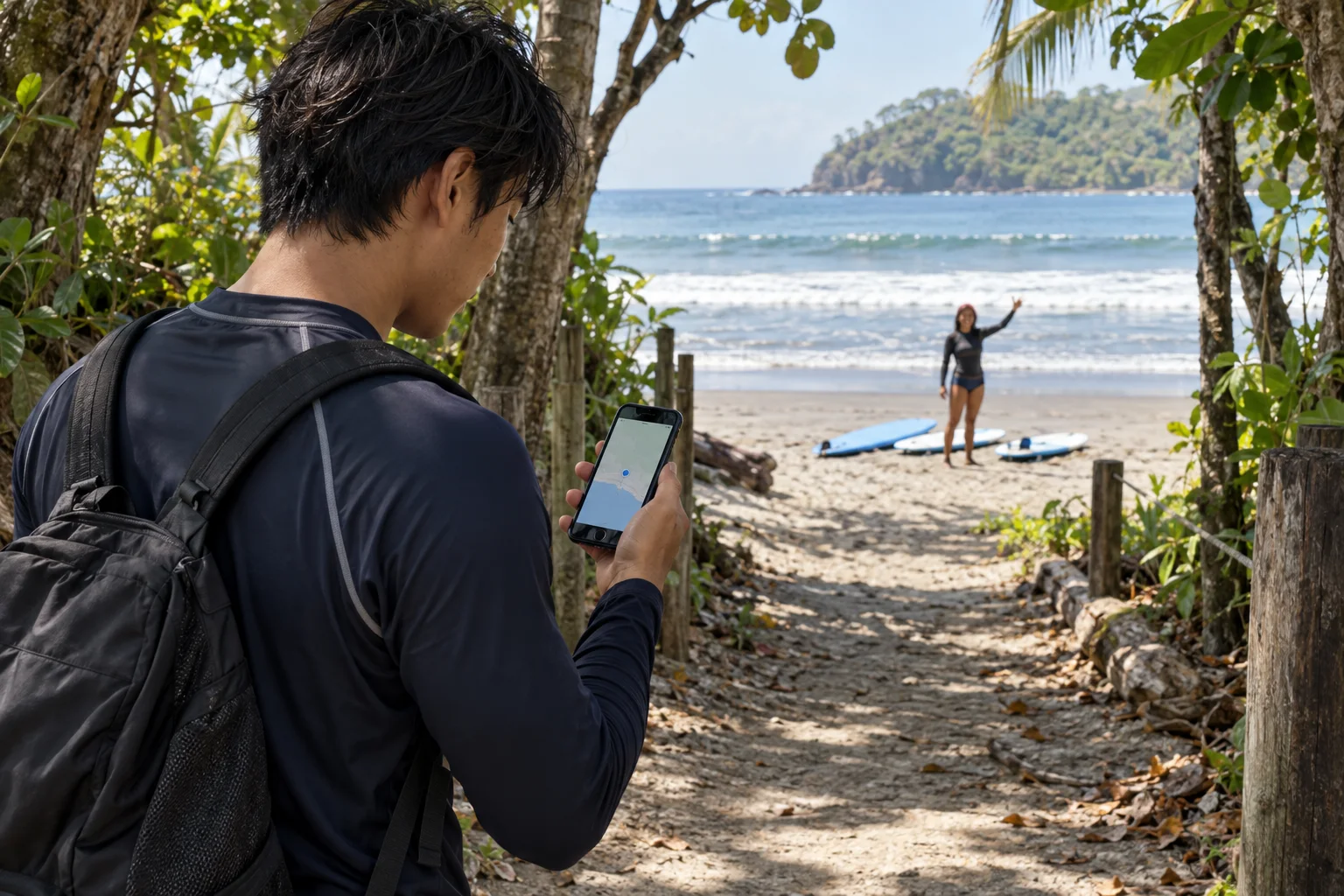
Pack for a lesson with hands free
If the board is supplied at the lesson, carry a small bag with water, sun protection, a towel, suitable footwear for the approach and whatever personal items the school asks you to bring. Protect your phone and valuables from water and sand. Ask whether the operator has storage for your bag; do not assume a shared vehicle, the beach or an unattended board rack is safe storage. A small dry bag or a companion who remains ashore may solve a different problem from carrying a large suitcase.
Check the school's guidance on clothing and rash guards. Some packages include one; others may expect you to bring it. If you have a medical or mobility consideration, tell the instructor before the class so they can discuss whether the session and access are suitable. The aim is to arrive ready to learn, not to improvise equipment while others wait at the waterline. A simple checklist sent the evening before prevents most last-minute purchases.
Choose transport for the person, not the board
Once the board is handled by the school, you can compare a walk, a suitable shared ride, a taxi or operator pickup based on your own route and schedule. Walking may be simplest from a nearby stay with a clear public access. A shared Bimba ride can be appropriate only when the route, weather and current approved endpoint fit. Check the live app before starting, return at the indicated location and confirm the trip closes. You still need to walk from that point to the lesson entrance.
Never carry an unsecured surfboard while riding a Bimba bicycle or scooter. It interferes with balance, steering and clearance around other road users. If the school requires you to collect and transport a board yourself, choose a suitable vehicle or a different lesson package. A school pickup may be worth comparing when your accommodation is on a steep road, you have multiple participants or the meeting point is difficult to reach. Confirm whether transport is included or separately charged.
Work backwards from the lesson start
The lesson time is not necessarily the time you should first reach the beach. Ask when to check in, meet the instructor and receive equipment. Add the journey, the final walk and a margin for finding the right access. If arriving by Bimba, include time to complete the return in the app. If your route relies on a driver, confirm the pickup in advance and share the exact destination. Do not schedule a café stop so tightly that one order delay makes you miss the safety briefing.
For a group, make sure every participant knows the same pin and arrival time. Decide whether you travel together or meet at the beach. Ask the school how it handles late arrivals and whether the start can move with conditions. A lesson near sunrise or late afternoon may also change the transport decision because the trip to or from the site could occur in poor light. Plan both legs, not only the outward journey.
The board and your return have separate endings
At the end, follow the school's instructions for handing back the board, leash and any rash guard. Ask where the equipment should be left and whether you need to return to the shop or can finish at the beach. Do not leave a board at a public access assuming staff will collect it. If your group plans to stay at the beach afterward, clarify when the lesson equipment must go back. A board included during instruction may not be available for unsupervised practice.
Your transport also needs a fresh decision. A Bimba returned before the lesson is not reserved while you are in the water. Open the app when you are ready to leave and use another suitable mode if no vehicle or endpoint fits. If you will be wet and tired, a practical walk or arranged pickup may feel different from the morning ride. Agree on the return with a driver or accommodation before you are standing on the sand with a dead phone.
An example message to the surf school
“We have a lesson for two on [date]. Are boards, leashes and rash guards included? Do we meet at your shop, an exact beach access or a pickup point? Please send the current pin, check-in time and contact number. Who transports and returns the boards, and will the meeting place be confirmed again if conditions change?” This short message gets the information needed to travel without a board. Add any access or dietary needs relevant to the group's plan.
Use the school's reply as the authority for that booking. Official operator pages such as Teresa Surf Co. and Salt Water Surfing Co. show that equipment-inclusive lessons exist, but their terms do not apply to an unrelated operator. The three photographs in this guide illustrate a typical planning sequence; they do not identify a particular surf school or a guaranteed meeting point.
Frequently asked questions
Do all surf lessons include a board?
No universal inclusion should be assumed. Confirm the exact package before paying for separate equipment.
Can the school meet me at my hotel?
Some providers may offer pickup, but the location and cost need confirmation. Ask about the actual entrance, especially for hillside accommodation.
Can I leave a Bimba at the surf school's beach meeting point?
Only if it is an approved endpoint in the app. Otherwise, complete the return at an approved return point and walk the remaining section.
Summary
Getting to a surf lesson is simpler when you know where the equipment will be. Confirm the meeting point, board inclusion and any pickup, then arrange separate equipment transport if needed. Leave time for the final walk and preparation so you arrive ready for the lesson rather than still organising the board.
Let the school handle the board
Book a lesson that includes suitable equipment at or near the session location. Travel as a person, not as improvised cargo, and confirm where belongings stay during the lesson.