

Renting a surfboard in Santa Teresa is about more than the daily rate. You need a board that fits your experience, somewhere to keep it and a practical way to reach the session. Settle those details before pickup and the rental becomes much easier to manage.
Choose a board for your experience and session
Explain your experience and the conditions you intend to use the board in. Ask a qualified instructor or the rental provider to help identify an appropriate option. A board that looks convenient to carry is not necessarily suitable for the session.
Do not choose from appearance or a single online label alone. Ask whether you can change boards if the first choice is not appropriate, and under what conditions that is allowed.
Inspect and agree before leaving
| Detail | What to record or confirm |
|---|---|
| Existing condition | Visible damage and the provider's acknowledgement |
| Included equipment | Leash, fins and any other supplied items |
| Rental period | Exact start and return time |
| Storage | Whether the provider can keep the board between sessions |
| Damage responsibility | How damage is assessed and charged |
| Deposit | Amount, payment method and release process |
| Changes | Board swap, early return and weather-related arrangements |
Keep the agreement and any condition photographs through the normal rental process. A deposit is not the same as comprehensive protection against damage.
Compare a day rate with the actual arrangement
Armonia lists surfboard rental among its on-site services. Confirm current visitor eligibility, the specific board and the full terms. Check which board and accessories the quoted rate covers.
If you are taking lessons, ask whether a separate rental is needed at all. The lesson may include the equipment for that session, while additional independent use has separate conditions. Avoid buying overlapping products without checking.
Solve transport before the handover
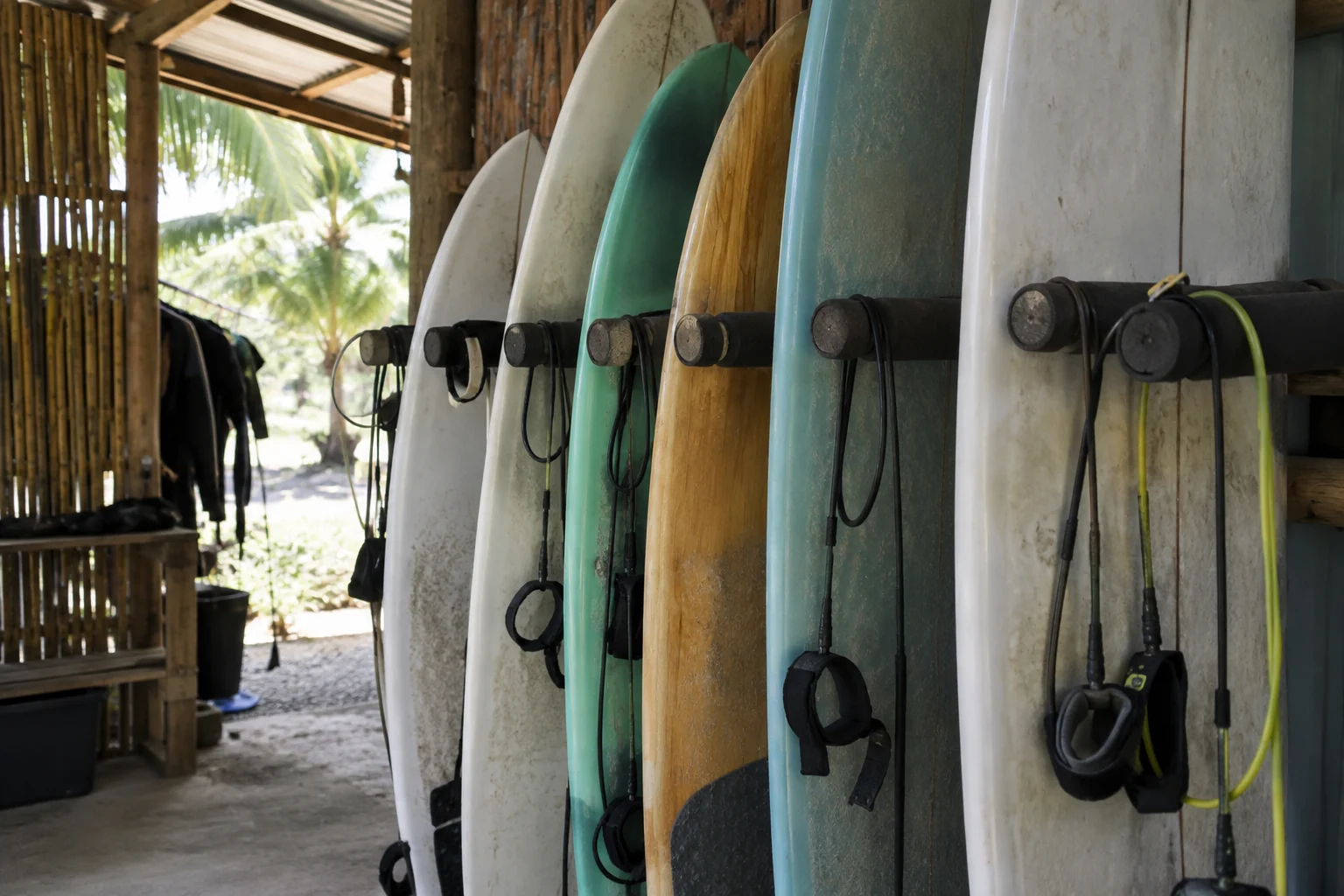
Ask whether the board can remain at the school or shop near the session. If you need to move it, arrange a vehicle and carrying system the provider confirms as suitable. Do not balance a board across a shared bicycle or standing scooter.
Your journey and the board's journey can be separate. You may reach a school by a suitable local mode while the equipment remains there. The beginner surf guide explains the broader session-planning context.
Know where the board stays between sessions
If taking the board to your accommodation, ask whether secure storage is available and whether boards are permitted in the room or shared areas. Do not assume a corridor, balcony or vehicle is an approved storage location.
Follow the provider's care instructions for transport, sun exposure and handling. Ask before attaching accessories or making adjustments. A simple equipment question at handover is easier to resolve than a disagreement after return.
Keep return timing realistic
Allow time to get back, inspect the board with the provider and settle the rental. Avoid placing the handover immediately before a departure transfer. If the shop has limited hours, confirm the arrangement rather than leaving equipment without an accepted return.
For your personal local travel, check Bimba's location network only after the board is stored appropriately. The shared vehicle is for a suitable rider journey, not an improvised equipment transfer.
Plan the board's day, not just the surf session
Start at pickup: which board and accessories are being handed over, and what condition are they in? Record existing damage with the provider and keep the agreement clear about responsibility.
Next, think about the time between sessions. Ask your accommodation where the board can be stored and whether the rental provider has any storage option. Leaving it somewhere convenient is not the same as having permission to keep it there.
Finally, arrange transport suited to the board. If a lesson includes equipment at the meeting point, that may remove a carrying trip entirely. Return timing should fit your departure plans with enough room to complete the handover properly.
For the next part of your plan, see our lessons versus a surf camp and lesson transport and provided boards.
Frequently asked questions
Should I bring my own board instead?
Compare transport fees, storage, convenience and how particular you are about equipment. Rental can reduce travel logistics, but the available boards should be confirmed.
Is a board included with every lesson?
Not necessarily. Ask about the exact package and session.
Can I leave a rented board on the beach between sessions?
Use only the storage arrangement agreed with the provider. Do not assume an unattended board remains within the rental's conditions.
Summary
A surfboard rental includes decisions beyond the board itself: equipment, damage terms, storage, transport and the return deadline all matter. Ask whether your lesson already supplies a suitable board before renting separately. With those arrangements settled, you can focus on the session rather than finding somewhere to carry or leave the equipment.
Rent for the session you will actually surf
Choose the right board with qualified guidance, inspect it together and arrange safe storage before leaving the shop. Do not carry a board on a vehicle not designed for it.