
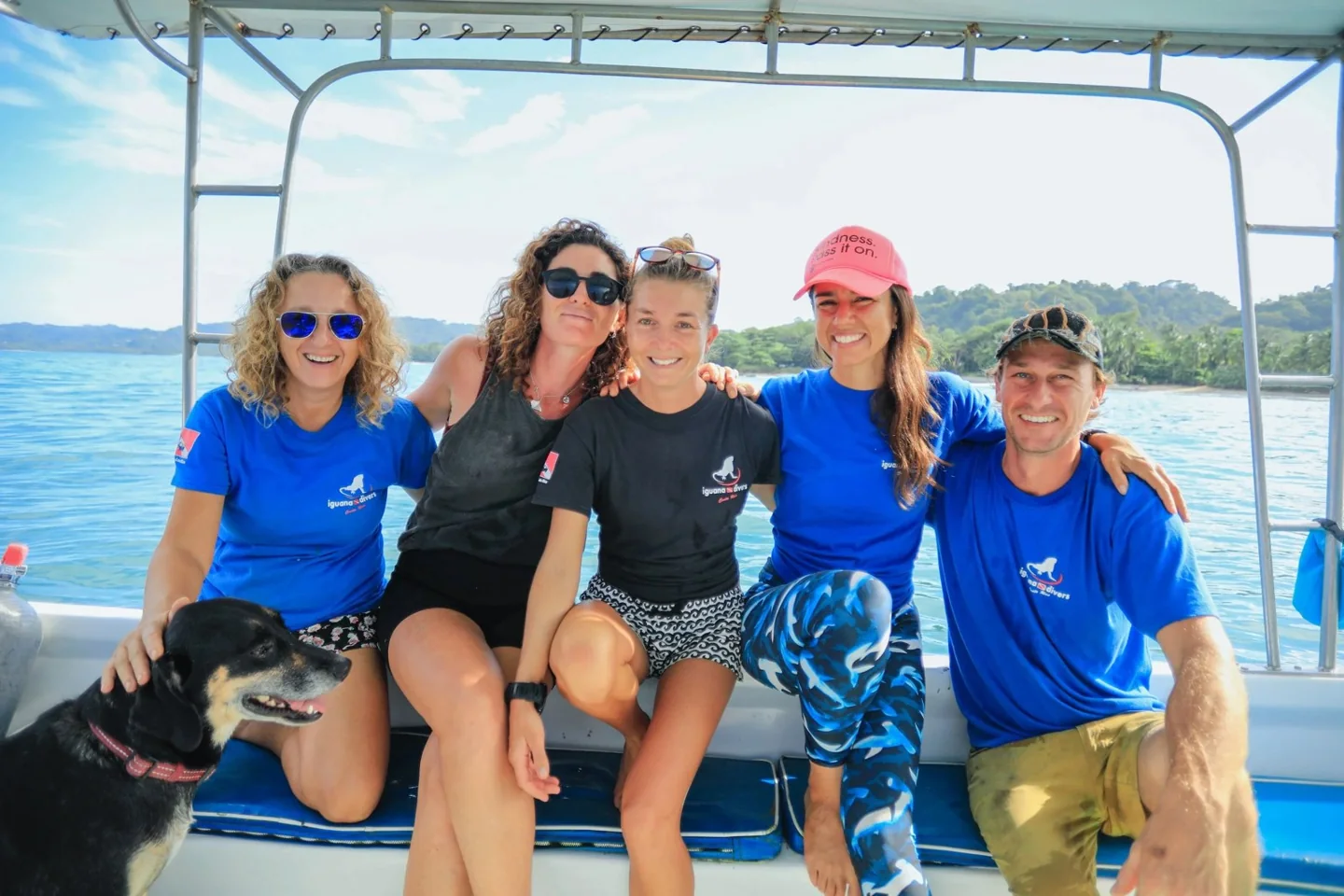
Iguana Divers team aboard a boat. Image source: View original photo.
You can ask a Santa Teresa dive center about a supervised introductory scuba experience before committing to a certification course. Start with the name of the program and the preparation it requires. An introductory booking involves learning, equipment fitting and an instructor's assessment, even if the advertisement emphasizes the ocean dive. Make space for that process in your itinerary. A person trying scuba for the first time needs a different plan from a certified friend who wants to join a regular guided dive trip.
Iguana Divers lists Discover Scuba Diving among the programs it offers in Santa Teresa. PADI describes Discover Scuba as an introduction in a pool or calm-water setting with a professional who explains equipment and basic skills. Ask the center for the exact version it proposes, including whether ocean dives form part of the booking. A program name does not establish every inclusion. Travelers who already hold a certification should use the separate certified-diver trip checklist rather than choosing an introductory program from its headline price.
Choose the outcome you want from the day
An introduction lets you explore whether you like the experience and want to pursue more training. A certification course requires a broader learning commitment. Tell the center whether you want one supervised experience or intend to qualify for future diving. It can then explain the relevant course and the time you need. Avoid booking an introduction with the assumption that you will leave ready to rent scuba equipment and dive on your own. Ask what record you receive and what it does, and does not, represent.
A couple may want different outcomes. One person may be curious about breathing underwater while the other wants to complete a course during the trip. Request separate plans that share a convenient meeting time if the center can arrange them. Do not ask the instructor to compress training so everyone can finish together. If a friend prefers to observe from the surface, compare a snorkeling outing near Santa Teresa. Having different activities for part of a day can produce a better experience than persuading the least interested person to join the same program.
Send the travel dates before choosing a dive date
Give the center your arrival date, intended departure flight and any planned travel to higher elevations. Include domestic flights, not just the international ticket home. DAN's flying-after-diving guidance treats the interval between diving and flying as part of risk reduction and distinguishes different dive patterns. Ask the instructor to help plan the itinerary around the actual program, and seek medical advice where needed. Do not use a generic claim that introductory diving is shallow as permission to ignore the post-dive travel discussion.
A useful schedule leaves the last part of your stay available for suitable activities that do not conflict with the center's advice. Tell the instructor if your next destination is Monteverde or another higher-elevation area, including a road transfer. The Monteverde and Santa Teresa route guide concerns transport planning, but your dive professional must address the diving implications of onward travel. Book the experience early enough to resolve those constraints. A tight itinerary is a reason to reconsider the dive date, not a reason to ask for a shorter safety interval.
Complete screening before the morning of the outing
PADI requires participant paperwork and uses a medical questionnaire to identify situations that need a physician's evaluation before diving. Request the current form from your chosen center while you still have time to complete it. Answer the questions yourself and follow the form's instructions. A travel article cannot interpret a medical history or clear a person to dive. If the process calls for a physician, arrange that evaluation before treating your reservation as ready. Ask the center which documents it needs and when it must receive them.
Do not ask a friend to complete your answers because they have dived before. Discuss medications, health questions and fitness concerns with the appropriate clinician, not through guesses in a group chat. The booking team can explain administration but should not promise approval on a doctor's behalf. If you need help locating a service in town, the Santa Teresa medical-care guide addresses how to contact a clinic; it does not establish that a particular clinician provides dive-fitness assessments. Ask for the relevant service before arranging an appointment.
Tell the instructor how you feel in water
Describe your actual experience. You may swim in a pool but feel uncertain in the sea, dislike putting your face underwater or have tried snorkeling without feeling comfortable. That information helps the instructor plan and decide whether the proposed activity fits. Ask about water-comfort expectations for the particular program. For families visiting Santa Teresa, a minimum age on a brochure does not describe an individual child's readiness, and an adult's enthusiasm does not remove the need to complete required preparation. Let the instructor explain the criteria it will use.
Ask which language the instructor will use for the briefing and practice. Choose a language in which you can understand instructions and explain discomfort without relying on a companion to translate technical details. If you feel anxious, say so before the group arrives. You can ask for additional explanation and discuss whether a private session is available. Do not hide uncertainty to avoid delaying other guests. An instructor can address a specific concern earlier in the process than a vague promise from a friend that everything will be fine.
Understand the training session as part of the experience
Expect to spend time learning how the equipment works and practicing the skills the instructor requires. Ask what preparation happens before meeting, what occurs at the pool or calm-water site, and what determines whether you continue to another stage. Treat this as booked instruction, not an obstacle between you and the ocean. The professional should explain and demonstrate procedures; an online travel guide should not replace that training. Keep your attention on the briefing and ask to repeat anything you have not understood before moving on.
Leave enough time to fit the equipment. Provide sizes when the center requests them and tell staff if something feels uncomfortable or if you need an accommodation. Ask where to store glasses, valuables and a dry change of clothing. A companion taking photos should follow the center's rules and avoid interrupting practice. If the package includes images, ask who takes them and when you receive them. First-time participants benefit from concentrating on the instructor rather than trying to operate an unfamiliar camera while learning unfamiliar equipment.
Ask how the ocean portion depends on readiness
If ocean dives are included, ask the center how it assesses readiness and chooses a site for beginners. The final plan must fit the participants as well as conditions. A published maximum depth is a ceiling within program rules, not a destination you should expect to reach. Avoid comparing introductory experiences by whichever advertises the deepest dive. Ask how much individual support the instructor provides and how it handles a participant who decides to stop. Those answers are more useful than a dramatic photograph or a long list of possible marine animals.
Confirm whether your group joins the same boat as certified divers and, if so, how the center separates instruction and supervision. A certified companion may share transport without being your instructor or dive buddy for the introduction. Let the professionals define those roles. If one person changes their mind after practice, ask what happens to their ocean portion and the rest of the group. Read the payment terms for that situation in advance. Declining to continue should not become a debate among friends about who has already paid for the boat.
Compare the full learning package
Request a quote that identifies the program, instruction, equipment, practice session and any ocean dives. Ask whether learning materials, required charges and transport between meeting points appear in the total. The center's shop, training location and boat launch may be different places. Get the sequence in writing rather than navigating to the first business address you find. An inexpensive introduction in a pool and a program with an ocean component involve different services. Compare them by the experience you want, not by price alone.
Check cancellation and rescheduling terms for weather, incomplete screening and a participant choosing not to continue. Ask when the center decides whether conditions suit the ocean portion and how it contacts you. If it offers an alternative date, make sure that date fits your departure travel and the instructor's guidance. Do not accept a last-day change without revisiting the flight discussion. Save the written quote and receipt. A booking with clear stages and terms gives you a useful basis for deciding whether to proceed as your travel plans develop.
Keep the rest of the day simple
Arrange appropriate transport for the confirmed meeting points and leave luggage at your accommodation. Ask the center what it provides and bring only the items it requests, plus agreed personal essentials. Do not plan to carry scuba equipment on a shared Bimba vehicle. Tell the instructor if another appointment creates a hard departure deadline; it may be better to choose another day. A learning session should not finish under pressure because a restaurant reservation or transfer looked convenient when you first drew up the itinerary.
At the end, ask the instructor for feedback on what you learned and the next suitable step. You may want a full course, another supervised introduction or time to think. Request a record of any training and ask a future center what it can recognize before assuming credit transfers. If you decide scuba is not for you, the day can still answer the question you came to explore. Keep the decision personal. Choose future activities around your interest and comfort rather than trying to match a friend's certification plans or vacation photographs.
Make room for the learning process
Choose a program whose instruction and language fit you, complete the required screening and plan onward travel with the dive professional. Decide about further training after the introduction.