
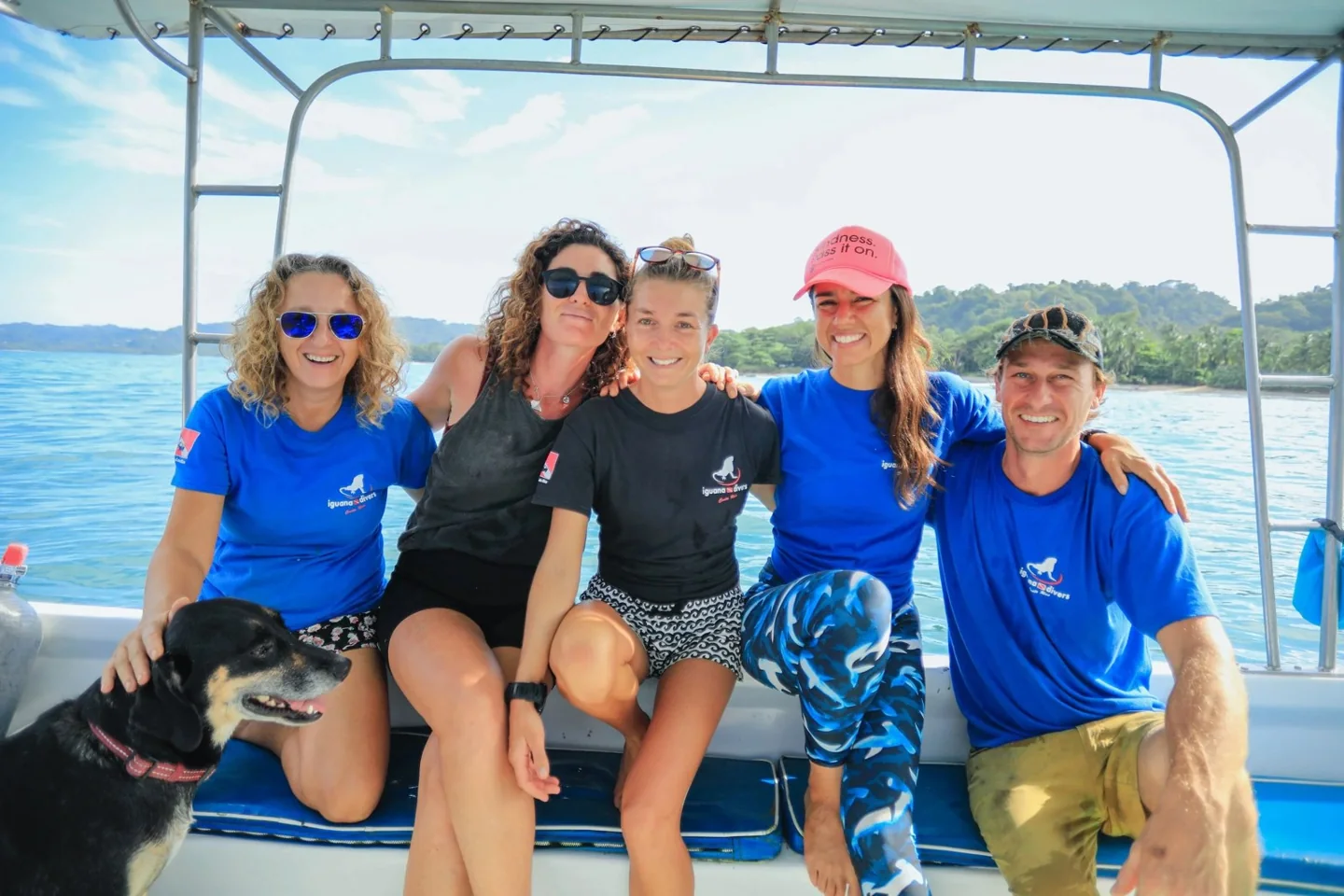
Iguana Divers team aboard a boat. Image source: View original photo.
A certification card starts the conversation about diving in Santa Teresa. Your recent experience, equipment familiarity and comfort in the proposed conditions determine the next questions. Send that information to the dive center before choosing a departure. A guide can make a more useful recommendation from your last few dives than from a label such as advanced. Someone with an advanced certification who has not entered the water for years may need a different preparation plan from a newly certified diver who has practiced throughout the past month.
Iguana Divers advertises certified-diver outings and a refresher option in Santa Teresa. Its local dive description identifies a launch at the Pescadería in Mal País, rocky and sandy underwater terrain, and conditions that can vary between dives. Those details support a conversation about a coastal Pacific outing. They do not promise visibility, a species encounter or a fixed dive profile on your date. If a travel companion has no certification, direct them to the introductory scuba guide and let the center arrange the appropriate program.
Send a short diving history with the booking request
Include your training agency, qualification level, date of last dive and approximate number of logged dives. Describe the recent environments you know: boat entries, current, reduced visibility or shore access. Mention any skills you want to review. This gives the center something concrete to assess. Do not exaggerate experience because you want to reach a site seen in photographs. A reservation that fits your actual skills offers more value than one that leaves the guide correcting an inaccurate booking description at the launch.
Attach or make available the certification proof the center requests, and check that you can access an electronic card before traveling. Keep recent log details available without depending on a mobile connection. If your name differs between an old certification record and current identification, ask how the operator verifies it. Resolve that administrative issue while the office has time to help. A missing card does not automatically mean you must repeat a course, but the center needs acceptable proof. It should explain the process rather than leaving you to guess on departure morning.
Decide on a refresher from your present readiness
PADI states that its certifications do not expire and recommends refreshing skills after inactivity. A continuing certification does not oblige a local operator to accept a diver on every proposed outing. Ask about the center's own recency requirements and assessment. Iguana Divers publishes both a refresher session and PADI ReActivate. Request a description of the difference, including knowledge review, water practice and what record you receive. Choose according to what you need to regain, with the professional's input, rather than picking whichever name sounds less demanding.
A refresher can address practical gaps you already recognize. You might understand the theory but feel unfamiliar with rental equipment, or remember equipment setup while wanting supervised practice with water skills. Tell the instructor where you need help. Ask whether the session must happen before the boat day or can form part of the proposed schedule. Do not compress it to preserve an unrelated reservation. If you complete review at home, ask what documentation the Santa Teresa center needs and whether it still expects a local orientation before your first outing.
Match the proposed profile to your limits
Ask about the type of site the guide expects, the planned range within your qualification and the conditions that would cause a change. A published depth or duration describes an offer, not a target you must reach. Your own training, the guide's plan and the day's conditions still govern participation. Give the operator a clear account of your comfort with current and visibility. A short boat journey does not establish an easy dive, and a long list of animals does not describe the effort needed to visit their habitat.
Discuss how the center groups divers with different experience. Ask whether it can offer a private guide or another departure if your goals do not match the planned group. Explain if you want a slow photography dive, a general wildlife outing or supervised practice. Those priorities can conflict when several divers share a route. Avoid asking the guide to take the whole group deeper or farther because your certification permits it. You booked into an agreed plan, and companions may have different qualifications and limits that the guide must respect.
Confirm rental equipment and personal equipment details
Give sizes for the equipment you intend to rent and identify the items you will bring. Ask about the cylinder connection and any compatibility question before packing your regulator. Confirm whether a computer forms part of the rental package and which model you will use if the answer matters to your preparation. The center should explain any unfamiliar equipment before the dive. Do not arrive expecting a specific brand because another guest used it in an old photograph. Availability and the actual fit need direct confirmation.
Ask how the operator handles equipment checks, service questions and substitutions. You should have time to become familiar with the supplied configuration under the center's procedures. If you bring personal equipment that needs attention, arrange inspection or service through a qualified provider before committing to the boat day. A crew member may be able to help with a minor adjustment, but you should not assume the booking includes repair facilities or spare parts. Keep your equipment plan separate from your wish to travel light so the center knows exactly what it must supply.
Treat the buddy arrangement as a real planning question
Tell the center whether you arrive with a dive buddy and whether you expect to stay paired. Two friends with very different recent experience may need different guidance. If you travel alone, ask how the operator assigns buddies and what the group briefing covers. A guide accompanying the group does not remove the need to understand the agreed buddy procedures. Review the plan with the people you will dive with and ask the professional to clarify any unfamiliar practice before you enter the water.
Photography needs the same conversation. Tell a prospective buddy if you carry a camera and may spend time observing a small area. Do not let that interest change the route without the guide's agreement. Ask about space for equipment on the boat and whether a rinse arrangement exists after the outing. Someone carrying delicate camera gear may need different road transport from a traveler with a small backpack. Use the day-bag packing guide for personal essentials, then agree on separate protection and transport for underwater camera equipment with the dive center.
Review health paperwork and insurance scope
Ask the center which current forms it requires from certified divers and complete them as instructed. A past certification does not answer a present health question. Direct any concern about fitness to dive or medication to an appropriate clinician and follow the operator's screening process. The local medical-service guide helps with contacting care, but it does not qualify a clinic for a dive assessment. Establish that service before booking an appointment. Keep your personal medical details out of a shared group reservation when a private channel is available.
Check your own insurance wording for the diving you propose, including qualification conditions and any limits relevant to the trip. Ask the insurer to clarify uncertain coverage in writing. A tour seller's statement that it carries insurance does not explain your individual policy. Ask the center about its emergency plan and how it communicates with shore. You do not need to turn the booking into an equipment inspection, but you should understand who manages an incident and which contact information the center expects from you before departure.
Place diving before suitable onward travel
Give the operator the time of your next flight and any travel to higher elevations, including a domestic flight or mountain road transfer. DAN distinguishes flying-after-diving guidance by dive pattern and notes that waiting reduces risk without guaranteeing its absence. Ask the dive professional how the actual planned schedule fits your onward journey, and seek medical advice when needed. Do not reuse a surface interval from a previous holiday without considering whether the dives and travel are comparable. The booking conversation should include the whole sequence of days.
If your next stop is Monteverde, discuss the route and timing before paying for the last dive day. Our Monteverde transfer guide can help with the transport conversation, while the dive professional addresses the diving implications. Avoid scheduling another dive because a boat has space if doing so creates a conflict with onward travel. Keep a written record of the final plan. If the operator reschedules a weather-affected outing, revisit the itinerary as well; a new date changes more than the line on your booking receipt.
Read the package through to the return ashore
Ask whether the quote includes equipment, the advertised number of dives, boat travel, refreshments and required charges. Confirm where you meet first and how you reach the launch. A shop address and a launch pin may refer to different places. Ask how the operator handles a second dive that cannot proceed, a participant who chooses to sit it out, or a full cancellation. Those policies determine what happens after you have already invested time in the trip. Read them before assuming an unused portion receives a proportional refund.
Plan appropriate transport for dive bags and any camera case. Bimba shared vehicles are for eligible short local trips within current app boundaries, not for transporting scuba gear. If a non-diving companion wants to join the boat, ask the center about seating and supervision rather than promising a place. A separate snorkeling trip may suit them better. After the outing, record the dives and the guide's feedback while the details remain clear. Use that record to decide on a second trip based on the actual experience, not the expectation you had before arrival.
Book for your current readiness
Choose a trip that fits your recent experience and agree on any refresher before the boat day. Confirm equipment and buddy arrangements, and check the full schedule against onward travel.