
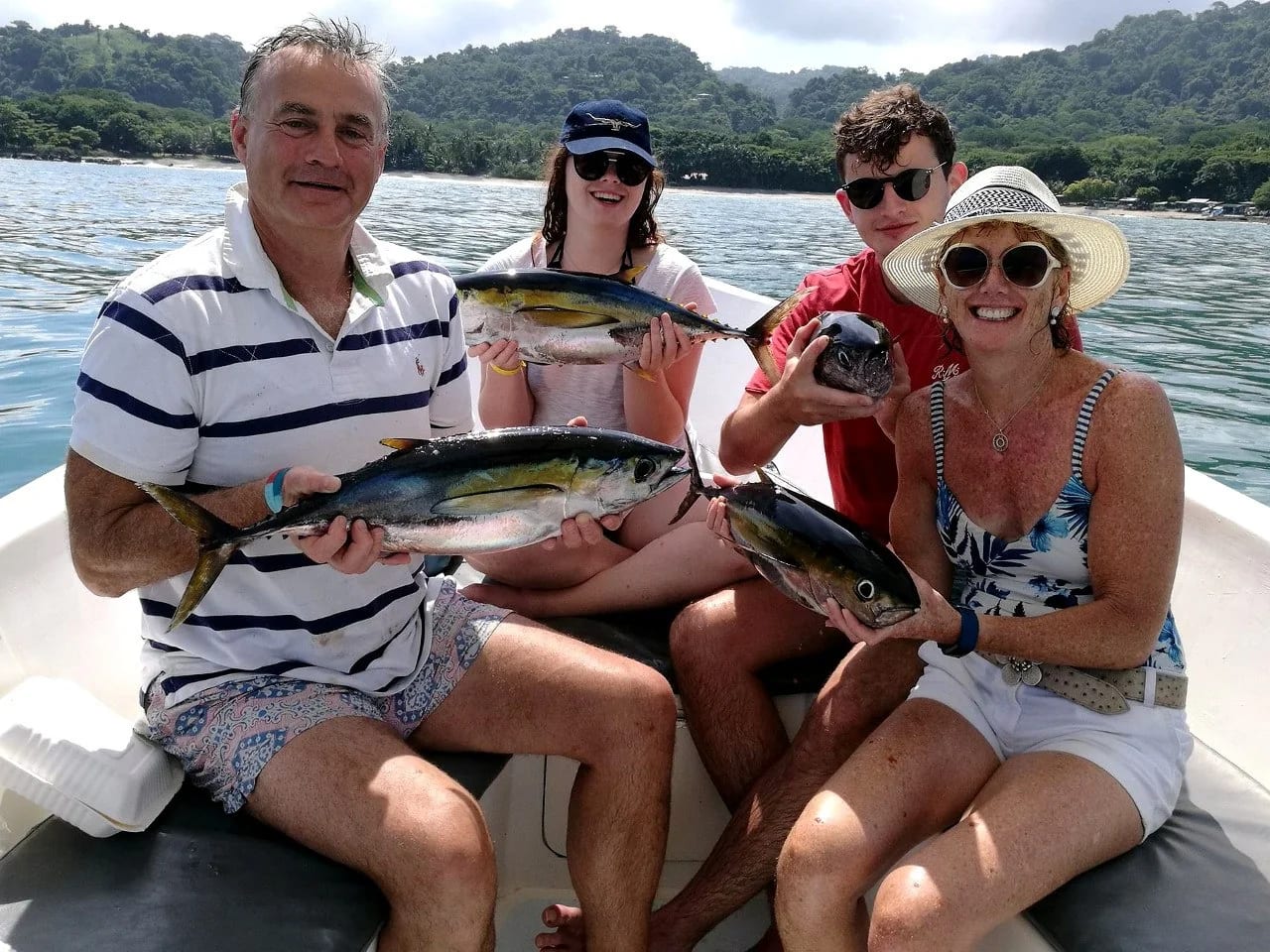
Guests aboard a Jason Tours fishing trip. Image source: View original photo.
A fishing charter from the Santa Teresa area usually begins with choosing a boat and a departure point in Mal País. The first useful decision is the kind of fishing day your group wants. Tell the captain whether you want a shorter introduction near the coast, time to practice a technique, or a longer offshore search. A photograph of a large catch cannot answer that question. You are paying for the boat, crew and agreed fishing effort; fish do not arrive on a booking schedule.
Jason Tours lists inshore and offshore fishing as separate products. Marlins Tours also distinguishes an inshore outing from longer offshore options and identifies its location as Malpais Fishing Village. These primary sources confirm that you can compare different charter types in the area. They do not establish one provider as the best fit for all anglers. Request a proposal for your group, including the actual boat and planned method. Visitors who prefer watching marine animals can compare a dedicated whale and dolphin outing before choosing a fishing charter.
Start with the people who will hold the rods
Count anglers separately from passengers. A group of four with one keen angler has different expectations from four people who each want substantial fishing time. Tell the operator how much experience everyone has and whether they want instruction. Describe experience in useful terms: you have cast from shore, fished from a boat, handled a conventional reel or used a particular technique. A broad label such as experienced may mean different things to the crew and to someone whose fishing has taken place in another environment.
Discuss what a successful day would look like without a catch. Some guests enjoy learning to handle the equipment and observing the coast. Others would feel disappointed after several hours without the target species. Have that conversation with the group before making the reservation. Ask how the crew shares turns and handles a fish that takes time to bring alongside. Agree among yourselves whether people rotate at each opportunity or whether the trip centers on one person's goal. The captain can then explain which arrangement fits the boat and method.
Understand what inshore changes
Inshore describes a fishing area nearer the coast, but it does not guarantee flat water or a quick return. Ask the captain what the proposed outing involves for your date: time traveling, time fishing, and whether the crew expects casting, trolling or another method. Those details tell you more than the product label. You may spend much of a shorter charter engaged with one method, whereas another plan uses more of the session to move between areas. Ask how the crew chooses locations without requesting a promise that one specific spot will produce fish.
A shorter coastal outing may suit a group testing its interest in boat fishing. It may also suit an experienced angler with a particular technique in mind. Avoid equating shorter with easier or offshore with more advanced; the crew should explain the physical demands of the proposal. If some companions would rather enter the water, arrange a separate snorkeling trip from Mal País. Adding snorkeling to a fishing charter changes where the captain can go and how the available time gets divided. Discuss that combination before paying, instead of suggesting it after departure.
Decide whether an offshore search fits your day
An offshore charter gives the captain a different operating area and may involve a longer run before fishing begins. Ask what the quoted duration measures. It might cover the period between departure and return, with travel inside that block. A full-day title does not mean that rods stay in use for the entire day. Ask how a change in conditions could alter the route or fishing method. A captain who explains alternatives gives you useful information even when they cannot promise the species you hoped to target.
Look at the boat's passenger arrangements as closely as the tackle. Ask about shade, seating, toilet facilities and the space available when people move around the deck. Send ages and any boarding or mobility needs before selecting a boat. If someone in your group has concerns about motion sickness or a health condition, consult a qualified clinician for personal advice before the outing. The booking office can describe the vessel and journey, but it cannot decide which medication or medical precaution suits that person. Avoid treating boat size as a guarantee of comfort.
Compare the complete charter price
Ask whether the quoted amount covers the whole boat or each person, and identify the maximum group agreed for that price. Request a clear list of included tackle, bait, crew, fuel, refreshments and any transport. If you want to bring your own rod or tackle, describe it before arrival so the captain can say whether it suits the plan and how to carry it. A discounted headline means little if the boat or duration differs from the offer you thought you were comparing.
For an illustrative comparison, imagine one quote with equipment and meeting at the launch, and another with the same fishing time plus hotel collection. Add the first quote's confirmed road transfers before comparing totals. Do not insert estimated local prices and call the result a saving. Check the payment currency and whether the balance changes if fewer friends join. A shared spot and a private charter create different obligations when your group shrinks. Read the minimum-participant and cancellation terms while you still have the option to choose a different arrangement.
Arrange the personal fishing authorization
INCOPESCA states that people fishing from a boat must carry a current fishing license. Its official services page explains personal fishing-card categories and directs applicants to its online process. Ask the charter operator whether it arranges the applicable authorization or expects you to obtain it. An included license should result in individual proof for the person who will fish. A captain's paperwork for the vessel does not answer whether your own document has been completed. Use the official INCOPESCA website for current requirements and charges.
Resolve the names and dates before departure. If the operator assists with the application, check that your name matches your identification and that the authorization covers the fishing date. Keep the required proof available to show without relying on mobile reception at the launch. Ask the authority or operator to resolve any uncertainty about participants' ages or categories; this guide does not decide exemptions. If a friend joins at the last minute, tell the office in time to address their paperwork, rather than assuming they can take turns with someone else's authorization.
Ask about release and catch handling before leaving
INCOPESCA's visitor guidance describes catch and release for billfish, with the fish kept in the water for photographs. Ask the captain to explain the approach for the species you may encounter and the current rules that apply to the trip. Follow the crew's handling directions. A photograph should not become a reason to delay release or demand a pose the captain declines. Tell companions before boarding that a catch photo may differ from images they have seen online. Set that expectation while everyone has time to understand it.
If keeping an eligible catch interests you, discuss that possibility without making dinner depend on it. Ask who decides what can be retained, how the crew stores it and whether cleaning forms part of the service. Then arrange any meal with your accommodation or chef in advance, conditional on a permitted catch and the kitchen's acceptance. A restaurant need not prepare fish brought by guests. The private-chef planning guide explains how to discuss ingredients and kitchen arrangements. A separate dinner plan prevents a fishing result from deciding whether your group eats that evening.
Make the launch instructions precise
Request the exact meeting pin, the check-in time and the name or description of the boat. Ask how boarding works and what footwear the crew recommends for that launch. Do not assume the departure resembles a marina with a level gangway. Tell the operator about anyone who needs help boarding so it can assess the arrangement before accepting the booking. Keep a compact bag with the agreed essentials, and ask where the crew stores items that need to stay dry. Leave valuable items you will not use at your accommodation.
Arrange suitable road transport for people and any fishing equipment. A surfboard carrier, luggage or long rods should not travel on a shared Bimba vehicle. If the charter includes hotel collection, establish whether the vehicle reaches your door or meets you on the road. For properties above town, describe the access using the questions in our hillside accommodation guide. Tell the return driver that the actual arrival may depend on the captain's decision. Agree on a contact method and waiting arrangement instead of promising an exact landing time you cannot control.
Read the cancellation decision as part of the product
Ask who makes the call if conditions do not suit the planned trip and how the office communicates it. The terms should distinguish a customer cancellation, an operator cancellation and a changed itinerary. Find out whether you can reschedule within your stay, receive a refund, or accept another format. Keep the answer with your confirmation. Do not ask the captain to continue offshore to protect another reservation or to justify the cost. Choose a day with room for the operator to use its professional judgment.
After the trip, record what you enjoyed before deciding whether to book again. You may prefer a different technique, a shorter outing or more instruction next time. Give the operator that feedback instead of comparing catch totals with another boat's social media. If your group wants a broader island excursion, the Tortuga Island day-trip guide covers a different use of the day. For this charter, the strongest booking is one that matches the participants, documents the complete cost and makes everyone comfortable with an uncertain catch.
Book around the anglers
Choose the charter that matches the group’s experience and preferred method. Complete personal fishing paperwork, confirm the launch instructions and keep dinner independent of any catch.