
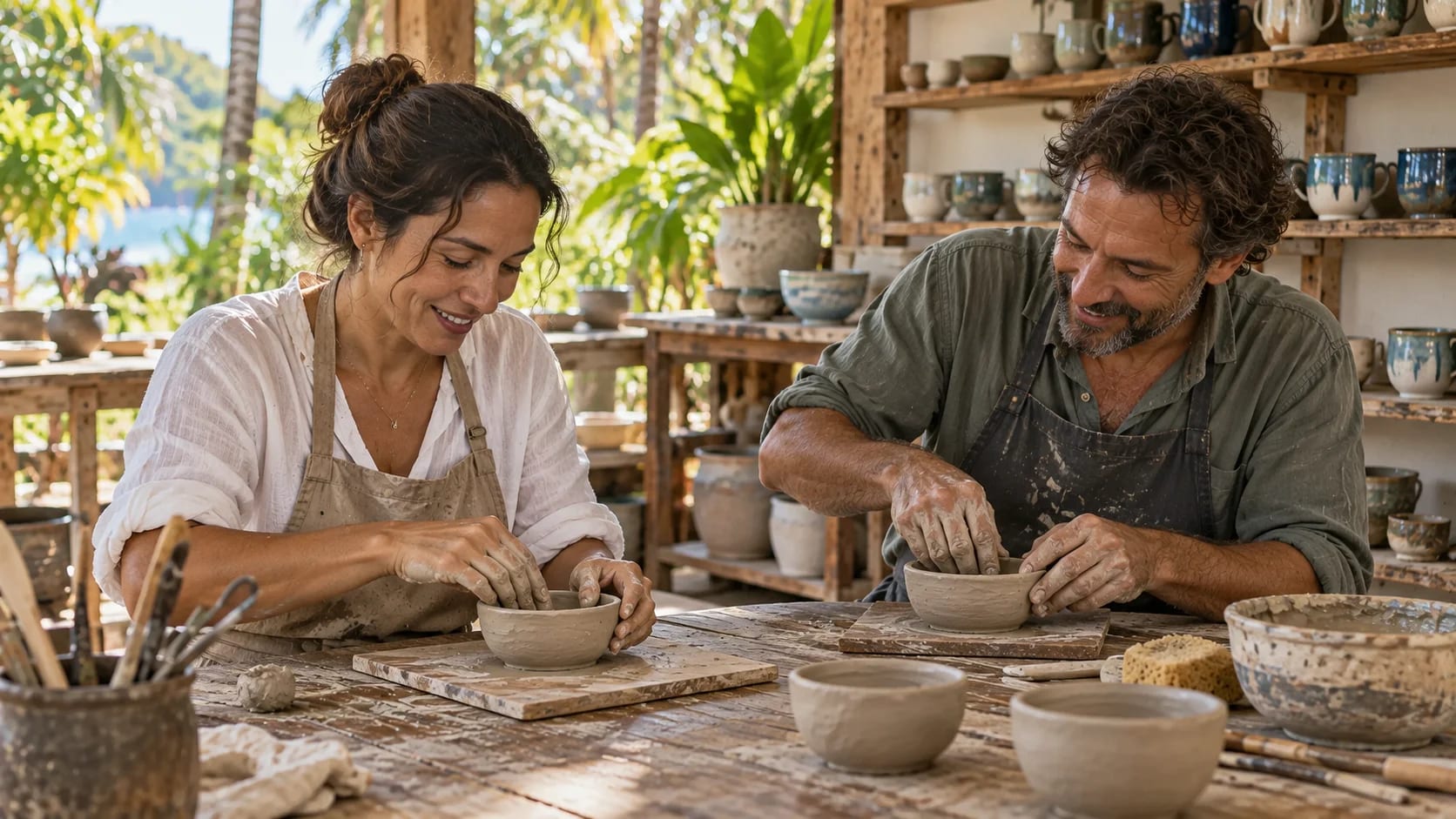
A pottery class in Santa Teresa can mean shaping clay from the beginning, decorating a piece someone has already made or returning regularly to develop a project. Those are different activities, even when the booking page groups them under ceramics. The most useful choice depends on what you want to learn and how long you will remain in town after the session.
For visitors, the important deadline is often the departure date rather than the class time. A finished object may require work after your hands leave the table. Tell the studio when you are leaving before paying, particularly if taking the piece home is essential. A workshop can still be worthwhile as a learning experience, but that is a decision to make in advance rather than discover at collection.
The local options supported by direct sources
ALAWA Cerámica identifies its location as Zeneidas Surf Garden in Santa Teresa. Its official class page, checked on October 21, 2026, separates a clay experience from painting an existing piece and from regular lessons. It directs inquiries through WhatsApp at +506 8481 7104. That is a useful starting point for an individual visitor who wants to understand the available format and current places.
The Pottery Journey lists Santa Teresa as its location and describes private and retreat-based sessions. Its retreat offering includes hand-building and sculptural formats, with different arrangements for drying or firing work. This is particularly relevant to someone organizing a group activity at a retreat or accommodation. Do not assume it operates a public drop-in studio simply because the service is available in town.
Both are direct provider sources rather than evidence for a ranked list of the best studios. We have not attended or compared their teaching. The practical comparison is between the activities they describe and the arrangements your trip needs. For a wider set of possibilities on days away from the water, see our guide to things to do in Santa Teresa without surfing.
Making a piece and painting a piece
In a making session, the appeal is working with the form itself. You can learn how the material responds, choose the size of an object and revise it as you work. A beginner should let the instructor help define a manageable project. A small bowl or simple sculptural idea may leave more room for learning than a complicated object copied from a photograph.
In ALAWA’s painting format, visitors choose an existing piece and add color; the studio then fires it. This removes the need to construct the shape during the session. It can suit someone more interested in surface design, pattern or a shared activity with mixed confidence levels. It still involves a later studio stage, so painting should not be interpreted as an automatic same-day souvenir.
Describe your preference when booking. Saying only pottery may not tell the studio whether you expect a wheel, hand-building or decorating. The reviewed pages do not establish a wheel-throwing session for every booking. If using a wheel is the main reason you want to attend, ask specifically rather than relying on a generic pottery photograph. Equipment and teaching time need to match that expectation.
Choose according to the remaining days of your stay
If you arrive for a brief visit, contact the studio before the trip and place the class early in your stay when possible. Provide both the class date you prefer and the last date you could collect. The useful answer is whether the proposed project fits that window, not simply whether a seat is available. A studio may be able to offer another format when the original idea cannot be completed in time.
If you leave the next morning, consider whether you would enjoy the session without taking home a finished piece. Do not ask the instructor to rush a process solely to match a transfer booking. Instead, discuss any genuine alternative the provider offers, such as later collection by someone you trust or an agreed shipping service. Neither arrangement should be assumed to exist.
For a longer stay, regular classes can make more sense than squeezing everything into one workshop. ALAWA explicitly addresses residents and temporary residents in its regular-class description. Ask how a new student joins, which sessions relate to the same project and what happens if travel interrupts the sequence. The schedule should support the work you want to develop, not merely fill an empty afternoon.
What to settle about firing and finishing
Ask the provider to explain the steps that occur after the session and who performs each one. Does the quoted class include the studio’s finishing work? Will you return to decorate, or will staff complete an agreed finish? How will you learn that the object is ready? These questions are more useful than requesting a universal number of days, because the answer depends on the class and material.
The Pottery Journey distinguishes air-dry and kiln-fired possibilities in its descriptions. Those terms should not be treated as different speeds of the same finished product. Tell the instructor how you intend to use the object and ask which material suits that use. A decorative object and a cup for daily drinks have different requirements. Do not assume a surface that looks glazed is approved for food, heat or washing.
Write down the care guidance when collecting. Ask about the actual piece rather than applying rules from a mug you own at home. The maker can explain whether it is decorative and what handling it requires. If the work changes during production or cannot be completed as hoped, discuss the studio’s policy calmly. A first class is a craft process, not a factory order for an identical object.
Children and mixed groups
ALAWA’s overview says its making and painting experiences are for children and adults. Its class page also displays a specific children’s group with an age range. These are not interchangeable promises that any child can join any adult session. Give the child’s age and ask which current class is appropriate, whether an adult must remain and how the instructor handles a mixed-age booking.
Think about attention and pace rather than choosing solely by the length of the activity. A child who enjoys drawing may prefer decorating a prepared shape; another may want to build and rebuild with clay. Let the teacher suggest a project that fits the session. Avoid turning the class into an obligation to produce a perfect gift for someone at home.
Our Santa Teresa family guide can help place the workshop among other activities. Allow time to wash hands, gather belongings and leave without rushing. If several families attend together, one adult should coordinate the reservation and explain exactly how many participants are making work. Spectators, supervising adults and paying students may require different space arrangements.
Private sessions and retreat groups
A private booking may be useful when your group needs a particular language, pace or time. It does not automatically mean unlimited project choice. Tell the provider the number of people, experience levels and intended setting. The Pottery Journey’s retreat page describes bringing tools and materials, while ALAWA invites inquiries for retreats, camps and group trips. Obtain a proposal suited to the actual event.
For a session at an accommodation, establish the working surface, access to water, shade or covered space and the cleanup arrangements. Ask the property manager before inviting an outside activity provider. A dining table may not be an appropriate work area without protection. The instructor should decide what setup the technique needs and whether the available site can support it.
If combining the session with a yoga schedule in Santa Teresa, leave a practical gap for arrival and cleanup. Do not assume pottery requires no concentration simply because it is often marketed as relaxing. Participants may appreciate an unhurried session more than another tightly timed item between activities. Avoid promising health or therapeutic outcomes that the class is not qualified to provide.
Compare the whole booking
Ask for the current total for the selected format, including materials, studio finishing, any additional piece and collection or shipping arrangements. A headline class price does not answer all those questions. If you want to make more than one object, mention that before the session. Extra material or firing may affect the quote, and a teacher may limit the project to keep it achievable.
Get the cancellation and rescheduling terms before paying. This is particularly relevant when you are trying to move the class around surf conditions or a day trip. An instructor who reserves a small group session has committed time and materials. Choose a time you can keep, then treat the reservation like any other booked activity.
A rainy afternoon can make a workshop attractive, but book the actual covered setting rather than assuming every pottery session takes place indoors. Our rainy-season guide helps with broader planning. Confirm the route and arrival point, especially for an accommodation-based workshop, so the first part of the session is not spent finding the group.
Collection and carrying the piece home
Before leaving the studio, make sure your work can be identified and that your contact details are correct. Photographing the piece with permission can help if several similar objects are waiting for collection. Agree who will contact whom and avoid arriving before confirmation that it is ready. A finished appearance on a shelf does not establish that it is available to take.
When collecting, ask how to protect the shape for your journey. Handles, rims and projecting details need space rather than pressure from tightly packed clothes. Think about the next stages of travel, including a shared vehicle and luggage handling. A piece that is easy to carry across town may still be awkward in a full suitcase. Leave room before the final shopping trip.
If taking home a finished object matters more than making one, browsing local ceramics may be a better fit for a very short visit. Our Santa Teresa shopping guide covers the broader purchase decision. We recommend choosing the workshop for the process you want to experience, then securing a realistic collection plan. That makes the class satisfying even when the best project is smaller or simpler than the one you first imagined.
Book the process and the pickup
Choose making for shaping and painting for surface design, then confirm the finishing and collection plan. For a very short visit, enjoy the lesson without assuming a same-day functional souvenir.