

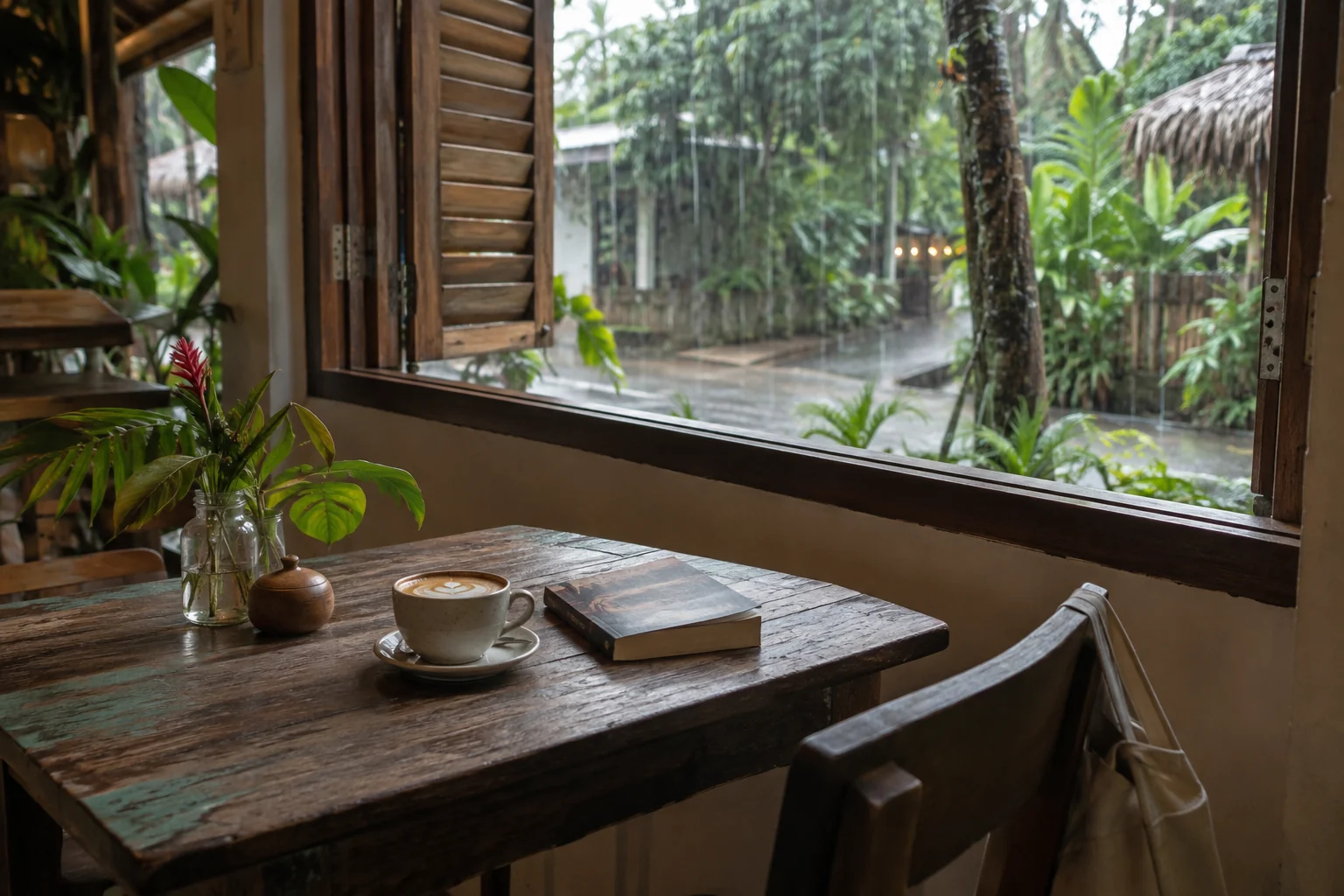
A rainy day in Santa Teresa can be a good excuse for a long breakfast, a class or an afternoon with a book. The easiest plans are usually close by. Start with the kind of day you want, then choose a venue with the space and service to match.
Start with somewhere nearby and sheltered
A passing shower might leave you happy to visit a nearby covered venue. During a severe storm, stay sheltered at your accommodation and rearrange plans. Let the conditions outside guide how far you go.
Use the IMN for current conditions and warnings. Choose a route that suits the conditions. A nearby outing usually leaves you more time to enjoy the venue and less time traveling in the rain.
Five plans that can work
| Plan | Specific place or starting point | Confirm before leaving |
|---|---|---|
| A long breakfast or lunch | The Bakery | Covered seating and the menu currently served |
| A meal with a clear service window | Aroma | Kitchen hours and seating availability |
| A focused work session | Armonia coworking | Day-pass access, power and a suitable seat |
| A yoga or movement class | Existing Bimba studio directory | Today's class, visitor access and whether the room is sheltered |
| A quiet treatment | A provider you can verify directly | Practitioner, appointment length and cancellation terms |
Choose the option that interests you, then confirm that it is operating before leaving.
Turn a meal into a proper break
The Bakery publishes separate food, evening, drinks and dessert menus. That makes it a useful starting point when people in your group want different types of meal. Confirm which menu is active when you intend to arrive.
Aroma separates breakfast service from lunch and dinner on its website. Check that distinction before setting off late in the morning. A restaurant can be open while the specific meal you want has finished.
Choose a table to suit the visit: room for wet bags, shelter from wind-driven rain and a place to sit without blocking the entrance. If you intend to stay well beyond a normal meal, ask staff whether that works for them.
Use a workday without assuming every café is an office
Armonia advertises coworking with day passes and memberships. Ask about the current pass, call-space availability and what happens if the internet or electricity is interrupted. A seat suitable for writing is not necessarily suitable for confidential video meetings.
If you only need to send a few messages, your accommodation may be enough. Finish tasks that can be done offline first, and avoid making your entire day depend on a connection you have not tested.
Book a class or treatment thoughtfully
Use the Santa Teresa yoga guide to find a class, then check the provider’s current schedule. Ask whether visitors need to reserve and whether equipment is included. If the class uses an open-sided deck, check how sheltered it is in rain.
For a treatment, choose the service and appointment length you want, then discuss any relevant needs with the practitioner. Leave enough time to arrive, change and settle in without rushing.
Make the journey part of the plan
Pick one nearby outing instead of several scattered stops. Keep dry essentials protected, arrange a pickup point if needed and know how you will get home. For shared mobility, consult the rainy-season riding guidance and change mode when conditions are unsuitable.
Choose by how you want to spend the afternoon
If you want company, a sit-down meal gives everyone time to talk without needing another activity. Check covered seating and the meal service you want; an open café may have already finished breakfast.
If you want to feel productive, give yourself one manageable task and a clear finishing time. A coworking pass can make sense for calls or several hours of focused work, while your accommodation may be enough for reading or planning.
If you want to switch off, book a class or treatment that interests you. Check the actual space: a roofed, open-sided deck is different from an enclosed room. Keeping the outing nearby leaves more of the afternoon for the activity itself.
For the next part of your plan, see our coworking day-pass comparison and yoga classes and retreats.
Choose the plan by the rain, not just the forecast icon
A rain symbol does not describe what is happening on the road outside your room. Before making a booking, look out, check current IMN information and ask your accommodation about nearby access. A brief shower with a clear, familiar route may leave room for a nearby meal. Sustained heavy rain, poor visibility, flooding or an official warning is a reason to stay sheltered and postpone nonessential travel. Reassess before the return trip too; conditions can change while you are indoors.
Keep a simple three-level plan. First choice: an activity you can reach comfortably and return from under current conditions. Second choice: a nearer or more sheltered option if the weather worsens. Third choice: reading, resting, ordering food where available or dealing with trip administration at your accommodation. This removes the pressure to salvage a fixed schedule. It also helps a group agree on what would trigger a change before someone has already paid for a class or ordered a ride.
Make a restaurant visit work in wet weather
For a long meal, confirm more than the opening status. Ask whether the seating you want is actually covered against wind-driven rain, whether the kitchen is serving the meal you expect and whether a reservation is needed. The Bakery publishes several menus, including food, evening and dessert options. Aroma presents breakfast separately from lunch and dinner. Those pages give you useful starting points, while the venue itself can confirm the current service window and seating on the day.
If you are staying in the café for a long time, order appropriately and be considerate of space during a busy service. An open-sided table may be pleasant in light rain but uncomfortable when wind changes direction. Carry a dry bag for electronics and leave wet items where staff direct you. When the weather is severe, consider takeout or delivery only if the provider confirms service and the route is safe for its staff; staying in can be the more practical rainy-day experience.
Build a useful work session without depending on perfect connectivity
A coworking space can be more dependable for several focused hours than trying to turn a restaurant table into an office. Armonia advertises day passes, communal work areas and call spaces. Before buying a pass, ask about the current price, opening hours, power access, calls, cancellation rules and whether a drop-in desk is available. Check the route and the amount of time you actually need: a pass may be excessive if you only have a few messages to send.

Prepare a task list with an offline part. Download documents when a connection is available, charge your devices and keep a meeting link and contact method somewhere you can access without browsing. For a confidential call, confirm a private space rather than assuming a communal desk will do. If a storm interrupts power or internet, finish the offline work and reschedule the call. The goal is a useful afternoon, not a guarantee that tropical weather will cooperate with every meeting.
Check whether a class is actually sheltered
Yoga, movement and wellness classes can be a good fit for rain, but a roof does not always mean a dry floor or enclosed room. Ask the instructor whether the class will run in the current weather, what happens if it is cancelled and whether visitors need to reserve. Check the start time, equipment, accessibility and any health-related requirements with the provider. A treatment should be booked with a qualified practitioner whose services and cancellation terms you understand. Do not make claims about medical benefit from a generic wellness listing.
Leave time to change out of wet clothes and arrive without rushing. If the venue is uphill or across a difficult section, a short class may not justify the journey in heavy rain. You can also ask your accommodation about a suitable indoor activity on site. The strongest rainy-day choice is often an activity that fits your location and comfort, even if it is less ambitious than the one in your original itinerary.
Adjust the day for children, groups and different energy levels
A group does not have to spend every rainy hour together. One person may want a quiet book, another a meal and another a work session. Agree on a meeting place and time that do not depend on mobile data working perfectly. For families, choose a sheltered venue with suitable seating, food and bathrooms, and check how everyone will travel there. A stroller or small child changes what counts as a short, easy walk when the road is wet.
Keep essential items in a small protected bag: medicine, dry clothing where needed, phone power and booking details. Avoid committing the whole group to a nonrefundable activity until you know both access and weather policy. If everyone is tired, an unhurried meal or rest at the accommodation can be more rewarding than a string of improvised stops. Rain is a reason to simplify the day, not a requirement to find a substitute attraction for each cancelled plan.
Plan the return before leaving shelter
Choose transport for the wettest leg you expect, not just the conditions at departure. A shared e-bike or standing scooter may be unsuitable when visibility, grip or road condition deteriorates; consult the current rainy-season transport guidance and the app. A taxi can be useful, but arrange a realistic pickup point and confirm the vehicle and price with the provider. Do not assume a vehicle will be immediately available when several people leave a venue as rain starts.
Check the route from the door to the pickup point. Keep the phone dry and charged, share the plan with your group and allow time for delays. If a severe-weather notice is in force or a road appears flooded, postpone the outing and follow local instructions. A pleasant indoor activity stops being a good plan if the journey to or from it is unsafe. The best itinerary ends with everyone back at the accommodation without having to improvise in the dark or rain.
An example of a flexible rainy afternoon
Suppose the morning begins with a shower. You check official weather information and confirm that a nearby covered lunch venue is serving. You walk only if the short route is suitable; otherwise, you arrange a ride. After lunch, you can choose a confirmed class, a few hours of work or simply return to the room. You make the second decision based on the weather at that time, not on the morning forecast. If the rain intensifies, you use the indoor fallback and move outdoor plans to another day.
This is a decision pattern, not a promised timetable. Named businesses can change service, space and availability, so verify directly. A rainy Santa Teresa day can still include a satisfying meal, conversation or progress on a personal project. Its success comes from choosing one workable activity and leaving room to change course, rather than racing between places in poor conditions.
Frequently asked questions
Is surfing a rainy-day alternative?
Rain alone does not determine surf suitability. Lightning, currents, visibility, runoff and the instructor's decision matter. Do not treat a wet-weather activity list as approval to enter the water.
What if everything I planned is cancelled?
Use the time for a meal, trip administration, reading or rest where you are staying. A flexible day is still a useful part of a trip; it does not need another paid booking to count.
Summary
A rainy day in Santa Teresa can still include a good meal, a class or a productive afternoon. Choose something you enjoy close to your accommodation, confirm that it is running and check the journey before leaving. When conditions make an outing impractical, a quiet afternoon at your base is a worthwhile plan too.
A better rainy-day plan
Book one meal, class or work session with confirmed access, then add a short activity only if conditions improve. Do not build the day around riding through heavy rain.