
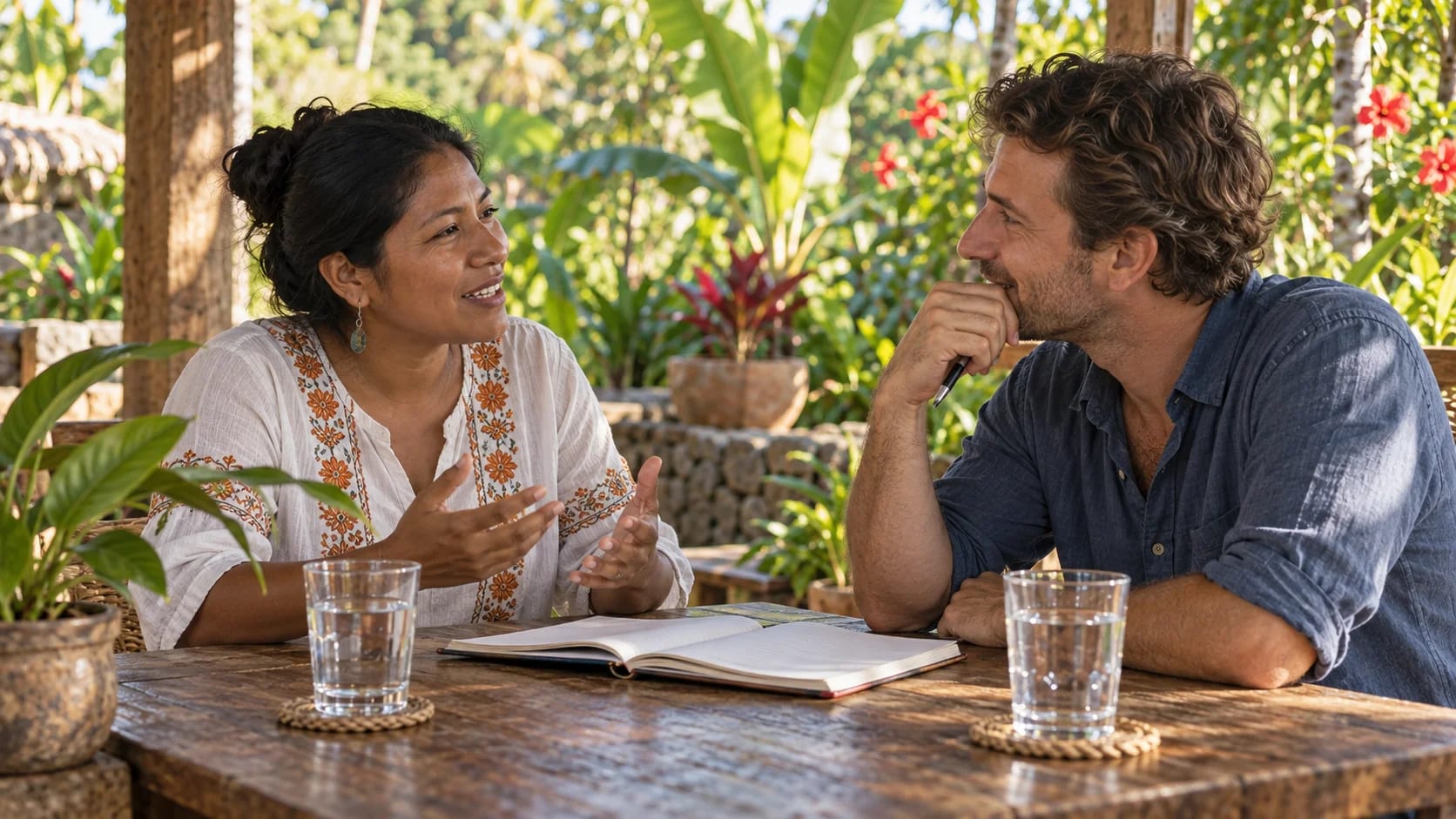
Spanish lessons in Santa Teresa can fit around a holiday without turning the whole trip into a course. The key is choosing a realistic goal. Someone arriving for four days may want to order a meal and understand the reply. A temporary resident may need longer conversations with neighbors or service providers. Those learners need different plans, even if both describe themselves as beginners.
Start by naming one situation you want to manage more comfortably. Then tell the teacher what you can already do and where you get stuck. This is more informative than saying you want to become fluent during the visit. A useful short course can make a particular interaction easier; it cannot promise a complete transformation by checkout.
Local teaching options and their settings
José Cardoza’s official website describes private Spanish lessons online and in person, with coverage in Santa Teresa, San Isidro, Mal País and Cóbano. It offers meetings at a student’s accommodation or a nearby café and provides WhatsApp contact at +506 8388 6840. This arrangement may suit someone who wants a lesson near where they are already staying rather than a daily commute to a classroom.
Casa Pampa’s Spanish course page also advertises lessons tailored to level, interests and available time. It invites contact from people interested in lessons even when they are not taking a broader course. Its published contact is info@casapampa.com. Establish the current meeting arrangement directly; an accommodation’s language offering does not by itself tell you the class size, weekly timetable or whether the lesson takes place at your own rental.
Tico Spanish is another regional option, but its published address is in Montezuma, next to Hotel Cascada. It should not be presented as a Santa Teresa classroom. If you want to compare a longer stay on the other side of the peninsula, our Santa Teresa and Montezuma comparison can help. A nearby regional search result is not proof that daily travel between your accommodation and the class will be convenient.
Describe your actual starting point
Before the first lesson, write a brief account of your experience. Perhaps you studied at school, recognize written words but struggle with speech, or can chat comfortably until the conversation moves into the past. Give examples. A teacher can use them to choose a starting task rather than spend the entire session discovering that a generic beginner label does not fit.
If the provider uses level labels, ask what they mean for your lesson. A quick online quiz can suggest a starting point, but your ability to select a correct answer may differ from your ability to speak spontaneously. Let the teacher hear you describe an ordinary situation. You do not need to perform well; the point is to make the lesson suitable.
Choose one priority for the initial session. Understanding numbers, asking for clarification or describing a plan may be more useful than collecting a long vocabulary list. Our Santa Teresa supermarket guide offers one practical setting: you could prepare a few questions about quantities and products, then review the replies that were difficult to follow.
Private lessons and learning with someone else
A private lesson gives the teacher room to adjust the pace to one learner. It can be useful when you need repeated practice with a specific task or feel uncomfortable speaking in front of a group. It also places more responsibility on you to participate. Bring a question, attempt an answer and tell the teacher when an explanation is unclear rather than letting the session become a conversation you only listen to.
A shared lesson can work for a couple or friends who want to practice together afterward. José’s site explicitly offers classes for two. Before choosing this format, explain whether your levels differ and what each person hopes to gain. One learner should not become the permanent interpreter while the other remains silent. Ask how the teacher will distribute speaking time and keep both people involved.
If you want a group course with several hours of study each day, ask providers whether that exact structure is available. Do not infer it from the word school in a business name. Confirm the class size, level grouping and course sequence. A collection of flexible private sessions can be useful, but it is a different commitment from joining a fixed cohort.
Build a plan that fits your visit
For a short stay, a possible structure is one lesson early in the visit, a modest practice task and a second lesson to revisit what happened. This is an editorial planning suggestion, not a provider package or a promise of progress. It gives the second session a concrete purpose: repairing misunderstandings that occurred after the first.
For a longer stay, reserve a regular time that does not compete with essential work or travel. Frequent last-minute changes make it harder to maintain a sequence. A morning lesson may suit one person; another may concentrate better later. Choose according to your own energy and the teacher’s actual availability, rather than a generic rule that every learner should study at the same hour.
Leave space between a lesson and a booked excursion. Our Santa Teresa day-trip guide can help identify days better left free of class. Arriving from a long journey and trying to study immediately may turn an enjoyable lesson into another deadline. A smaller number of sessions that you can attend attentively is often a more workable holiday choice.
Practice in ordinary interactions with respect
Use the lesson to rehearse a real exchange, including what to say when you do not understand. A request to repeat or speak more slowly can keep a conversation going without pretending you followed every word. Ask the teacher to practice both the question and several possible replies. Learning only your own line leaves you unprepared for the other half of the exchange.
Outside class, choose moments when the person you are speaking with has time. A cashier facing a queue is not an unpaid tutor. Keep the transaction clear, accept a switch of language when necessary and save detailed grammar questions for your teacher. Respectful practice means paying attention to the other person’s work and preference as well as your own learning.
Food can provide a useful subject because the same words recur. Read our Costa Rican food guide, choose a dish you genuinely want to understand and bring questions to class. You could practice asking what is included, describing a preference and understanding an alternative. Do not rely on an improvised beginner phrase for an essential dietary or medical instruction; make sure the meaning is understood.
Ask about local usage without collecting stereotypes
A local teacher can help explain the expressions you hear and the situations in which people use them. Bring an example with context rather than asking for a list of slang to repeat everywhere. A friendly phrase among acquaintances may not suit a formal request. The useful skill is recognizing how the conversation changes with the relationship and setting.
You can also ask about the forms of address you encounter. Instead of assuming every speaker uses the same pattern, let the teacher show examples and explain the choices. Listen for usage during the week, then return with a specific question. This approach treats language as communication between people rather than a collection of phrases intended to make a visitor sound local.
A class can include culture without making broad claims about what all Costa Ricans think or do. Ask about the particular community, the teacher’s own experience and differences across settings. If a conversation raises a topic you do not understand, curiosity and a clear question are more useful than repeating an explanation from a travel slogan.
Settle the booking and the learning space
During this research, José’s English and Spanish pages displayed different prices and trial conditions. For that reason, this guide does not select one as the current offer. Request a written quote for the chosen lesson length, number of learners, location and any package. Confirm cancellation terms with the same message. A screenshot from a different language version may not reflect the arrangement being offered to you.
If a teacher comes to your accommodation, obtain any necessary permission from the property and choose a suitable shared space. A stable table, comfortable chairs and a place where you can hear each other matter more than a scenic background. Avoid the busiest check-in area or a spot where another guest is trying to work. Give clear arrival instructions so the booked lesson begins with teaching.
For a café lesson, ask whether the venue suits the time and whether you are expected to purchase something. A public table is not automatically a reserved classroom. Noise, music and passing traffic can make listening practice difficult. The setting should support the lesson’s goal, especially for someone already struggling to distinguish words in connected speech.
Continue online if the arrangement works
Online teaching is explicitly part of José’s offer and can help maintain continuity after leaving Santa Teresa. Before committing, test the connection, microphone and place where you will join. Agree on the time zone in writing when you travel. A lesson entered into a calendar without a zone can become confusing after a flight, particularly if your home location changes clocks seasonally.
Keep a small record of what you practiced and which questions remain. A few useful sentences, an example correction and the next task are more practical than pages of notes you never revisit. If your teacher supplies material, clarify how it should be used between sessions. Optional resources should support the plan rather than become a substitute for speaking and listening.
Spanish lessons are one of several ways to learn something during a stay. A local cooking class may offer another setting for vocabulary, but its teaching language and participation format must be checked separately. Our recommendation is to start with a clear goal and one well-matched lesson, then continue if the pace, setting and communication suit you. The strongest reason to book another session is that you know what you want to work on next.
Start with one useful objective
Choose a teacher whose format and location fit your stay, obtain a current written quote and test the fit in one lesson. Plan a respectful practice task and use the next session to review what happened.