
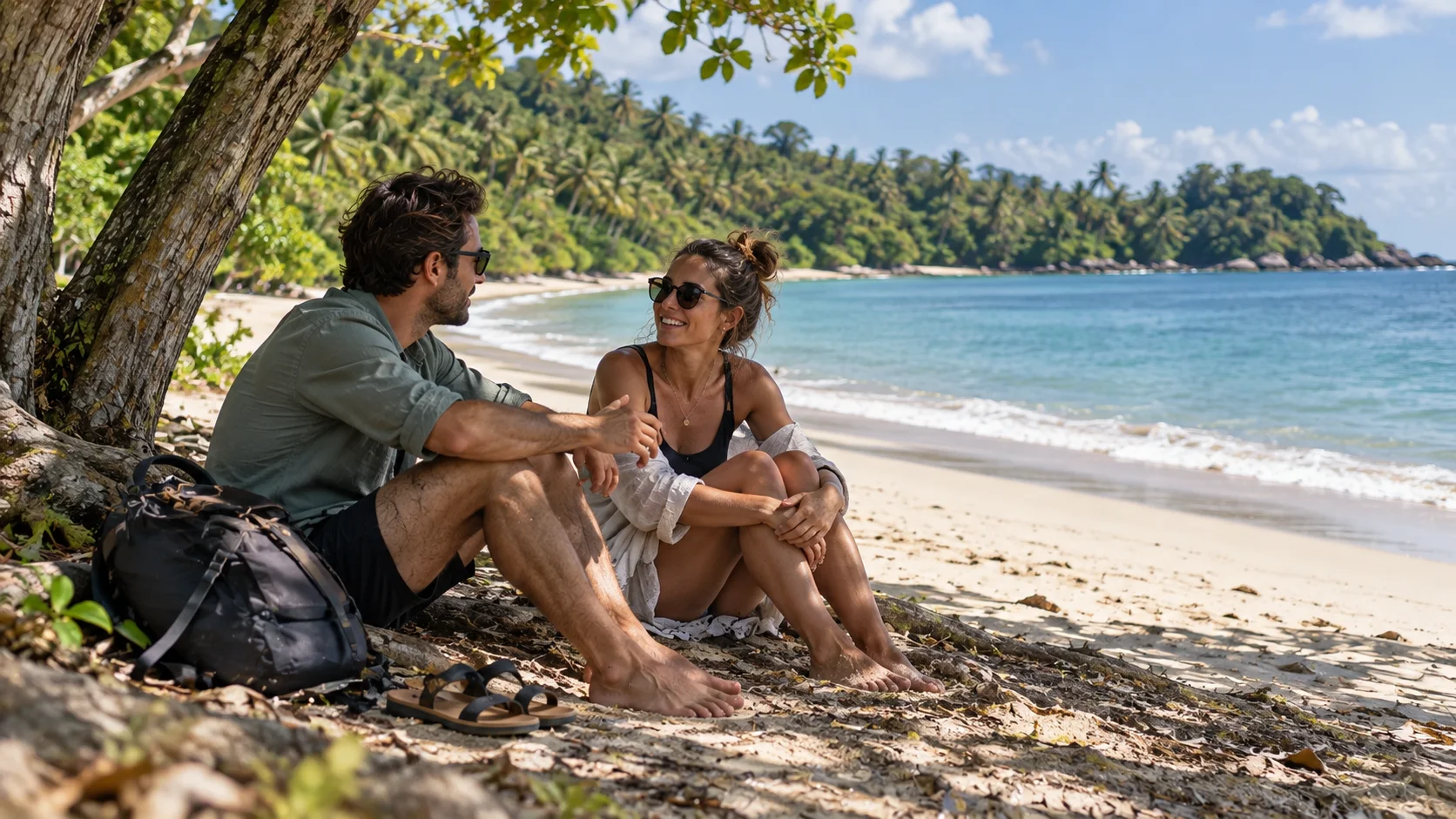
Santa Teresa and Sámara can both support a beach holiday with surf lessons, meals out and time away from a busy itinerary. The useful choice depends on which version of that holiday you want to repeat. Write down your ideal ordinary day before comparing hotel photographs: where you eat breakfast, what you do before lunch and how you spend an afternoon when you do not enter the ocean.
Sámara lies in Guanacaste's Nicoya canton, as identified in the ICT's destination plan. Official tourism information describes its bay and a range of coastal activities. Santa Teresa belongs to the southern Nicoya Peninsula travel area covered in the tourism board's Puntarenas material. These are distinct bases, even though both appear in Peninsula itineraries. A regional map is a starting point, not proof that moving between them is a short local outing.
Start with three versions of a beach holiday
For a surf-focused stay, compare coaching arrangements before hotels. Santa Teresa has providers such as Cafecito advertising lessons and video review, while Surf Samara advertises coaching in Sámara. Both towns can enter the shortlist. Ask each provider to match your current level and goals with the expected conditions and available teaching. A destination's surf reputation cannot choose the right session for an individual traveller.
For a holiday organised around sitting by the beach, reading and choosing a few activities, look at the actual place where you will spend those hours. Sámara's bay makes a useful reference when comparing lodging positions and excursions. In Santa Teresa, identify the particular beach access near the room you are considering. “Near the beach” needs a route and a usable place to spend time, whichever town appears in the address.
For a mixed group, write a separate ordinary day for the surfer, the person who prefers land activities and anyone who needs more rest. A shared breakfast and evening meal may be enough common structure. The group does not need to do every activity together. Choose the base where each person can follow a workable plan without depending on one driver or one activity organiser all day.
Compare surfing as a service, not a town-wide promise
Surf Samara's own website describes personalised coaching and a camp that can combine surfing with other activities. Cafecito describes beginner and intermediate lessons, plus video-related services. These offerings establish that you can investigate structured instruction in either destination. They do not establish that one town guarantees easier waves, better progress or appropriate conditions on every day of a trip.
Send the same description of your experience to both schools. Include whether you catch unbroken waves independently, how comfortable you feel in the ocean and the board you normally use. Ask about a suitable first session, the instructor's plan for changing conditions and the complete price. Comparing answers to an identical brief is more useful than comparing two unrelated package names.
Use the lesson versus surf camp guide if you are deciding between a few sessions and a stay with a structured programme. Choose the format before treating accommodation, meals and coaching as one price. A package may simplify coordination, but you should still understand which parts are included and which activities you would arrange separately.
Separate the bay view from swimming conditions
The official description of Sámara identifies a bay with moderate waves. That is a broad geographic description, not a daily swimming assessment. Conditions vary, and a traveller still needs local information appropriate to the day and their ability. Do not choose either town on the basis of a claim that the ocean is safe for all children or suitable for every beginner.
If swimming is central to the trip, ask prospective hosts how they help guests obtain current advice and whether a suitable pool is part of the accommodation. A pool can give your group another way to spend a day when you decide against sea entry. Check the actual facilities and supervision arrangements you need instead of treating the pool icon on a booking page as a complete answer.
The Santa Teresa family guide helps identify practical questions about children's activities and transport. Apply the same questions to Sámara. Your own needs, the particular accommodation and current conditions should determine the plan. A town can appeal to families while a specific room, route or activity remains unsuitable for your group.
Put two real accommodation options on the map
Choose one candidate room in each town and mark a breakfast stop, the activity meeting point and an evening meal. Ask the hosts for the route between those places and the hotel entrance. The comparison becomes concrete once you examine the same daily needs in both locations. A distant room with a town name in its listing may produce a different holiday from a central room under the same destination label.
For Santa Teresa, the hotel location checklist helps inspect the last part of the walk and the surroundings. Use the method in Sámara too, without assuming the routes have the same conditions. A property on a hill, across a busy road or away from the activity you booked needs its own transport plan. Request current photographs if the route is hard to understand from the map.
Consider the room as somewhere you will spend time between outings. Ask about noise, shaded seating, the kitchen if relevant and the arrangement for drinking water. A room that supports a relaxed afternoon may be more valuable than a slightly cheaper one requiring an outing for every meal and break. Compare what you will use, rather than a long list of amenities that do not affect your stay.
Decide what a non-surf day looks like
Sámara's tourism chamber lists a local information centre that arranges tours, transport and accommodation in the Sámara–Carrillo area. Surf Samara also describes activities that can be added to its camps. Use these as channels to investigate the particular outing you want, such as a guided nature activity or paddling experience, and obtain its current meeting point, suitability and operating conditions.
For Santa Teresa, southern-peninsula outings can be part of the decision. The Montezuma day-visit guide and Cabo Blanco visitor plan explain two different excursion types. They require their own access and return arrangements. Being based in Santa Teresa does not turn a regional excursion into a short shared-bike journey, and the name of a reserve does not guarantee entry on a particular date.
Compare one realistic outing in each destination. Count preparation, transport, the activity and recovery time afterward. Ask whether an operator can accept the whole group or whether some people will prefer to stay at the accommodation. A holiday with two carefully chosen excursions can work better than changing town to collect a longer list of activity names.
Fit the base into the trip before and after it
Build the arrival route from your actual airport or preceding destination to the room. Then build the departure route to the next reservation. Request current options and complete quotations from transport operators. A town that looks farther from one airport may still fit your route better if you arrive from a different region or have an onward stop nearby.
Include baggage, surfboards and any child seats or mobility requirements in the enquiry. Confirm the final drop-off and how the host handles an arrival outside normal reception availability. A transfer quote that ends at a meeting point leaves another leg to organise. Compare the whole journey in both directions, not only a headline driving estimate from a general travel page.
For a short stay, moving between both towns may use time you would rather spend at the beach. The guide to choosing how many days to stay helps separate full activity days from travel days. Do not split a brief beach segment automatically. Choose two bases only when each offers a distinct experience you want enough to justify packing and transferring again.
Compare complete stays in the same currency
Ask for accommodation totals for the same dates, occupancy and cancellation terms. Add arrival and departure transport, your selected lessons and one non-surf outing. Include ordinary meals according to the facilities you will have. You can then compare two actual holiday plans without claiming that one whole town is always cheaper.
If a camp includes breakfast or a board, record that once. If a room has a kitchen you will use, price a realistic grocery plan rather than assuming every meal will be self-catered. Keep optional activities separate from committed costs. This makes it easier to change one part of the plan without losing track of why you preferred a particular base.
The trip budget worksheet approach is useful for both destinations. Build a comfortable plan, then remove or change the least important extras if needed. Do not choose a lower room rate that forces repeated paid journeys to the places where you intend to spend the day. The final cost depends on your arrangement, not a destination stereotype.
Make a provisional choice and test it
Choose Santa Teresa provisionally if your strongest interest is a particular coaching arrangement or a southern-peninsula stay you have planned around confirmed activities. Choose Sámara provisionally if the bay setting, your candidate accommodation and a Sámara–Carrillo activity plan fit the ordinary day you described. These are editorial decision rules, not universal rankings of either town.
Now imagine a day when the main activity does not happen. You wake up later, change the surf plan or stay near the room. Ask whether you still like the accommodation, meal options and simple things you can do. A base that works on an ordinary unplanned day is less dependent on perfect timing and more likely to suit the way you travel.
Before committing, resolve only the facts that could change your decision: the room, transport, essential activity and cancellation terms. Keep the rest of the schedule flexible enough to use local advice. You do not need to prove that the other town is worse. You need a complete stay that fits your group's interests and the time available.
Choose the complete stay
Pick the base whose room, coaching or outings and arrival route fit together. Keep both towns on the shortlist until you can compare actual services for the same dates and group.