
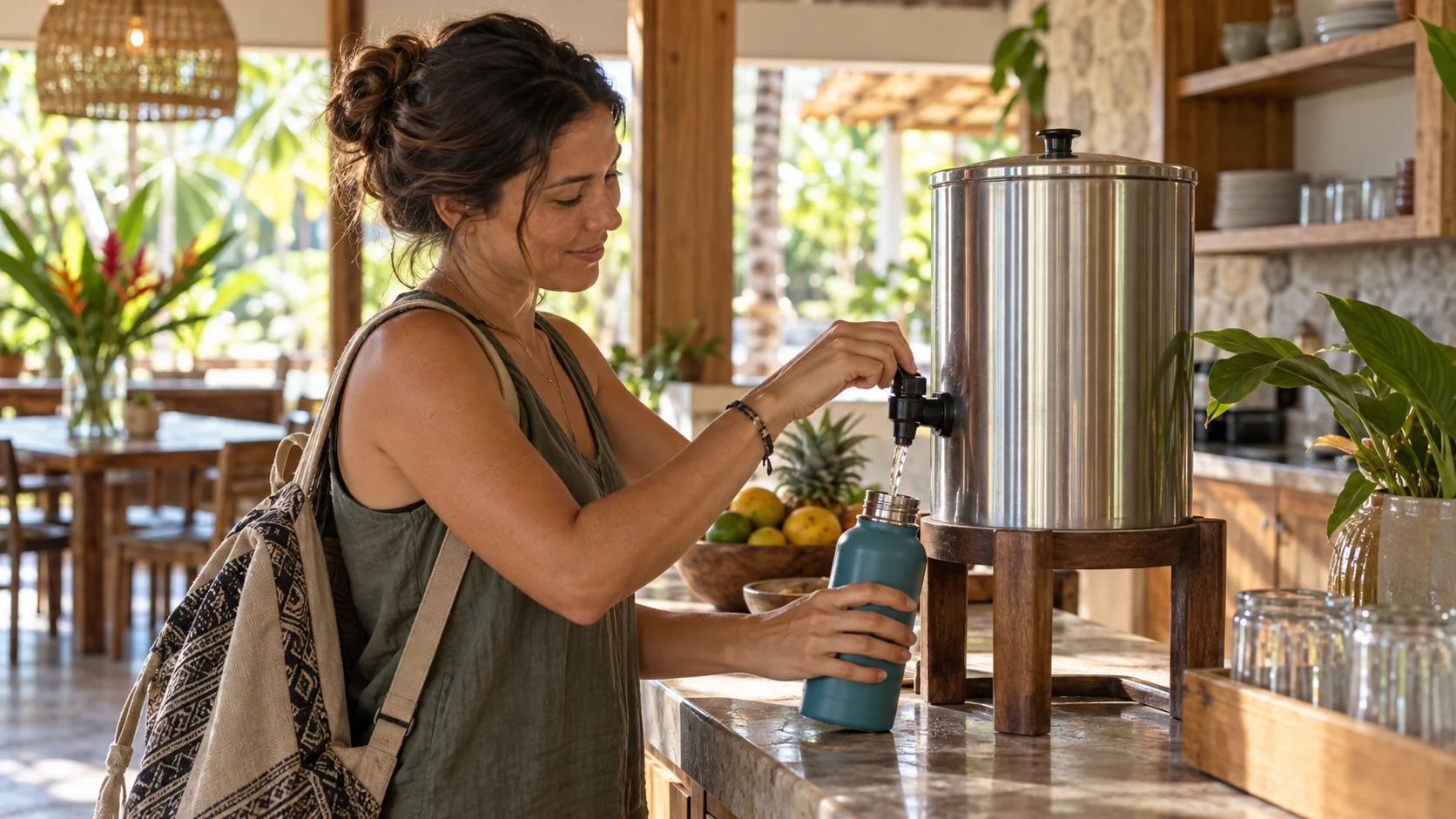
There is no useful town-wide answer that can certify every tap in Santa Teresa for the dates of your stay. Ask about the supply at the accommodation you booked and the outlet you intend to use. The question is specific: where should you fill a drinking bottle today, and what information supports that instruction? A host can explain the building's arrangement and direct you to its water supplier for a current notice.
Costa Rica's official tourism website describes drinking water as potable in most of the country, with exceptions. That national statement is context, not a test result for an individual room. The CDC advises travellers to know their water source and notes that contaminated water may appear clear. Neither a general tourism description nor appearance alone settles the question at a particular tap.
Send one useful message before arrival
Ask the host: “What is the water source for this property, which water do you provide for drinking, and is there a current interruption or advisory affecting it?” Add your arrival date and the exact unit if the property has several buildings. This is more useful than asking whether Santa Teresa water is good, which invites a broad answer unrelated to your accommodation.
If the reply says filtered water is available, ask where, how guests access it and whether there is a charge. If it says bottled water is provided, ask what quantity is included at arrival and how you obtain more. You need an operational plan as well as a description. A dispenser behind a closed reception desk may not help when you arrive after the staff leave.
Save the answer with your check-in instructions. The first-evening guide can help you organise an arrival meal and essentials so that you do not need to solve everything after a transfer. If the host cannot give a clear answer before arrival, plan an appropriate drinking-water purchase rather than assuming the kitchen tap will be the refill point.
Identify the supplier and the building arrangement
Ask whether the property receives its water from a utility, a community system, a private source or another arrangement. Ask the host for the responsible supplier's name rather than choosing a contact from a search result with a similar place name. Costa Rica has places with names resembling Santa Teresa, and an unrelated water association's notice will not describe your accommodation's supply.
Then ask whether the water passes through a storage tank or treatment system before reaching your room. You are not conducting an engineering inspection. You need to know whom to ask about the network and whom to ask about equipment within the property. A supplier can address its system; the host manages the building's facilities and should explain the drinking-water provision guests may use.
For a long stay, ask how the host communicates maintenance or changes in supply. Include this discussion in the monthly accommodation checklist. A useful arrangement identifies the person responsible, the designated drinking outlet and the alternative if that outlet is unavailable. Keep those practical details separate from promotional language about the property's sustainability or location.
Check whether a notice applies to your address
If someone mentions a water notice, request the original message or official link. Read its date, area and instructions. An image forwarded through several chats may omit the date or the affected streets. Ask the host or supplier whether your building falls within the stated area. Do not spread an old notice as current information about the entire town.
Distinguish an announced interruption from a notice about water quality. The instructions may differ, and water flowing again does not by itself answer whether a quality-related notice has ended. Follow the responsible authority's instructions and ask for the current update. This guide does not establish that any specific notice is active in Santa Teresa today or predict conditions on your travel dates.
AyA publishes customer-service information and a reporting channel for its customers. Use the official supplier contact appropriate to the property, or ask the host to make the enquiry with its account details. You should not need to share your passport or card information to ask which notice affects a building. Keep a copy of the response that describes the address and the relevant period.
Choose an interim drinking-water option
If you have not established a suitable source, obtain water from a verified alternative. CDC travel guidance identifies unopened, factory-sealed bottled water as an option and cautions that source and treatment still matter. Check the seal before use and buy from an established seller. Do not treat an unlabelled container as equivalent merely because someone calls its contents purified water.
A refill service can be practical if the operator can explain its drinking-water provision and handling. Ask the accommodation which supplier it uses and where guests should fill their bottles. Confirm whether you can bring your own container and how payment works. Avoid assuming that a bathroom sink, garden tap or decorative water feature shares the designated drinking supply.
The supermarket guide helps organise a purchase alongside food and other essentials. If a large container is difficult to carry, ask about a suitable delivery arrangement. The grocery delivery comparison covers order and handover questions. Confirm the exact product, container size and delivery destination so the driver does not leave a heavy order somewhere you cannot move it.
Match the plan to the kitchen you will use
Ask your host which water to use for drinking and food preparation under current guidance. Include ice and drinks made at the accommodation in the question. A refrigerator with an ice tray or a coffee maker does not establish the source of the water someone used to fill it. If a notice applies, follow the official instructions for the uses it covers rather than guessing from the appliance.
For a shared kitchen, agree which container belongs to your group and label it without obscuring manufacturer information. Avoid mixing water from an uncertain source into a container reserved for drinking water. Keep the vessel closed and use it according to the supplier's instructions. Ask where you can wash and dry your reusable bottles using an appropriate water source and the bottle manufacturer's care directions.
The self-catering guide helps you organise food storage and equipment with your host. A water arrangement should fit that same routine. If the kitchen plan depends on a kettle, filter or another device, confirm the device and its maintenance instructions rather than treating the presence of equipment as proof that it addresses the problem described in an official notice.
Avoid guessing what a filter can do
The word filter covers different products and capabilities. Ask the host what system serves the drinking outlet and how they maintain it. You do not need to become a water-treatment specialist to recognise that an unspecified filter is an incomplete answer. If you bring your own device, read the manufacturer's intended uses and follow the relevant health authority's guidance for the water conditions.
Do not improvise a treatment recipe from a travel conversation. A quality notice can involve a specific concern, and a method appropriate for one concern may not address another. Obtain the authority's instructions or use a suitable alternative supply while you clarify. This article provides service-navigation questions, not a personalised medical assessment or a universal treatment method.
If you have health-related requirements that affect your water choices, discuss them with a qualified healthcare professional before travel. Give the accommodation the practical provision you need without asking its staff to interpret medical instructions. If you become unwell during your stay, seek appropriate medical advice; a conversation about where you filled a bottle cannot diagnose the cause.
Build refills into an ordinary day
Choose a confirmed refill point before leaving for an activity and know whether you can use it on return. Carry a bottle you can manage with your day bag. The amount you need depends on the person and activity; this guide does not prescribe a fixed intake. Ask an excursion operator what drinking water it supplies and what you should bring, then follow professional advice relevant to your situation.
For a day away from the accommodation, ask whether the activity's refill provision is part of the booking or a separate purchase. A photograph of a dispenser on a website does not confirm access during your tour. Resolve the question alongside the meeting point and return time. The packing guide can help you place the bottle where it is easy to reach without creating an awkward load.
If the household shares a large container, agree who checks the remaining supply and who places the next order. A simple handover prevents two people each assuming the other has refilled it. Keep a modest practical backup suited to your group and storage space, without making unsupported predictions about shortages or buying far more than you can use.
Report a change with specific information
If the water looks, smells or behaves differently from the supply you were instructed to use, stop relying on that outlet for drinking until you obtain guidance. Tell the host which tap or dispenser, the time and what changed. Describe your observation without claiming a laboratory finding. Ask whether the host has received a notice or changed a tank, filter or supply arrangement.
The host can contact the responsible supplier, and you can request the resulting instructions. Do not open tanks, change filters or alter building equipment yourself. If other guests need information, share the verified instruction with its date and source. Avoid turning one unexplained observation into a statement that all water in Santa Teresa is unsafe.
At departure, leave any rented or returnable container according to the supplier's agreement and take your reusable bottle. Keep the source details if you plan to return, but ask again on your next stay. The useful habit is a short, address-specific check followed by a workable refill routine. That gives you a practical answer without relying on an unsupported promise about an entire destination.
Confirm the outlet and the alternative
Get an address-specific answer about the designated drinking water and current notices. If the answer remains unclear, arrange a verified alternative and follow the responsible authority’s guidance.