
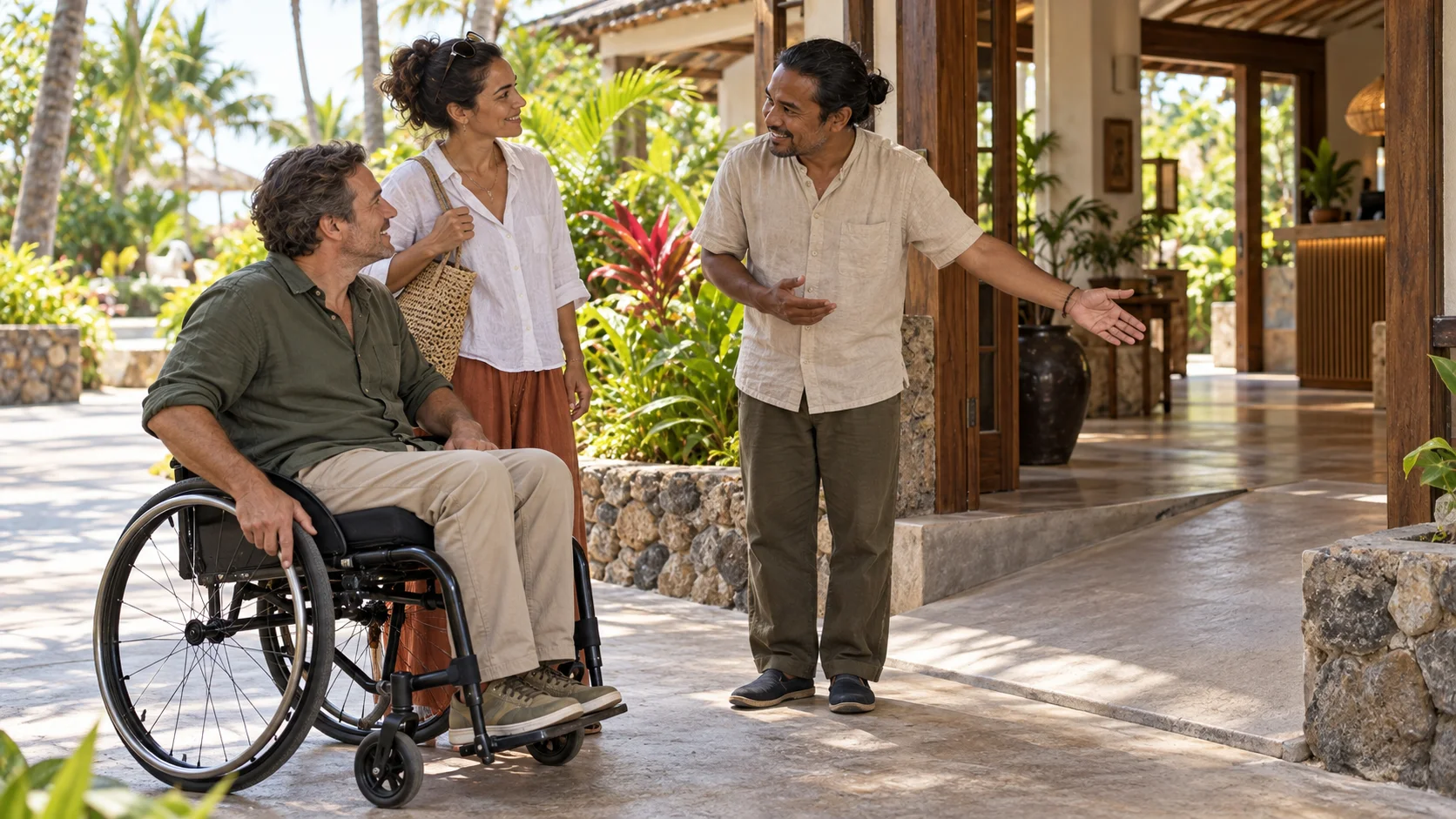
An accessible trip to Santa Teresa requires answers about the particular room and route you will use. A ground-floor room can still have a step at the entrance. A bathroom photograph may hide the clearance beside the toilet. Start by writing what you need to move, transfer and rest comfortably, then ask the property to show those details. You can make a decision from evidence without accepting a broad promise that a place is suitable for everyone.
Costa Rica's official tourism website advises travellers to confirm current transport, equipment, routes and accommodation with providers. The Red Costarricense de Turismo Accesible offers a directory and information about accessibility work. These are useful research channels, but neither a national initiative nor a listing establishes that your planned Santa Teresa room or beach approach meets your requirements. This guide does not certify a venue or route.
Write a short access profile
Describe the mobility equipment you use and the dimensions relevant to doors, vehicles and turning space. Include its weight if a lift or transport service needs that information. State whether you remain seated in the equipment during travel or transfer to a vehicle seat. You decide what information to share; a useful enquiry explains functional needs without requiring your full medical history.
Add the help you want and the tasks you prefer to do independently. A staff member may offer to lift a chair as a solution to a step, while you require a step-free route. State that requirement before comparing rooms. If you travel with another person, clarify whether they can and wish to assist. Do not let a provider assume that a companion can perform transfers or carry equipment.
Include needs beyond movement where relevant: written communication, reduced background noise, lighting, clear signs or a way to contact reception without a voice call. Ask the provider to reply to each essential item. Mark preferences separately from requirements that determine whether you can stay. This gives the reservations team a practical brief and helps you compare their answers without lengthy repeated messages.
Ask for a continuous arrival video
Request a current video from the vehicle drop-off point to reception, your proposed room and the bathroom. Have the person pause at thresholds, gates and changes of surface. Separate photographs can show a pleasant room while omitting the difficult section between it and the entrance. A continuous route makes those gaps easier to discuss, though it still cannot replace your judgment about suitability.
Ask for the distance from drop-off to the room, the surface type and any slopes or steps. Request measurements where a clearance matters. For a door, ask for the usable opening with the door open rather than the width of its frame. Ask the person to show the measuring tape in the photograph. Specify your required clearance instead of accepting a guessed description such as wide enough.
Check the route in both directions, including how you will leave after rain or after dark. Ask where water collects and whether temporary items can block the passage. The hillside-hotel access guide helps identify questions about the vehicle approach, while the hotel location checklist covers surroundings. Neither guide establishes wheelchair access; use them to identify parts of the journey that need your own confirmation.
Make the room reservation specific
Request the room category and, where possible, the exact unit that matches the photographs. Ask whether the property can guarantee that room and what happens if maintenance makes it unavailable. An assurance that accessible rooms exist has little value if the booking assigns a different room at arrival. Keep the written room commitment with the measurement photographs.
Check the route around the bed, the height of the sleeping surface and the side from which you transfer. Ask whether furniture can move and whether staff will arrange the room before arrival. If you need clearance beneath the bed for equipment, request that measurement too. Avoid assuming that a large room offers the particular usable space you need beside the bed.
Discuss charging for powered equipment and the location of an outlet you can reach. Give the provider the equipment requirements from its manufacturer and verify electrical compatibility through the appropriate professional or supplier. Ask about a plan during an interruption to power if that affects your stay. Do not accept an improvised adapter or extension arrangement without checking suitability for your equipment.
Examine the bathroom as a separate booking requirement
Ask for photographs from the bathroom doorway and from each side of the toilet and shower. Explain which side you use to transfer and how much clear space you require. Ask for the toilet height and the location and type of grab rails. A photograph showing a rail does not tell you its dimensions, condition or whether it matches your needs.
For the shower, confirm whether there is a threshold, the available turning area and how the water drains. Ask about the exact shower chair or bench if you need one: dimensions, stability, condition and whether the property reserves it for you. A plastic patio chair is not an agreed substitute for appropriate bathing equipment. Resolve the equipment requirement before booking, with the relevant provider or specialist.
Check whether you can reach taps, towel hooks and the basin, and whether the door can close with your equipment in the room. Consider the practical sequence from bed to toilet to shower. A room may meet one requirement and fail another. If a crucial answer remains uncertain, request more evidence or choose a different option rather than hoping staff can modify the bathroom when you arrive.
Confirm the actual vehicle and loading method
Tell the transport company your equipment dimensions and your transfer needs. Ask for photographs of the vehicle that will operate the service, its entry and any lift or ramp. Confirm capacity for your equipment plus other passengers and bags. A company advertising accessible transport may need to schedule a particular vehicle, so ask for a written commitment and a plan if it becomes unavailable.
If you remain in your wheelchair during transport, discuss appropriate securement and seating arrangements with the specialist operator. If you transfer to a seat, ask about seat height, handholds and storage for the chair. Avoid agreeing to a manual lift you do not want or cannot use. The driver needs to understand the method before arriving, not while other passengers wait to depart.
Review each transfer in a journey with several segments. A suitable airport vehicle does not confirm access on a later shuttle or at a ferry boarding point. The group transport guide helps coordinate people and luggage, but an accessibility booking needs more specific detail. Ask who is responsible at each handover and keep contact information for the operators actually performing the service.
Assess the beach approach without assuming beach access
A hotel described as beachfront can have soft sand, a step or an uneven approach between the room and the view. Ask where the firm route ends and request photographs of that point. Decide whether your goal is to enjoy the view from a suitable terrace, reach the sand, or enter the water with appropriate support. Those are separate access requirements.
The beach-access guide describes general arrival planning, not verified accessible beach infrastructure. Ask current local providers and the accessibility network about any route or equipment they can document for your dates. If someone mentions a beach wheelchair, establish who supplies it, how you reserve it and what assistance the service includes. Do not assume that equipment on a past photograph remains available.
Ocean access requires attention to conditions and specialist support appropriate to the activity. An accessible path does not establish safe water entry. You can choose a coastal meal, a view or another activity without making sea entry the test of a successful stay. Give the provider your actual goal so they can explain the experience they can offer without substituting a different one at arrival.
Plan meals, rest and communication
Choose a few outings with confirmed entrances, seating and bathrooms instead of a long list of places carrying broad accessibility tags. Ask a restaurant about the route to the table and the usable toilet facilities, including any steps between them. State the seating arrangement you need when reserving. Access through a kitchen or service area requires a specific agreement, not an assumption based on a staff suggestion in an old review.
Keep the first evening straightforward after the arrival journey. The first-evening plan can help coordinate food and room access, and the restaurant reservation guide explains how to communicate a group's needs. Ask the host which contact can resolve a room or equipment problem after the reservations office closes. Save written instructions in a format you can use offline.
Build rest into the day according to your own preferences. A transfer to a meal can require as much coordination as the activity itself. Consider whether a confirmed room service or food-delivery arrangement gives you a useful fallback. Ask how deliveries reach the room and what help staff provide, rather than assuming a service exists because a restaurant is nearby on the map.
Decide from the evidence you have
Compare candidate properties using your essential requirements: arrival route, room, bathroom and transport. Record each answer as confirmed, unsuitable or still unanswered. A prompt, specific refusal can be more useful than a cheerful promise without measurements. Keep exploring alternatives while you resolve gaps so that a payment deadline does not push you into accepting an uncertain arrangement.
Before paying, ask the provider to attach the agreed access details to the reservation and explain cancellation terms if a promised facility becomes unavailable. Reconfirm close to travel because repairs, equipment and staffing can change. At arrival, check the room before unpacking and raise any mismatch at once. Your preparation should give you a clear conversation with the provider and a stay chosen around your requirements.
Reserve the documented arrangement
Book only once the specific room, bathroom and transfers meet your essential requirements. Keep measurements, photographs and written commitments together so staff can identify the agreed arrangement.