
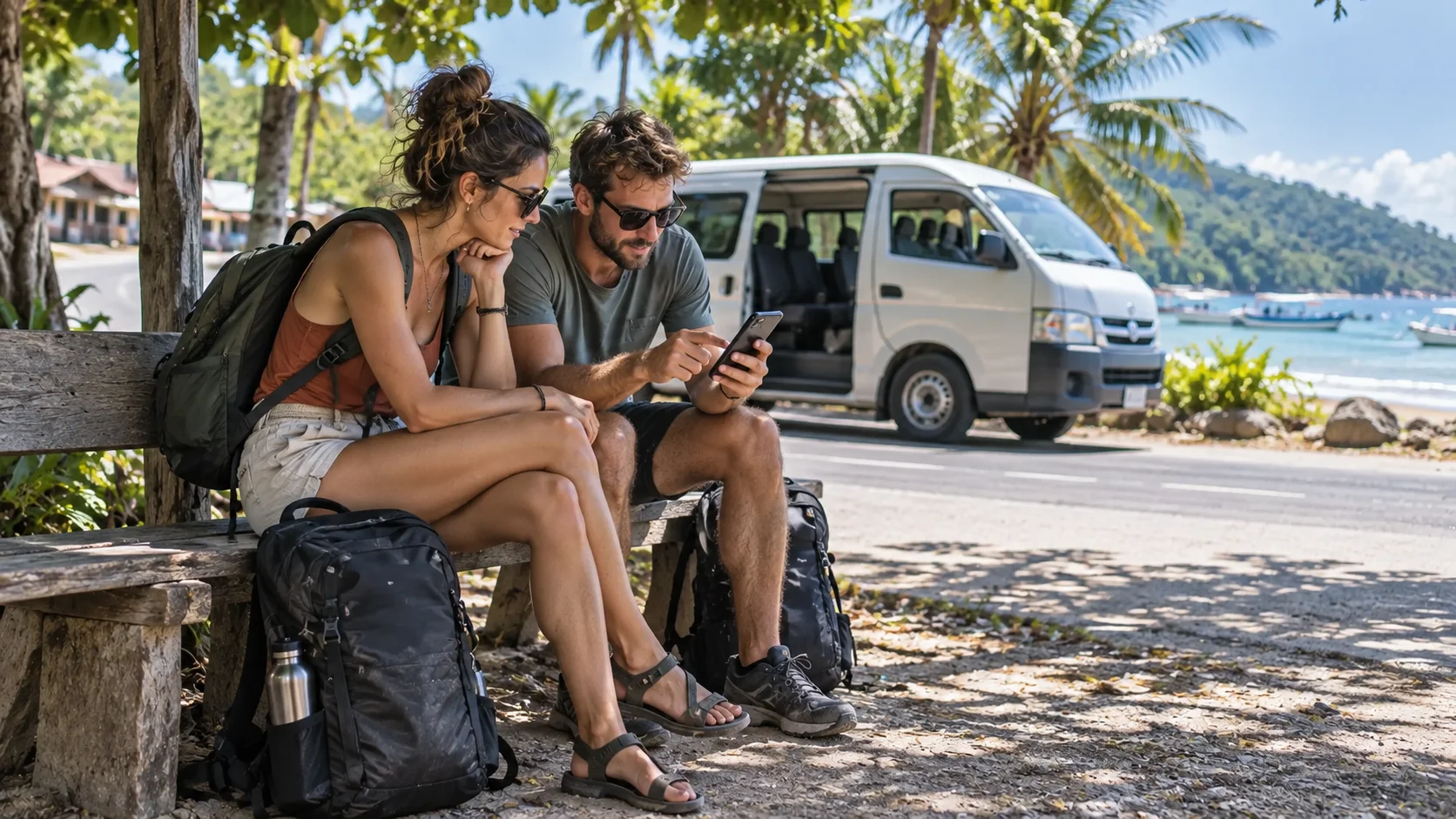
Tamarindo to Santa Teresa is an overland transfer across the Nicoya Peninsula. You do not need to add the Puntarenas–Paquera ferry to the direct road plan described by current operators. Tropical Tours offers shared and private services on this route and explicitly states that no ferry is required; Costa Rica Shuttles Bus describes its private service in the same way. Start with that geography, then choose the departure and vehicle that fit your group rather than copying an arrival route designed for travelers coming from San José.
Both places are beach destinations, but changing between them is still a substantial travel commitment. Treat the transfer as part of the decision to split your stay. If you are choosing the two bases rather than already holding reservations, the Santa Teresa and Tamarindo comparison helps you decide what the move adds to your trip. A new hotel and different surf surroundings may be exactly what you want. The value is less clear if the change leaves almost no time to settle in at the second destination.
Choose the road connection, not a line along the beach
The direct private route described by Costa Rica Shuttles Bus turns inland through Guanacaste and continues toward Cóbano and Santa Teresa. It is not a short coastal highway joining the two beaches. Ask the operator to identify the route planned for your date, especially if you are comparing a transfer with a self-drive itinerary. A road that appears close to the shore on a map is not evidence that it is a suitable shortcut for your vehicle, the weather or the time available.
If a booking result includes a ferry, ask why. It may describe a different itinerary or a broader network connection rather than the direct overland service you meant to compare. A ferry is not inherently a problem, but it changes the sequence and should be an intentional choice. Do not buy a crossing because general Santa Teresa arrival advice mentions one. Your origin is Tamarindo, already on the peninsula, so the relevant transport offer should explain its route from that starting point.
Avoid turning the transfer into an improvised coastal exploration. Beach stops, river crossings or detours seen in someone else's travel video are not part of a confirmed road transfer unless specifically agreed and suitable. For self-driving, get current route guidance from the rental company and respect the vehicle's use conditions. For a hired driver, explain any desired stop before the quote. The person responsible for the journey should be able to decline a proposed deviation without the passengers treating it as a failure to deliver the trip.
Morning departure or more time in Tamarindo?
Tropical Tours currently lists more than one shared departure on this route, including morning and afternoon options. Confirm the actual time for your property and date because the published timetable is not the same as your pickup confirmation. An earlier service gives more room at the Santa Teresa end; a later one lets you keep part of the day in Tamarindo but may move arrival into the evening. Decide which part of the day you value instead of assuming every option produces the same check-in experience.
If you want a final surf before leaving, work backward from the confirmed pickup. Include the return of rented equipment, a shower, packing and checkout. A session that ends at the time you intended to leave the beach does not leave time for those tasks. Ask the accommodation whether you may use facilities after checkout and where bags can remain. Do not arrange the transfer around a promise that you can finish a last wave whenever the vehicle arrives; shared passengers cannot plan around that flexibility.
A later pickup also needs a practical waiting plan. If your room must be vacated earlier, decide where you will spend the gap and how you will keep luggage together. An unstructured afternoon with several bags can be less pleasant than the morning you hoped to preserve. The luggage storage guide concerns Santa Teresa, but the same booking principle is useful when speaking to your Tamarindo host: storage is something the property agrees to provide, not an assumption attached to any reception desk.
For a private departure, request a time with the final arrival in mind. Starting after lunch may be attractive, but ask what it implies for reaching the accommodation and collecting keys. A private driver offers a different schedule arrangement, not a guarantee that traffic, weather and the last access road disappear. If arriving in daylight matters to you, make that priority explicit and allow margin beyond the estimated journey. Do not judge the choice only by how leisurely the checkout feels at the first hotel.
Make the Tamarindo address precise
Use the actual property name, map location and access instructions. A traveler staying in Playa Langosta or elsewhere near Tamarindo should identify that location expressly. Nearby does not automatically mean the same pickup zone or time. If the property has several entrances, agree on the one the driver will use. Ask whether a condominium gate needs advance notice of the vehicle. These small details are easier to resolve while you are still communicating with the host than when the driver is outside the wrong entrance.
Do not book a Tamarindo pickup for a property in another coastal community merely because its marketing uses the Tamarindo name. Provide the address and let the operator quote the service it can deliver. If an extra local ride to a meeting point is needed, include that in the comparison with a private pickup. A cheaper advertised seat can lose its advantage when the first connection is omitted. Confirm whether the proposed meeting point has somewhere appropriate to wait with your bags.
If returning a rental car, coordinate the return office and pickup location as separate pieces. Ask how much time the rental company expects for inspection and paperwork, and complete the return before the transfer's reporting time. A shuttle driver should not be expected to wait while a deposit or damage question is resolved. Conversely, do not return the vehicle at a distant office because it appears close on a map without checking how you and the luggage reach the actual pickup afterward.
Decide what should travel with you
Two surf towns can create a misleading assumption that any board rental or transport arrangement works across both. A board hired in Tamarindo belongs to its rental agreement; returning it in Santa Teresa requires explicit authorization, not a convenient shop found on arrival. Settle the return before booking baggage space for something you may not be allowed to take. If you own the board, send the number, bag dimensions and other equipment details to the transfer provider. Keep the acceptance with your reservation.
Tropical Tours publishes different equipment conditions for shared and private services. Ask for the current rule for the exact option you choose rather than applying a private-service inclusion to a shared seat. Confirm that the board and all luggage fit the assigned vehicle, including any child seat or mobility equipment. The Santa Teresa board rental guide helps if you prefer to rent at the destination. That can simplify this transfer without implying that every board or size will be available without arranging it.
Keep the road-day bag small and useful. Carry water, essential documents and personal items you will need before reaching the accommodation. Pack damp towels and swimwear separately, and collect loose purchases into closed bags. A journey between beach hotels still involves several hours away from either room. If your group needs a planned meal or rest stop, ask about it before departure. Do not assume a shared service can add a restaurant visit chosen by one party halfway through the route.
Compare shared and private totals with the same assumptions
For a solo traveler, a shared seat may fit well when the confirmed departure and addresses work. A couple may also prefer that simplicity. A group can request a private quote and compare the full cost, especially if it has equipment or a particular schedule. The transport guide for couples and groups explains why per-person and per-vehicle prices must be separated. Do not divide a private headline price by your group size until the provider confirms that the quoted passenger allowance includes everyone.
Use the same information in each enquiry: date, people, children's ages where relevant, pickup, destination and luggage. Then ask what is included and what remains extra. A pickup supplement, board charge or additional vehicle for the final entrance changes the comparison. Keep the accepted total and currency in writing. The best quote for your group is the one whose service matches its needs at an understood cost, not necessarily the smallest number displayed before the booking form asks for your details.
For self-driving, compare the whole rental plan rather than only fuel against a shuttle ticket. Consider the rental days you retain, the return location, any one-way arrangement and the access needs at both hotels. A car you want for later regional travel may make sense even if the single transfer costs more. If you plan mostly short local outings after arrival, keeping the car may have a different value. Decide according to your actual itinerary instead of allowing one transfer to determine the rest of the holiday by default.
Settle the final address before leaving Guanacaste
Give the Santa Teresa host the transfer details and ask for the best vehicle access instructions. The driver needs the entrance, not just the accommodation's promotional map location. For hillside stays, use the road-access guide to ask whether the booked vehicle can complete the approach and whether a local connection is necessary. A door-to-door promise should be interpreted through the provider's confirmation of that particular property. Get a clear answer before assuming the road transfer ends beside your room.
Bimba does not serve the Tamarindo–Santa Teresa regional route and is not a way to move suitcases or a surfboard from a drop-off. Finish the arrival with suitable transport for passengers and belongings. Once settled, you can plan short local trips according to the live app boundaries. Keeping those two needs separate prevents a misleading cost calculation in which an incomplete regional transfer appears cheaper because the final luggage journey has not been considered.
Send an arrival window rather than a guaranteed minute, and ask how keys are handled if timing changes. Keep the first meal easy to arrange. The first-evening guide helps you avoid stacking a restaurant reservation, lesson and shopping run immediately after a substantial drive. If you arrive with time to spare, you can choose what to do then. If you arrive later, the room and essentials should still be accessible without requiring the driver to solve accommodation arrangements during the final stretch.
Your confirmation should now describe a complete overland journey: exact Tamarindo-area origin, selected departure, passenger and equipment approval, route arrangement and final Santa Teresa address. Review that before paying and keep the contact responsible for changes. The move works best when it gives you a useful stay at the second beach base and a travel day you can comfortably manage. The direct road connection does not need a ferry added from another itinerary, but it does need proper time and a clear finish.
Make the beach-base change worthwhile
Book the direct overland route that fits your addresses and luggage, confirm the equipment rules and plan the arrival before leaving. Give the second destination enough time to justify moving between beach bases.