
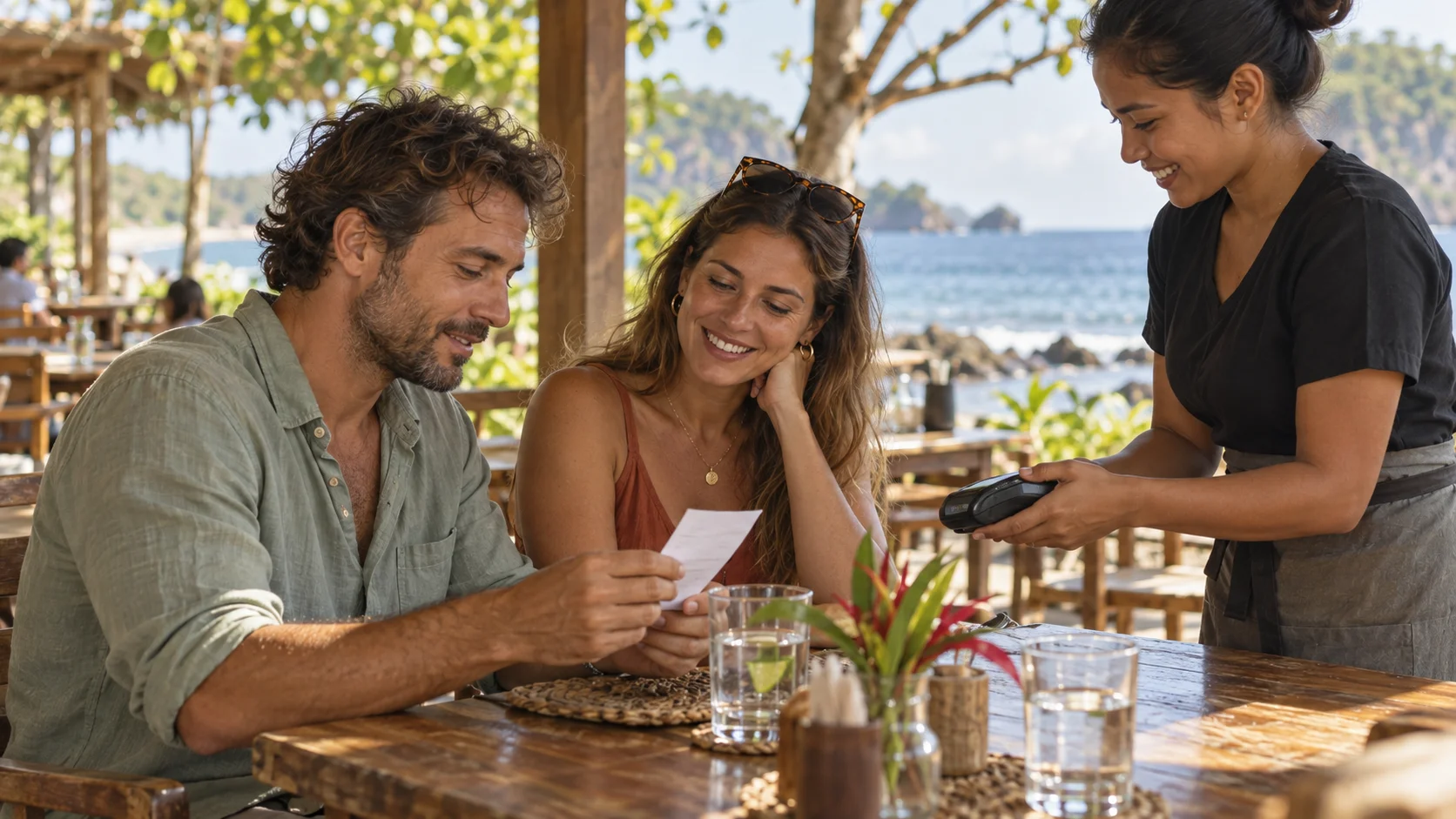
Tipping in Santa Teresa is easier to understand once you separate the restaurant account from an optional gesture of thanks. Ask for the itemised bill, find the service entry and read the amount that the staff member will charge. You can then decide whether you want to leave an additional tip. A familiar payment screen or a custom from another country should not make that decision for you.
The official text of Costa Rica's Law 9116, amending Law 4946, provides a ten-percent charge for service at the table, calculated on the account without sales tax and identified separately as Servicio 10%. It distinguishes that charge from a voluntary additional tip. The Ministry of Labour's published explanation also treats the table-service amount and a voluntary tip as separate concepts. The practical task for a diner is to identify which amount appears on the bill.
Read the menu price before ordering
Look for the menu's explanation of prices and inclusions. Ask staff to clarify the total basis if the wording is unclear. A number beside a dish, a package price and a special-event quotation can present information in different ways. You need to know what you will pay for the meal you choose, including drinks and any clearly stated additional items.
Use a direct question: “¿El precio incluye impuestos y servicio?” This asks whether the price includes taxes and service. If the answer describes additions, ask for the complete total of the order you intend to place. Avoid trying to infer the arrangement from another table's receipt or a menu photograph taken months earlier. Save a photograph of the relevant menu wording if you need to refer to it later.
For a set menu or a group booking, ask the organiser what the quoted amount covers before you confirm. Drinks, a room charge or another event cost may have their own line. The restaurant reservation guide helps organise these questions while staff still have time to explain them. Clear information at the start reduces a difficult calculation at the end of an evening.
Follow the bill from items to total
Read the food and drink entries first. Check quantities, shared dishes and anything cancelled or replaced during the meal. Then identify discounts, tax, service and the final amount. If you cannot follow an entry, ask what it means before you approve payment. Staff can resolve a misplaced item more easily while the order is still familiar to everyone at the table.
The phrase “¿Me puede explicar este cargo?” means “Can you explain this charge?” Point to the entry rather than saying that the whole bill is wrong. If the amount differs from what you understood at ordering, show the menu or reservation message and ask the staff member to reconcile them. A difference needs an explanation; it does not establish dishonesty without further information.
Keep the itemised account separate from the card terminal receipt in your mind. The first explains the restaurant's calculation; the second records a payment. You may need both to understand what happened. If you pay in parts, track the total of those payments so that a receipt for one person's share is not mistaken for the complete table bill.
Use a small calculation to check the service amount
For an illustrative account with a pre-tax table-service base of ₡10,000, ten percent is ₡1,000. That example identifies the service component only. It does not quote a Santa Teresa meal price or calculate the tax due on a real order. To check your own receipt, first ask which amount the restaurant used as the base instead of applying a percentage to a total that already contains additions.
Use the calculator on your phone if the numbers are awkward. Write down the base and the service amount shown, then compare them. If the result does not match your understanding, ask staff to explain discounts, rounding or the calculation. Do not change a bill yourself and assume the restaurant has accepted the revised amount.
The daily-expenses example can help you keep meal spending organised, but use the actual receipt for payment. A travel budget is an estimate. A current bill contains the items and applicable charges for the meal you ordered. Keeping those purposes separate avoids importing a planning percentage into a transaction with different inclusions.
Make an intentional decision about an extra tip
After understanding the account, decide whether you want to give something extra and how much. You do not need to reproduce a percentage customary at home. You can choose an amount that reflects your own appreciation and budget. Avoid allowing a suggested button on a screen to replace reading the restaurant account and deciding for yourself.
If you want to leave cash, tell the staff member which amount is payment and which is the extra. With a card, ask how the restaurant handles an additional voluntary amount before authorising it. The Ministry of Labour discusses card payments in its explanation of tipping, but that does not establish the operational options of the terminal in front of you. Ask the venue what it can process and keep the receipt.
A helpful phrase is “Esto es una propina adicional”, meaning “This is an additional tip.” Use it only when that is what you intend. If you simply hand over more cash to obtain change, say so. Clear communication helps distinguish an intended gift from a payment that still requires change, particularly when several people hand money to the same server.
Handle a split bill without counting an extra twice
Agree within the group whether you will divide the complete account equally or pay for individual orders. Shared food and drinks need an allocation too. Ask the restaurant early whether it can prepare separate accounts or accept several payments. A large group deciding this after the terminal arrives can create confusion even when the original bill is correct.
In an illustrative equal split of a final ₡30,000 account among three people, each person's share is ₡10,000. If the account already contains its stated charges, splitting it does not create a new charge to add to each share. Any voluntary extra needs a separate group decision. This is an arithmetic example, not a quotation of a meal or a statement about how a venue must split payments.
Nominate one person to track contributions if the group pays one combined amount. Record who paid by card, who supplied cash and whether a person has already included an extra. Count the contributions against the agreed total before passing them over. The small-group travel guide can help organise other shared costs, but keep the restaurant calculation visible to everyone paying for this meal.
Confirm currency and the amount on the terminal
Check the currency on the menu, bill and payment device. If a venue offers a conversion, ask which amount will reach your card and what rate or conversion applies. Your card provider's terms govern its own charges. Do not confuse a currency difference with an extra tip, and avoid assuming that a familiar currency symbol identifies the same currency at every stage.
Read the terminal total before entering your PIN or otherwise authorising the payment. If the device shows an amount you did not expect, pause and ask staff to explain. After payment, compare the receipt with the amount you authorised. Keep enough information to identify the transaction without sharing your full card number or security details in a message to the restaurant.
For cash, count the notes together with the change and say the amount you are handing over. The cash and ATM guide helps plan access to money, while the trip budget guide helps keep discretionary extras within your spending plan. Neither requires carrying a fixed tipping allowance or accepting an unexplained conversion at the table.
Ask about takeaway and counter service on their own terms
A takeaway pickup, counter order and seated meal can involve different service arrangements. Explain how you are ordering and ask what each charge represents. Do not infer the applicable treatment merely because the business has tables somewhere on the premises. A delivery-platform fee may also use a different description from a restaurant's service entry.
If you ordered at a counter and the receipt surprises you, ask the manager to explain the service performed and the calculation. Keep the order record and itemised bill if you need further advice. This guide does not decide a disputed transaction from a brief description; the relevant authority can assess the facts and the applicable rules.
The guide to comparing complete inexpensive meals is useful here because a posted food price may not capture your complete purchase. Compare the final quoted amount for the service you want. Keep delivery, packaging or another disclosed item identifiable rather than grouping unfamiliar lines together under the word tip.
Resolve a discrepancy with a clear record
Start with the restaurant while staff can review the order. Describe the specific item or amount and the correction or explanation you are requesting. Ask for a revised account if they identify an error. Retain the original record and the corrected one so that you can understand the final payment later, especially if your bank displays a pending transaction before a settled one.
If the issue remains unresolved, write a short factual timeline with date, venue, order, amount shown and amount paid. Add the relevant menu or booking message and receipts. Avoid publishing personal information about employees or other diners as part of the complaint. The Ministry of Economy, Industry and Commerce offers an official consumer-advice channel where you can ask about the appropriate next step.
Use the authority's current instructions for any formal process, including eligibility and required documents. A general travel guide cannot promise a refund or determine a legal outcome. The useful preparation is an accurate record and a precise description of the disagreement. For an ordinary meal, reading the bill and clarifying the payment before authorisation often keeps the question small enough to resolve at the table.
Read first, then choose any extra
Identify the itemised service charge, clarify the total and authorise the amount you understand. Decide on an additional tip afterward, and keep the bill and payment receipt if a question remains.