
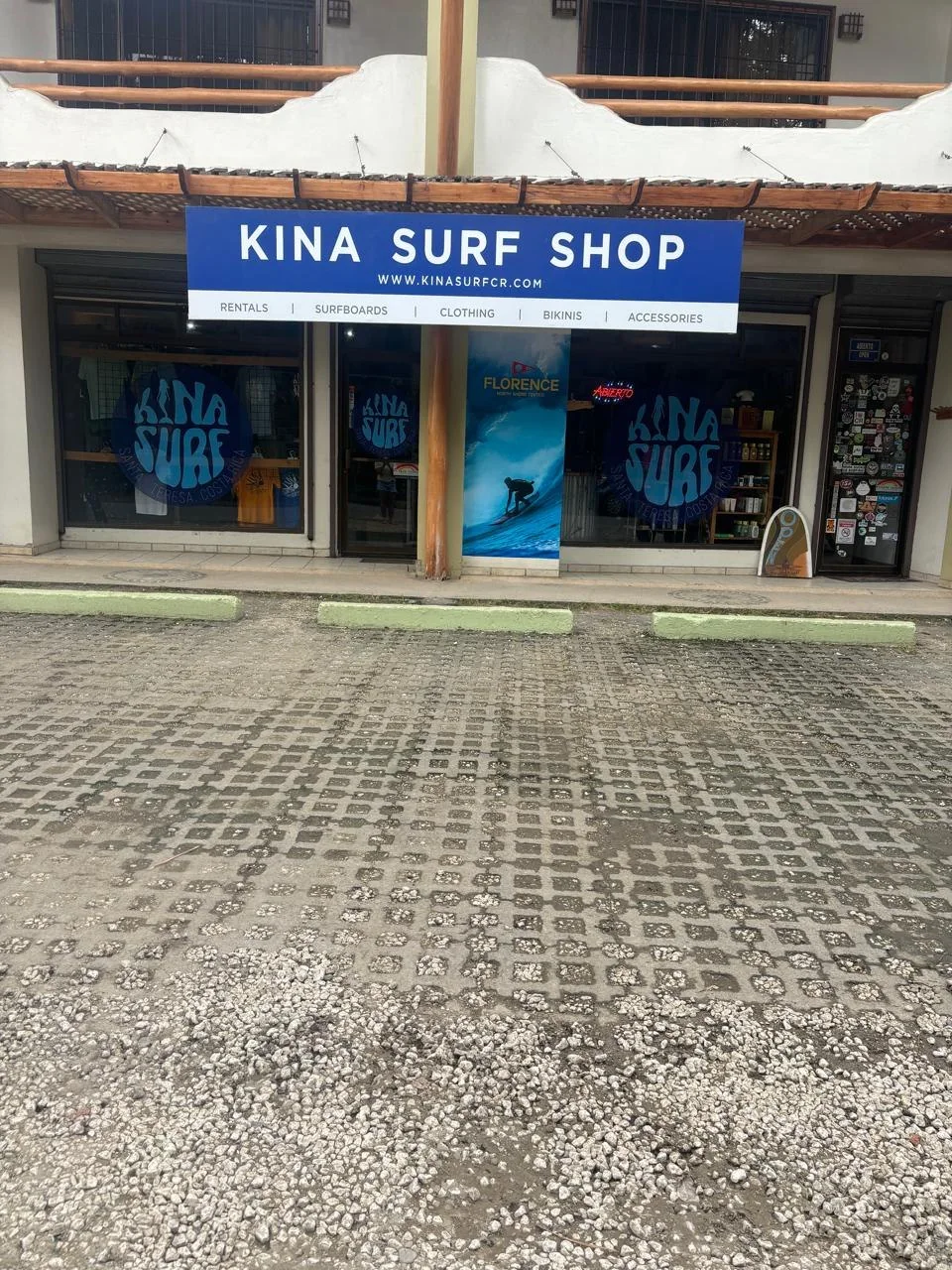
Kina Surf Shop storefront in Santa Teresa. Image source: View original photo.
Buying a used surfboard in Santa Teresa starts with two separate decisions: whether ownership fits your trip and whether the individual board is worth buying. A low asking price answers neither question. You need a suitable shape, an honest account of repairs, somewhere to keep it and a plan for departure. A board you cannot transport or sell may cost more than the rental you hoped to avoid.
Kina Surf Shop's own website confirms that it sells new and used boards in Santa Teresa. That gives you a direct local contact to ask about current stock. It does not establish a particular model, price, return policy or buyback offer. Start with your requirements and ask for photographs of available boards before travelling across town to inspect one.
Decide whether ownership fits this stay
Count the days you expect to surf, allowing for other plans and your own energy. A two-week holiday does not necessarily mean fourteen sessions. Compare the complete cost of buying with a confirmed rental quotation for the days you need. The surfboard rental guide helps separate rental duration, storage and equipment handover from the ownership decision.
Ownership gives you continuity with one board and responsibility for its care. Rental may offer a different arrangement, such as returning the board after a short period, but do not assume swaps or damage terms. Ask each business what applies. If you are still discovering which shape works for you, a short period with suitable rental equipment and an instructor may be more useful than an immediate purchase.
Consider your remaining route through Costa Rica. A board can be convenient during a settled beach stay and inconvenient during a sequence of hotel changes. The monthly-stay checklist can help you discuss secure space with a host. Tell the host the board's length; a vague promise of storage may refer to a small locker or an area that other guests use.
Give the seller a useful brief
Describe the board you currently ride, your approximate experience and the type of session you want. Include the problems you are trying to solve. “I need something that lets me catch more waves while I practise going along the face” is more useful than naming a professional surfer's board. An instructor who knows your surfing can help narrow the search without relying on the seller to assess you from a short conversation.
Record length, width and thickness, plus volume where the board has a reliable marking. Photograph the dimensions and any model or serial information. Numbers help identify a board, but they do not replace an assessment of shape, construction and your ability. Two boards with similar volume can feel different. Avoid choosing only because one fits a numerical chart.
Ask what comes with the sale. Fins, leash and bag can change the total cost, and fin systems need compatible parts. Global Surf Industries notes that fin inclusion varies by product, which is a useful reminder to check the actual item in front of you. Obtain a separate price for missing equipment before comparing one seller's board-only price with another seller's complete package.
Inspect in daylight with the board dry
Arrange a place where you can see the deck, bottom, rails, nose and tail without rushing. Ask the seller to show the board dry. Water and a quick photograph can make surface detail difficult to judge. If wax conceals an area you need to inspect, ask the owner to expose it with an appropriate method. Do not scrape or press hard on someone else's property without permission.
Look along the length of the board from more than one angle. Note changes in surface level, visible cracks, discolouration and repaired areas. A mark does not automatically mean the board is unusable, but it gives you a specific question. Ask where it happened, who repaired it and whether the seller has photographs from before the repair. Write the answers beside photographs of the relevant area.
Check the fin boxes and leash attachment with the seller. Ask them to demonstrate fitting the included fins and identify any movement or damage they know about. Do not force unfamiliar hardware. If you cannot distinguish a cosmetic mark from a problem affecting the board's structure, pay for a knowledgeable repairer's assessment or choose another board. A visual checklist cannot certify a board's condition.
Turn repair history into a price decision
Ask the seller to identify all known repairs, not only the most visible one. Compare that account with what you can see. A clear history lets you ask better questions; an evasive answer leaves uncertainty you should include in the decision. You do not need to prove that a seller is wrong before declining a purchase that you cannot assess.
Get a repair estimate before paying if the board needs work. Ask about the proposed repair, drying requirements and the date it could be ready. A cheap board awaiting repair may use up the surf days you came for. The right comparison includes the purchase, repair and time without equipment. Avoid assuming a quick patch will be sufficient for damage you have not had assessed.
Follow the manufacturer's material guidance for the actual board. Firewire, for example, specifies epoxy-compatible repairs for its boards and warns against riding damaged equipment that can take in water. That advice does not identify the construction of an unlabelled second-hand board. Ask a qualified repairer to establish the material before choosing products or accepting a home repair as appropriate.
Calculate a conservative ownership cost
Use a simple working total: purchase price plus missing accessories, necessary repairs and board-specific transport. Add storage if your accommodation charges for it. Keep potential resale income in a separate line. You can compare an optimistic scenario with a no-sale scenario, but budget so that a failed resale does not disrupt your onward travel.
For an illustrative example, imagine two boards with the same asking price. One includes compatible fins and needs no identified immediate work; the other lacks fins and requires assessment of a repaired area. Their advertised prices match, but you do not yet have comparable offers. Obtain the missing costs and condition information. This example uses no local market price and makes no claim about which board will last longer.
Compare costs in the same currency and note any payment conditions before handing over money. A receipt should identify the board and included items, the amount paid and the seller. Agree on the actual handover. Keep the record with your photographs. The trip budget guide can help you reserve money for equipment without treating an uncertain future sale as cash already available.
Read trial, return and buyback promises as separate terms
A seller may permit a trial, offer a return arrangement or discuss buying the board back. These are different promises. A trial needs an agreed duration, permitted use and responsibility for damage. A return needs a deadline and clear conditions. A buyback needs a price or a calculation method and an explanation of how condition at return affects it.
Do not interpret “you can sell it again” as a guaranteed repurchase. Ask who would buy, whether they have committed and what documentation confirms the arrangement. If the seller offers consignment, ask about commission, payment timing, how long the board can remain and what happens if you leave Costa Rica before a buyer appears. No such service is assumed here for Kina or another shop.
Take time to understand the terms in the language you prefer. If the conversation changes from a sale to a deposit or reservation, have the seller specify what the payment secures. Avoid transferring funds merely because a photograph looks convincing. Confirm the board, the seller and the agreed collection before completing the transaction.
Arrange care and transport before collection
Ask your host where you may rinse and store the board, and how to avoid blocking shared passages. Follow the manufacturer’s care instructions for the model you buy. Firewire and Global Surf Industries both advise protection from heat and prolonged sun exposure. A board bag is useful equipment, but it does not make a parked hot vehicle an appropriate storage room.
Measure the board for any transfer and explain its size when booking. Ask the driver or transport company to confirm the carrying arrangement and any charge. Do the same for onward flights under the airline's current sports-equipment rules. Do not assume that an ordinary baggage allowance includes a surfboard. Resolve the complete route before buying a board you plan to take home.
For the local handover, use suitable transport or an agreed collection arrangement at the surf location. Do not carry a board on a shared scooter or e-bike. The guide to surf lesson transport discusses coordinating equipment with a provider, while the shopping guide helps plan other purchases around the same outing without making the load impractical.
Prepare an honest resale listing
Start early enough to inspect the board again, photograph it and answer questions without a departing shuttle waiting outside. State its dimensions, model where known, included accessories and the repairs you know about. Show recent photographs of the actual board. If you damaged it during your stay, disclose that and describe any professional work completed afterward.
Choose a price based on the item and your time constraints, not a promise that travel boards retain a fixed percentage of their value. A later buyer will make the same condition and cost calculation you made. Arrange a sensible handover with time to inspect and verify payment. Keep a fallback plan: take the board onward under confirmed transport terms, or agree on another lawful transfer with a willing recipient.
Buy only after you can answer three practical questions in full: the board suits your present surfing, you understand its condition well enough to accept the cost, and you can care for it through departure. A well-documented ordinary board can be a better purchase for your trip than an exciting bargain with unresolved damage or an impossible journey home.
Price the whole ownership period
Compare board condition, accessories, repair time and transport before paying. Buy a suitable board you can afford to keep, with clear written terms for any promised return or buyback.