
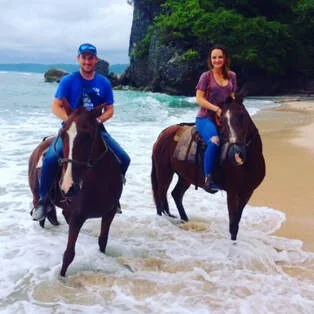
Riders pictured by Ollie’s Adventures. Image source: View original photo.
Horseback riding around Santa Teresa can combine coastal scenery with inland trails, but the best booking begins with the rider and the horse. A short, well-matched outing may suit a beginner better than a longer route with a more dramatic description. Experienced riders also benefit from choosing the correct format instead of joining a group that expects a gentle introduction.
Ollie’s Adventures provides direct information about several local riding products. This guide uses those published distinctions as a starting point, alongside equine-welfare guidance from Brooke. It is not a firsthand assessment of the operator or a guarantee about any individual horse. Use the information to arrange a ride whose pace, duration and care you understand before arriving.
The published ride formats differ
Ollie’s lists a two-hour beach, jungle and mountain group ride, with advertised departures at 8 a.m. and 3:30 p.m. It also offers private arrangements for experienced riders and families, while its longer Manzanillo beach-and-farm ride is labeled for advanced riders. Its swimming-with-horses product was marked unavailable when checked on October 21, 2026.
The practical comparison is between duration, group composition and the riding experience required. A longer outing is not automatically better value for someone who rarely rides. Time in the saddle can be demanding even when the horse walks. Describe your recent experience and let the operator explain which format matches it.
For a mixed group, start with the least experienced person’s needs. If one traveler wants a faster ride and another is nervous about mounting, a shared booking may disappoint both. Separate arrangements can make more sense than asking a guide to deliver incompatible experiences during the same outing.
Describe experience with concrete examples
Tell the operator when you last rode and what kind of riding you did. A guided walk several years ago is different from regular lessons or independent trail riding. Avoid using advanced because you once cantered on holiday. Honest information helps the operator choose the horse and the structure of the session.
Explain whether you are comfortable mounting, following instructions and spending the proposed time in the saddle. If you need help getting on or off, discuss the arrangement before arriving. The operator should know about requirements that affect participation, while any health-related decision belongs with an appropriate professional rather than a tour description.
For experienced riders, a private booking can create more room to discuss pace, but it does not grant permission to ride however you choose. The guide must account for terrain, conditions, the horse and other people on the route. Agree on expectations before payment and accept that the actual ride may need adjustments.
Read the rider limit and booking conditions
Ollie’s published terms set a 95-kilogram rider limit and require a 20% deposit to confirm. They specify written cancellation notice of one week for November through April and 48 hours for May through October, with booking or card fees excluded from the stated deposit refund. Reconfirm these terms for your travel date before paying.
Give accurate information when the operator asks about rider size. A limit is part of matching the load to the animal and service, not an invitation to negotiate at the stable. If the available horses or conditions do not suit you, choose another activity. Do not conceal information because other members of your group have already booked.
Compare the complete quote, including the guiding arrangement and payment method. The operator distinguishes cash website prices from card charges. Ask for a total in the currency you will use, and keep the written booking confirmation. A deposit receipt should connect clearly to your date, party size and chosen ride.
Put horse welfare into the decision
Brooke encourages travelers to consider animal welfare before riding, including suitability for the rider’s weight and how the operator handles unexpected problems. Its holiday code advises one rider per animal and avoiding animals with sores or wounds. These are useful principles for selecting an activity; they do not replace a veterinary assessment or establish that a particular business meets every standard.
Ask how horses receive rest, water and appropriate care, and how staff decide which animal carries which rider. Ollie’s describes a work-and-rest rotation on its own site. Treat that as the operator’s stated practice, not an independent welfare certification. Look for clear answers and observe how staff handle the horses when you arrive.
If something concerns you, pause before mounting and explain the concern. You do not have to proceed simply because the rest of the group is ready. Avoid making unsupported diagnoses from a photograph, but do not ignore an obvious wound or rough handling. If you witness mistreatment, document the relevant details and report through appropriate operator or authority channels.
Children need a specific arrangement
A family private ride can allow a different pace and more attention, but the word private does not establish that every age can participate. Give children’s ages and riding experience when enquiring. Ask how each child will ride, what supervision the guide provides and whether the available protective equipment fits.
Do not assume an adult and a small child should share a horse to simplify the booking. Discuss a suitable arrangement consistent with the operator’s limits and the animal’s welfare. If a child is not ready to ride independently under the offered format, another activity may be the better choice for that day.
Use our Santa Teresa family guide to plan the rest of the day around the outing. Leave time for preparation and a calm return rather than putting a tired child straight into another timed activity. A shorter appropriate ride can be more enjoyable than completing a route chosen for the adults’ preferred scenery.
Confirm the route without assuming reserve access
Tour descriptions can use beach names, nearby landmarks and protected-area references loosely. Ask the operator to identify the actual route and which sections are currently permitted. A commercial description mentioning Cabo Blanco does not, by itself, verify horseback access inside the reserve. We have not independently confirmed that access and do not recommend treating it as included.
Our Cabo Blanco visiting guide covers the separate reserve visit. If a protected area is the main reason you want the ride, resolve that detail directly with the responsible authority before purchasing. Otherwise, choose a route you understand without relying on an ambiguous reserve claim.
Also distinguish a general coastal ride from a guaranteed sunset or wildlife encounter. Conditions and the route can change the view. Choose the activity because you want a guided ride, with scenery as part of it, rather than expecting the operator to reproduce a specific promotional image.
Prepare for the riding arrangement
Confirm helmet provision and suitable sizes before booking, especially for children. Ask the operator what footwear and clothing it requires, and follow its guidance. Long trousers and secure footwear may be practical choices, but the particular riding setup should determine what you wear. Do not arrive in beachwear assuming a stable can supply everything.
Keep belongings limited and ask how to carry water. A loose bag, unsecured phone or dangling accessory can interfere with the activity. Arrange photographs through the guide’s instructions instead of trying to manage a device while learning to control the horse. A photo stop should not require you to improvise handling.
Our packing guide helps with the broader trip. For this outing, the most useful preparation is a small set of appropriate clothing and a clear equipment agreement. If you cannot meet the requirements with what you brought, resolve the gap before the departure rather than at the moment of mounting.
The shop and stable are different meeting possibilities
Ollie’s booking page publishes separate map links for its shop and horse stables. That makes the exact meeting point an essential part of the confirmation. Ask which location applies to your ride and whether any transfer is included. A general business address is not enough if the horses depart elsewhere.
Save the map and contact channel before leaving. Allow time for arrival, matching and instructions in addition to the advertised riding duration. If a two-hour ride is listed, do not assume you can arrive exactly at departure and leave exactly two hours later for another reservation. Preparation belongs in the day’s schedule.
The day-trip planning guide can help avoid an overloaded itinerary. A local ride still deserves a clear time block, especially if your accommodation is far from the stable. Arrange the return journey as well as the outward trip, and do not use a tour listing as evidence that a venue is a Bimba parking station.
Weather and route changes need a fair plan
Ask how the operator handles conditions that make the intended route unsuitable and who decides whether the ride proceeds. During the rainy season, that conversation should cover the route and access to the meeting point. A change in scenery can be reasonable if it protects riders and horses, but you should understand the alternative.
Distinguish your cancellation from an operator cancellation. The written terms for a traveler changing plans may not explain what happens when the operator stops a ride. Ask whether the remedy is a different date, another route, credit or refund. The answer matters if you are leaving the area the following morning.
Have an alternative that does not involve horses if the suitable ride is unavailable. Our non-surf activity guide offers options. Choosing another plan is a sensible outcome when the horse-and-rider match, weather or agreed conditions do not work.
Our choice for a first-time rider
For a beginner, we would prioritize a manageable duration, clear instruction and a group or private format that fits the participant. For an experienced rider, we would discuss a private outing without assuming a faster pace is guaranteed. In both cases, welfare and honest communication come before the route’s marketing language.
A useful confirmation names the ride, riders, meeting point, equipment, total and cancellation arrangement. Keep it with the operator’s current terms. The right tour gives you a riding experience you understand and a reasonable basis for deciding that the horse’s care belongs at the center of it.
Match the ride to the rider and horse
Choose a manageable duration and disclose experience and rider size accurately. Confirm the stable meeting point, equipment and terms, and treat welfare questions as part of choosing the activity.