
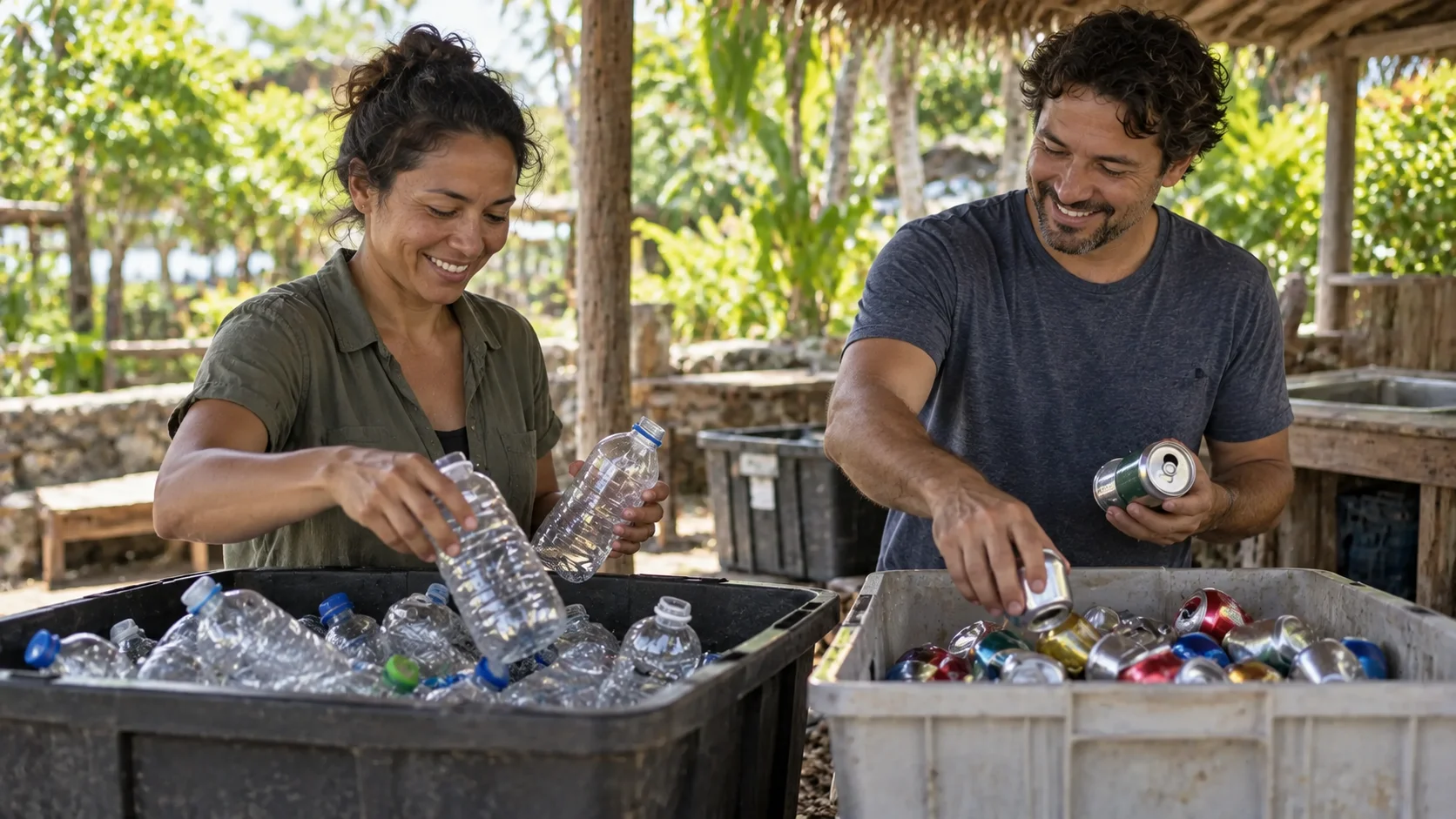
Recycling in Santa Teresa works best when you learn the accommodation’s system before the first shopping trip. A bottle, a beverage carton and a cardboard food box may all look recyclable, yet they do not necessarily have the same local destination. The practical question is who will receive each material and under which conditions. An appealing recycling symbol cannot answer that on its own.
Nicoya Peninsula Waterkeeper operates a regional program with BIONIC and describes a processing center at Vivero Lacón in Cóbano. Its published collection coverage includes Santa Teresa, Mal País, Carmen, Hermosa, Cóbano, Montezuma and nearby communities. That establishes a local system, but it does not establish pickup at every rental address. Guests should connect with the arrangement already used by their host rather than leave bags beside the road and hope a truck recognizes them.
Start with the person managing your accommodation
Ask where clean recyclables go, whether categories need separate containers and who moves them to collection. A kitchen bin with a recycling label may be only an intermediate storage point. The housekeeper or host often knows what actually happens next. Request the instructions in a message if several guests will be using the kitchen, so everyone follows the same system during the stay.
Clarify the last collection before checkout. A weekly route can fall after you leave, and the host may have a secure place to store prepared materials. Leaving a mixed bag on the kitchen floor is not a handover. Agree on the final location and keep food waste separate. This is particularly useful in a self-catering stay in Santa Teresa, where several days of cooking can produce more packaging than a hotel room does.
For a longer rental, ask whether the address is already connected to the program and whether any service arrangements require the owner’s involvement. Do not register someone else’s property or change its pickup instructions without their knowledge. Your task as a guest is usually simpler: prepare the material correctly and leave it where the responsible person has agreed to receive it.
The material categories published locally
Waterkeeper’s project page, checked on October 21, 2026, lists plastic, aluminum and tin cans, glass and beverage cartons among collected categories. Read that as a category list rather than approval for every object made from those materials. A drink bottle and a broken plastic chair are not equivalent collection items. For an unfamiliar package, ask about its exact form and condition before adding it to the load.
The distinction matters at the supermarket. A carton designed for milk or juice is different from ordinary cardboard packaging, even when both feel paper-based. A thin wrapper, a rigid container and a multilayer pouch can also require different treatment. Do not transfer assumptions from your home city to Santa Teresa. Use the receiver’s instructions and keep an uncertain item aside while you obtain an answer.
Our Santa Teresa supermarket guide helps plan the purchase itself. Add one practical check before filling the basket: can your group finish the contents, and does the accommodation have a destination for the packaging? A larger package is not automatically a better choice if half the food will be discarded at checkout. Buying to match the stay reduces both food waste and the amount that later needs sorting.
Clean and separate at the source
Waterkeeper’s own account of the recycling operation explains that dirty, mixed material increases handling costs and affects workers. The useful response is to separate while the container is still in your kitchen. Empty it fully, remove ordinary food residue as the local system directs and keep it apart from general rubbish. A bag of clean containers becomes harder to process once leftover food has been tipped into it.
Set up a small, obvious station instead of relying on everyone to remember a conversation. You might use the host’s labeled containers and a separate place for items awaiting clarification. Keep the arrangement out of rain and away from animals. If the accommodation provides only one container, ask how the internal separation should work rather than inventing a system that the collection team will have to undo.
Use water thoughtfully when preparing packaging. Emptying and a modest rinse of ordinary food residue is different from trying to decontaminate a container that held chemicals. The latter requires specific disposal guidance. Do not pour unknown liquids into a sink simply to create a clean-looking recyclable. Ask the host or program contact where that item belongs and leave it clearly identified.
Glass needs a manageable container
The organization specifically identifies very heavy glass bags and mixed broken glass as problems for workers. A visitor can avoid creating that problem by keeping intact bottles in manageable quantities and following the host’s approved container method. Do not force bottles into a thin bag until it becomes difficult to lift. Whoever carries it next should not have to discover the weight or a hidden sharp edge unexpectedly.
If glass breaks in the accommodation, tell the host and follow their disposal instructions. Broken drinking glasses, ceramics and ordinary bottles should not be treated as one interchangeable category. Keep people and pets away from the area while it is addressed. A brief message about what broke and where it has been contained is more useful than hiding fragments inside the recycling.
Do not break bottles to save space. Likewise, do not crush an unfamiliar object because it resembles a recyclable container. Preparation should make handling easier without creating a new hazard. When the storage area is full, tell the responsible person early. A short stay does not justify balancing extra glass beside a container where someone could knock it over.
Cardboard, electronics and bulky waste need another answer
In a 2023 explanation of its operation, Waterkeeper explicitly named cardboard, electronics, scrap and construction material among items it could not process through that center. The date matters: use the current receiving instructions if they have changed, but do not assume these materials are accepted merely because they are recyclable elsewhere. The organization also distinguishes bulky waste from ordinary municipal collection.
A broken charger, a damaged suitcase or a discarded beach chair needs a specific destination. Ask the accommodation manager before leaving it behind. Describe the object rather than using the broad word recycling. If an appropriate collection campaign exists, check its date and material list. A campaign for electronic devices does not mean a public station accepts them at any hour throughout the year.
For a rental group, this is a reason to resolve damaged equipment before the final morning. A broken cooler discovered at checkout can become someone else’s disposal problem. Report it when it happens and agree on the next step. Our Santa Teresa shopping guide may help with local purchases, but buying a replacement does not resolve the destination of the damaged item.
Special collection points accept specific things
The ecoins Costa Rica directory lists a medication collection point at Pharmacy & Medical Doctor Santa Teresa, opposite Café Mafras, and another at Waterkeeper in Plaza Kahuna. Those directory entries were visible when checked for this guide. They are material-specific listings, not proof that either location receives household bags, electronics or all hazardous waste. Confirm the item and current acceptance before taking it there.
Keep medication separate from ordinary recyclables and ask the listed receiver how it should be presented. Do not empty tablets into a bottle-recycling container or pour liquid products into drains. A collection point may have limits on packaging or item type. The staff receiving it should give the applicable instructions; a travel article cannot establish the appropriate route for every pharmaceutical product.
The same logic applies to batteries and other special items: find a receiver that explicitly accepts them. A nearby recycling sign is insufficient. If no verified local destination is available during your stay, discuss responsible storage or onward handling with the host. Avoid leaving unidentified material for cleaning staff to discover after departure.
Verify the route for your actual address
Waterkeeper publishes a link to weekly collection information, but the route image could not be verified during this research. We therefore do not reproduce a weekday or roadside pickup time. Older articles and shared graphics contain schedules that may no longer apply. Use the current official contact, ariadnawaterkeeper@gmail.com, together with your host’s arrangement to establish where and when materials should be handed over.
Do not treat the office in Plaza Kahuna and the processing center in Cóbano as interchangeable. One is an office location mentioned in the organization’s participation information; the other is part of the recycling operation. Neither statement establishes unrestricted drop-off hours for every material. Before making a special trip, confirm the receiving location, access and whether the quantity you have can be accepted.
A station that is full or damaged is not a reason to leave bags alongside it. Contact the operator or host for the next step and keep the material securely stored in the meantime. If a storm is approaching, exposed bags are particularly poor storage. Our guide to Santa Teresa in the rainy season provides wider travel context, but the waste arrangement still needs a protected place at the property.
Beach plastic is a separate task
Material collected from the shoreline can require a different sorting and recovery process from packaging used at home. If you join a Santa Teresa beach cleanup, use that event’s instructions. Do not add unknown beach debris to the accommodation’s ordinary recycling without agreement. A project capable of processing some weathered plastic does not automatically accept every object you find.
For daily life, the easiest improvement often happens before disposal. Carry a reusable shopping bag, refill a suitable water container where drinking water is provided and avoid taking utensils you do not need. Choose habits that fit the trip instead of buying a collection of new accessories you will not use. Reuse what you already brought when it is suitable for the purpose.
Our recommendation is a simple sequence: learn the receiving arrangement, separate correctly and complete the handover before leaving. Ask a precise question when an item falls outside the routine categories. Visitors do not need to become waste-management specialists, but they should avoid making uncertainty invisible by placing everything under a recycling label.
Follow the receiving system
Learn your host’s arrangement before shopping, keep accepted materials clean and separated, and resolve unusual items before checkout. Do not leave bags at a station without confirming their destination.