
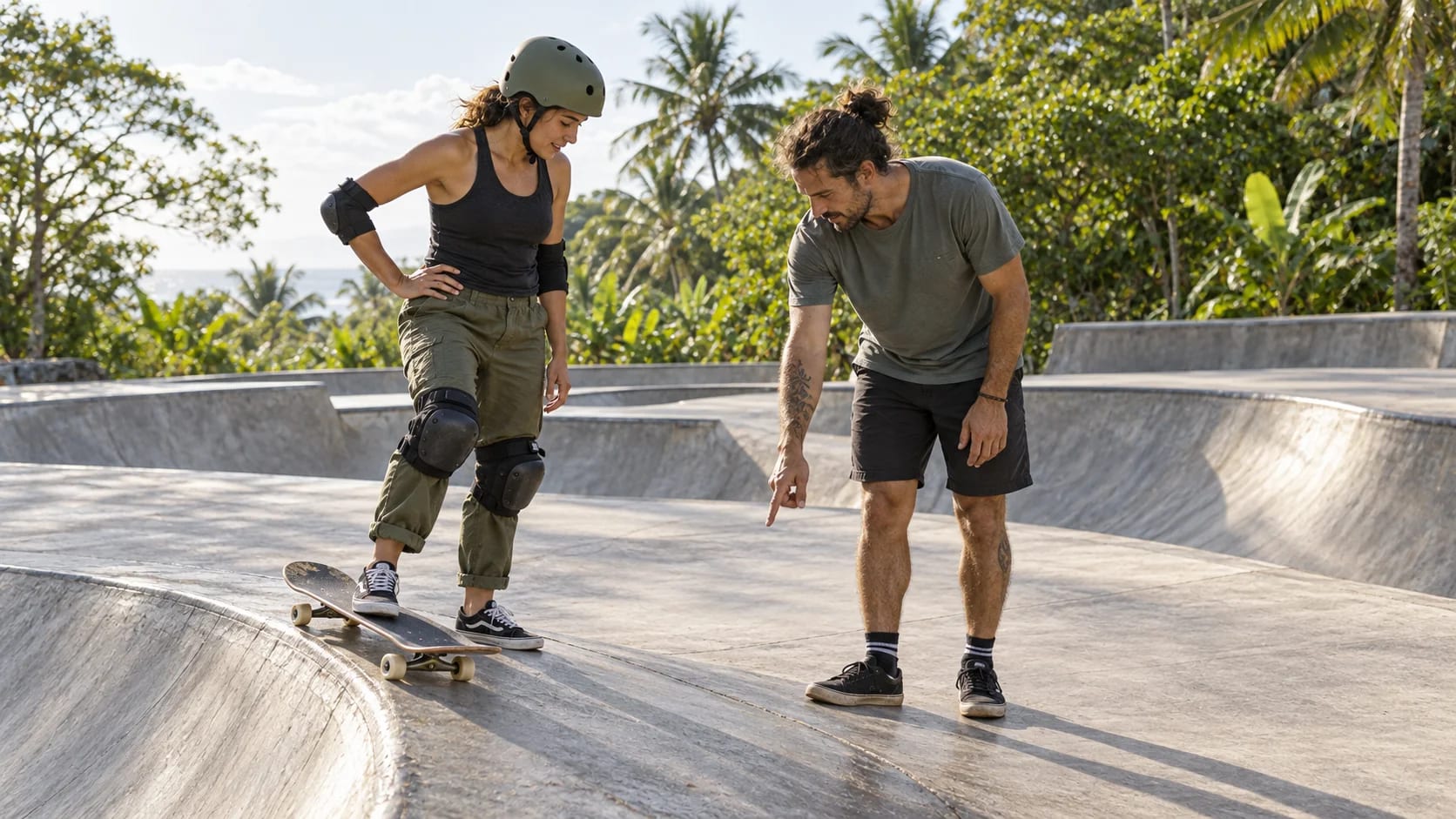
Santa Teresa’s community skatepark is a place to bring an existing interest in skating or arrange a considered first lesson. It is not a staffed activity desk where a visitor can assume that a board, protective equipment and an instructor will be waiting. Planning those pieces separately makes the visit much easier, especially if you are traveling with children or trying a surfskate for the first time.
The useful starting point is the community park near the football field. Search results also describe private parks, hotel facilities and old events elsewhere in the area. They should not be treated as one interchangeable attraction. Confirm the exact park before arranging transport or meeting someone for a lesson.
Find the community park near the football field
Concrete Disciples lists Santa Teresa Skatepark at 20 meters west of the football field. Charlie on the Move’s June 2024 account also places the community park behind the field in the northern part of Santa Teresa. Use the field as the local reference, then verify the entrance on arrival rather than following a vague listing for any skatepark in town.
The current indexed Skatedex entry describes a free outdoor concrete park. Treat that as directory information, not a promise of round-the-clock access, staffed services or unchanged rules. Posted notices and current conditions at the park should guide the visit. We have not verified an official daily timetable or a permanent on-site equipment-rental service.
Save the location before leaving your accommodation. If someone is meeting you, use the specific park name and the football-field reference in the message. Saying only skatepark can send two people to different places. That matters even more when a lesson has a fixed start time and the instructor has another booking afterward.
Understand the layout before joining a line
The published visitor account describes a compact arrangement with ramps at different heights, flat ground and a half-open bowl. Those features suggest several possible ways to use the space, but a written description cannot establish the condition of an individual edge or surface today. Walk around the outside and observe before putting the board down.
Watch where skaters begin and where their lines finish. A flat section that appears empty may be the exit from a ramp or bowl. Standing there to discuss a trick can obstruct someone who is already moving. Choose a place for bags and conversation outside the active paths, and ask a regular where people normally wait.
A beginner should not select the tallest feature because another person makes it look effortless. An experienced skater may use speed and transitions that require skills you have not practiced. Start with terrain you can manage, and use qualified instruction for unfamiliar techniques. This guide does not teach drop-ins or other maneuvers.
A first session should have a clear teaching plan
If you have never skated, arrange a lesson before assuming the community park is the right place to start. Tell the instructor your age, previous board experience and what you want to learn. Ask where the first session takes place and whether that location is suitable for learning basic control without crossing busy lines.
Surfing experience does not establish skateboard control. The surface, stopping and equipment differ, and confidence in one activity can lead you to underestimate the other. Describe your actual skating experience rather than saying you are athletic and will work it out. A good introduction begins with the skills you have today.
For friends with mixed abilities, avoid asking the strongest skater to supervise everyone while also practicing their own session. Either separate the activities or agree that the visit is an introduction for the beginners. Our non-surf activities guide offers other choices if part of the group would rather watch or do something else.
Arrange the board and protective equipment
A street skateboard and a surfskate do not handle identically. Explain which type you know when arranging a rental or lesson. Ask the provider to check the setup and explain anything unfamiliar before you use it. Do not change a borrowed board’s adjustments based on a quick online tip or someone else’s preferred configuration.
The U.S. Consumer Product Safety Commission recommends a helmet designed for skateboarding, along with other protective gear, and checking the board and riding surface before use. Follow equipment instructions and choose a helmet that fits. If a rental provider cannot supply the right size, resolve that before starting rather than accepting an unsuitable substitute.
Bring appropriate shoes and keep the board dry and free of beach sand. A basic equipment handover should identify existing damage and clarify the return time. If you are paying for a lesson, ask whether the board and protective gear are included. The packing guide can help you decide what to bring from home once those arrangements are clear.
Share the park without guessing the order
Spend the first few minutes watching how people take turns. At a compact park, riders may share several connected features rather than forming a separate queue at each one. Ask before entering a line if you are unsure. A brief conversation is easier than stopping another skater halfway through a run.
Keep your turn proportionate to the group and clear the active area after it ends. If your board rolls away, alert others before stepping across their path to retrieve it. Do not leave equipment on a ramp edge or in a landing area. These habits help people with different speeds and experience use the same space.
Visitors can be friendly without taking control of the session. Avoid directing local skaters around your filming plan or reserving a feature informally for a large group. If you want an organized lesson or event, the instructor should establish permission and suitable use of the space. Paying someone privately does not give your group exclusive use of a public park.
Rain changes the decision
An outdoor concrete park needs an in-person surface check. Look for wet patches, loose debris and anything that affects the line you intend to use. If the surface is unsuitable, postpone skating. A weather app can tell you about rainfall in the area but cannot inspect a shaded corner, a puddle or a damaged feature.
Skatedex displays estimated drying information based on weather data and explicitly distinguishes that estimate from a camera. Do not treat an automated dry-by time as clearance to skate. Your own inspection and any local closure notice take priority. During the rainy season, keep a flexible alternative rather than making the park the only plan for the day.
Covered private facilities may have different conditions, but access needs a separate arrangement with the owner. Do not move to a hotel or residential park merely because you saw an older blog mention it. A roof in a photograph does not establish present opening, public admission or the state of the riding surface.
Families and spectators have their own responsibilities
Parents should plan supervision rather than assuming a community park provides it. Decide which adult watches a child who is skating and where younger siblings will stay. The family guide helps plan the wider day, but the park visit needs a clear arrangement of its own.
For a child’s lesson, ask about age suitability, protective-equipment sizes and the instructor’s approach to first-time learners. Confirm whether the parent remains present and where the lesson starts. A public space with flat ground is not automatically a suitable teaching environment at every level of crowding.
Spectators should remain outside riding lines and avoid stepping backward into the park while taking photos. Ask before making an identifiable person the subject of a close-up, especially a child. Keep snacks, bottles and bags in the waiting area, and take litter away. Watching can be enjoyable without occupying a ramp or blocking a landing.
Read community event notices by their date
Santa Teresa Lifeguards published an Expression Sessions skate event for June 21, 2021, at a venue described as STLG Skatepark. That is useful evidence of community skate activity, but it is a historical notice. Its contest hours, prizes and location should not be presented as a current weekly event or as the timetable of the football-field park.
For a new event, look for a dated announcement from its organizer and confirm which venue it uses. A repost without a year can circulate long after the original session. If you want to help with a cleanup or community project, contact the people organizing it rather than assuming any person skating there manages the park.
Our community cleanup guide covers practical ways to participate in local environmental work. Keep those activities distinct from ordinary park use. Joining a skate session, attending a fundraiser and volunteering each involve a different commitment and should have their own clear information.
A realistic first visit
Arrive in daylight with equipment arranged, inspect the park and watch the flow before joining. Keep the first session modest enough to understand the space. If the park is wet or too busy for your experience, leave without trying to make the trip worthwhile through a riskier feature.
For a structured activity with a reserved space, our padel and pickleball guide explains a different approach. For skating, the attraction of a community park comes with shared access and changing conditions. Our recommendation is to visit with that expectation, respect the people already using it and choose a session that matches your current ability.
Visit the right park with realistic expectations
Use the football-field reference for the community park, arrange equipment separately and inspect the surface before skating. Beginners should agree on a suitable teaching location rather than assuming public access includes a lesson.