
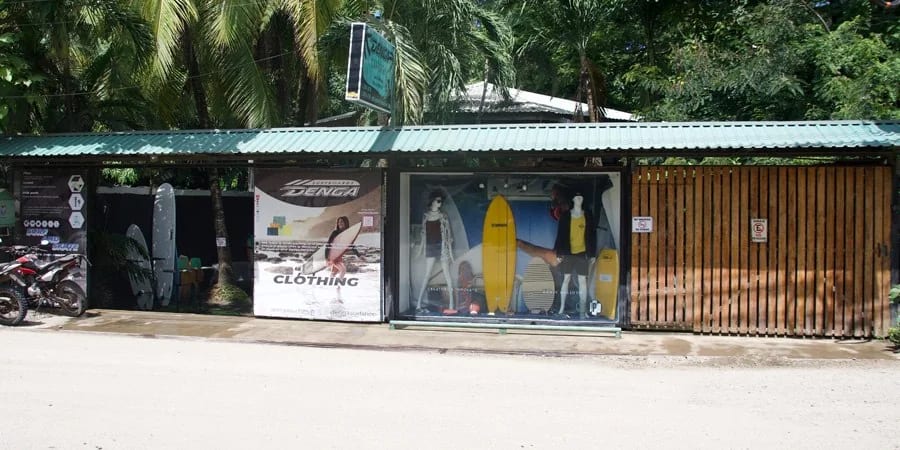
Exterior of Denga Surf Shop. Image source: View original photo.
A damaged surfboard changes the practical question from where to surf to who can assess it, what the repair involves and when it can be used again. In Santa Teresa, begin with the board's owner if it is rented, then contact a repair lead with photographs and an honest account of what happened. A price sent from one close-up image is useful only as an initial estimate. The board may need an in-person assessment before anyone can commit to the scope, cost or completion date.
There is a local lead, with an important limit to the evidence. DingShacks lists Denga Surf Shop for ding repair, but the directory entry is unclaimed. Denga's own current website confirms the shop and provides contact channels; it does not explicitly confirm a current repair service. Treat Denga as a place to ask whether repairs are being accepted or referred elsewhere, not as a guaranteed booking. We have not tested its work, verified workshop availability or adopted the directory's advertised opening hours.
First, keep the decision reversible
Stop using a board with suspected damage until its owner or a qualified repairer has assessed it. Firewire's care guidance specifically advises keeping its damaged boards out of the water and protecting them from excessive heat. That is a useful reason not to squeeze in one more session while deciding what to do. Follow the care instructions for your particular construction. Keep the board protected while arranging assessment rather than treating a trip's remaining surf days as evidence that a small-looking crack can wait.
Do not conceal a crack with wax, alter the area or start a chemical repair to make the board look better in a photograph. An assessor needs to see the condition you are describing. Tell them about any temporary patch or previous repair already present. If you do not know what material someone used, say so. This guide covers obtaining professional assessment and a useful quote; it is not a recipe for sanding, mixing resin, drying a core or deciding whether structural damage is safe to surf.
If an impact also injured someone, attend to the person before the equipment. The medical care guide for Santa Teresa de Cóbano explains how to locate care and emergency assistance. A board dispute, deposit concern or closing workshop should not become the main task while someone needs help. Once the people involved are cared for, record the basic circumstances accurately. A calm factual account is more useful to the owner and repairer than a speculative explanation of who must be responsible.
If the board is rented, contact its owner
Send the rental shop a message promptly, including the board identification and photographs. Ask where they want the board taken and whether they authorize an outside repair. They may prefer their own assessment or a particular workshop. Do not commission work on someone else's board merely because another shop can begin sooner. Keep the rental agreement and the original condition photographs available. The surfboard rental guide covers that handover record, which becomes particularly useful when distinguishing a new mark from damage already noted at collection.
Ask how the rental period, replacement board and deposit will be handled while the damage is assessed. Those are separate questions from the technical repair quote. A workshop's estimate does not automatically establish what the rental owner may charge under your agreement, and a withheld deposit does not mean the repair has been completed. Request an explanation of each item and keep the conversation in writing. Avoid arguing from another traveler's old price; their board, damage and rental terms may have been different.
If you borrowed the board from a friend, the same principle applies. Share the assessment and obtain consent before authorizing changes. The owner may value the original finish, a particular repair method or advice from the manufacturer more than a quick cosmetic result. If you own the board, check whether a warranty or retailer claim might be relevant before work begins. Ask the seller or manufacturer about the process without assuming that accidental damage qualifies. A repair booking and a claim review are different actions.
Send a small set of informative photographs
Take one photograph showing the whole board, another locating the damaged area and a few clear close-ups from different angles. Include a size reference without pressing into the damage or pulling at loose material. Photograph model or construction markings when visible. The point is to help the repairer understand what they are looking at, not to produce an artistic image. Good light and an uncluttered background are more useful than filters, heavy zoom or a single extreme close-up with no indication of where it belongs.
Describe when the damage happened, whether the board entered the water afterward and what changed from its previous condition. If the damage was noticed after transport, state that without claiming you witnessed a particular impact. Mention previous repairs near the same area if you know about them. Keep uncertainty visible: I noticed this after today's session is different from I know this happened on the reef. An honest account helps the repairer decide what to inspect and keeps your written record consistent.
A concise enquiry could say: I have a board with this model and construction marking. The damage is on the rail near the tail; these photos show the whole board and the area. It was used in the water after I noticed the mark. Are you accepting this type of work, and can I bring it for assessment before my departure date? This is an illustrative message. Replace every detail with your own information rather than copying the scenario as if it described your board.
Identify the construction before discussing materials
Firewire states that its boards use EPS-based foams and epoxy resin, and warns against polyester repair products on those boards. Keep that statement within its scope: it does not establish the construction of every board in Santa Teresa. A repairer should identify the actual board and suitable process. Bring any model information, purchase record or manufacturer guidance you have. If a label is missing, ask how the workshop will determine the construction instead of choosing a resin based on color, weight or a friend's guess.
Different damage locations also deserve different questions. For a rail crack, ask what area the assessment covers. For damage near a fin box or leash attachment, ask whether the surrounding structure needs inspection as well. For a crease or a board broken into sections, ask whether repair is advisable for the intended use and what limitations could remain. These are assessment prompts, not diagnoses. A visible mark alone cannot tell a visitor the full extent of the work or predict the board's later performance.

Ask for a quote with a defined result
A useful quote describes the damaged area, the proposed work, the finish and the estimated cost. Ask whether it is a firm price after inspection or an estimate that may change when the work reveals more. Agree on how the workshop will contact you before exceeding the authorized amount. If there are several damaged areas, identify each separately so a quote for one is not mistaken for a complete restoration. Keep the approved scope with the photos used during the assessment.
Discuss appearance separately from function. Ask whether color matching, artwork, polishing or blending an old repair is included. A repair can remain visible even when the workshop considers the agreed work complete; the expected finish should be described before you pay. Conversely, a neat-looking surface is not a technical assessment you can make from a photograph. Ask the professional what they will check and what they consider the board ready for. Avoid requesting an invisible finish on a deadline without understanding the additional work.
For comparison, send the same information to another available repairer rather than asking only for their cheapest ding price. Compare scope, assessment, communication and collection arrangements as well as the total. If the board is not worth repairing for your intended use, ask for a direct answer and decide what happens next. The used-board buying guide addresses a replacement purchase separately. Do not include an assumed resale value in the repair decision unless you have a real buyer and an agreed condition disclosure.
Separate completion from permission to surf
Give the repairer your actual departure date and the last time you can collect the board. Ask when they can inspect it, when they expect the work to finish and when they say it can return to the water. These may be different points in the process. A board ready to collect is not necessarily a board you should take directly to a sunset session. Get the care and use instructions from the person doing the work, especially if travel is close to the expected completion.
If the timeline does not fit, arrange an alternative rather than asking the workshop to shorten a necessary process. You might rent another board, move a lesson or choose a day away from surfing. Our activities for non-surfers can help fill that gap without turning a repair delay into pressure to use damaged equipment. Ask what happens if the repair takes longer than estimated and whether someone else may collect the board with written permission. Confirm any storage or onward delivery arrangement before leaving town.
Record the handover and inspect the agreed work
At drop-off, record the board model, distinctive marks, accessories left with it, agreed work and contact details. Keep fins, leash and bag only where the workshop asks; note anything that remains in its custody. Obtain a receipt or written acknowledgement. For transport, use a suitable vehicle and tell the driver the board dimensions in advance. The surf transport guide explains the equipment arrangements to settle before pickup. Do not carry a surfboard on a Bimba. Avoid an unplanned stop that leaves the board exposed while you are distracted by another errand.
At collection, review the agreed areas with the repairer and ask them to explain any change from the original quote. Obtain the final receipt and the return-to-water instructions. If something seems unfinished or differs from the agreement, raise it before leaving. Keep the before-and-after photographs with the paperwork, particularly for a rented board that must go back to its owner. A useful repair process ends with a documented result and clear next steps, not merely a message saying the board is ready.
Get the board assessed before committing
Use Denga’s official contact to enquire about the directory-listed repair lead, then agree on a documented assessment and scope. Protect the board and allow a realistic process rather than promising yourself one more session.