
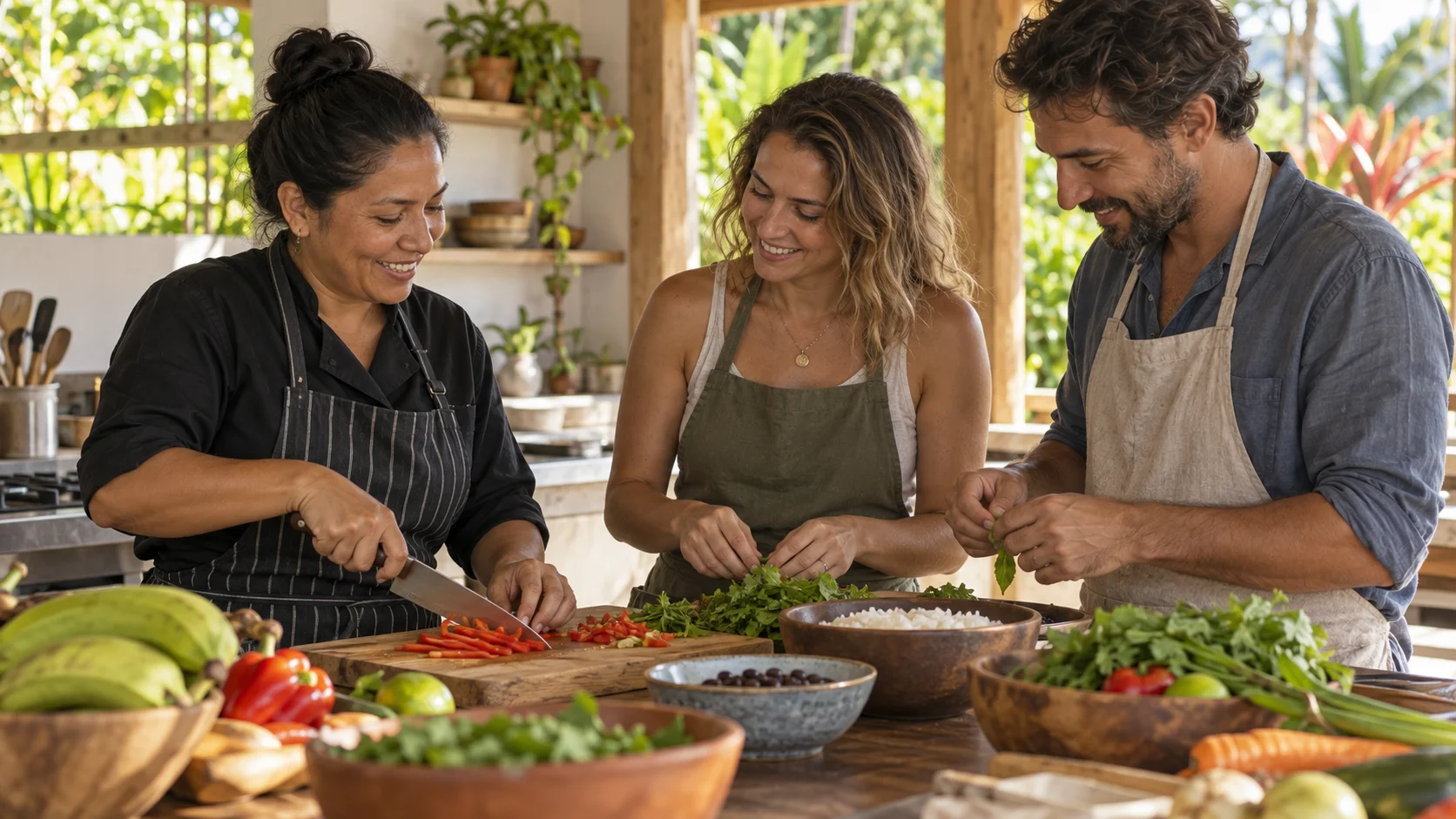
Booking a cooking class in Santa Teresa begins with a distinction that can be easy to miss: a private chef dinner is not necessarily a lesson. Watching a meal arrive, hearing the chef describe it and preparing part of it yourself are different experiences. If you want to learn, the reservation should say what participants will actually do and how much of the session is devoted to teaching.
The verified local options are mainly private services arranged by inquiry. That can be an advantage for a group with a shared interest, because the menu and format can be discussed before the chef plans the work. It also means that a general services page is not a fixed timetable. Start with a clear request rather than assuming there is a public class every afternoon.
Providers with a published cooking-class offer
Chef Mario Espinoza’s official services page, checked on October 21, 2026, lists private cooking classes separately from in-home cooking, chef’s table experiences and catering. It describes a practical session focused on Costa Rican cuisine. The published contact is chefmarioespinoza@gmail.com, with Santa Teresa identified as the business location. Ask specifically for a class when contacting him so the proposal is built around participation.
The Private Chef, at crchefs.com, also advertises cooking classes and lists Santa Teresa among its service areas. Its description includes demonstration, theory and hands-on practice, with several cuisine and skill-level categories. Regional service coverage does not establish a dedicated classroom in town or availability on your date. Request the actual venue and the chef assigned to the proposed session.
We have not attended these classes and do not rank their teaching. The evidence supports contacting them about a private lesson. The useful comparison is the proposal each gives for your group: what you will cook, how you will participate and what the final price includes. For a tasting-centered alternative, compare the Cabuya chocolate workshop, which has a different ingredient and activity focus.
Choose a learning goal before choosing dishes
A group that wants to understand a familiar Costa Rican meal should say so. Another may be interested in handling local produce or adapting a technique to a home kitchen. These are more useful requests than asking for the most authentic menu. The chef can explain which dishes fit the available time and equipment, and where a simplified teaching version would differ from restaurant service.
Begin with one or two skills you want to practice. You might ask to work on a dough, compare seasoning decisions or understand the order in which components are prepared. These are examples of possible learning goals, not dishes guaranteed by either provider. A short class works better when the menu leaves time for questions and repetition instead of requiring everyone to rush through many recipes.
Use our Costa Rican food guide to identify what interests you, then let the chef propose a realistic session. If you have already eaten a dish you enjoyed, describe it and ask whether something related is possible. The teacher should not have to guess whether your priority is a full dinner, a technique or a cultural introduction.
Define participation clearly
Ask whether everyone has a task, whether the group rotates through stations or whether one person demonstrates while others watch. A demonstration can be valuable, especially for a technique requiring careful control, but it should match expectations. Someone who wants to chop, shape or cook should know if that opportunity is limited to a small part of the session.
Group size affects this choice. Eight people around a small domestic counter may not all work comfortably at once. Ask how the instructor plans to share the space and whether the menu allows different tasks to happen safely. It may be better to divide into pairs or choose a dish with several manageable components than add more people to an unchanged setup.
Also distinguish preparation from dining. Does the class include sitting down to eat the food, or is it a shorter tasting? Are all guests participating, or are some only joining the meal? Give the provider both numbers. A nonparticipating diner still affects ingredient quantities, seating and service, while a participant needs work space and instruction.
Check the kitchen before reserving
For a class at your rental, obtain the property manager’s agreement and send the chef an accurate description of the kitchen. Useful details include available work surfaces, stove and oven, refrigeration, cookware and dining space. Photographs can be more informative than calling the kitchen fully equipped. A room suitable for breakfast may not support a group cooking session.
Ask what the chef brings and what the property must provide. Do not assume knives, cutting boards, serving dishes or cleaning supplies are included simply because ingredients are. The provider should identify the setup required for the chosen menu. Resolve missing equipment before the day rather than sending someone shopping while the instructor waits.
Our self-catering accommodation guide can help evaluate a kitchen’s everyday usefulness. A class adds another requirement: enough room for people to learn without blocking the cooking area. If the rental cannot support that, ask whether the provider has another confirmed venue. Do not move the session to a shared hotel kitchen without explicit permission.
Set the menu around actual dietary needs
Collect dietary information from the entire group before requesting a menu. Distinguish allergies, medically necessary restrictions and preferences so the chef can respond accurately. A vegetarian request is different from a need to avoid a specific allergen in a shared kitchen. Do not rely on one organizer’s assumption that everyone eats the same food.
Ask how the provider handles the particular requirement and whether the venue can support it. A menu that omits an ingredient does not establish that equipment or surfaces are free from contact with it. If the chef cannot accommodate the need with confidence, choose another menu or activity. A private format allows discussion; it does not create a universal guarantee.
For ingredients unfamiliar to the group, ask for an explanation before preparation starts. Participants should understand what they are tasting and handling. If a proposed dish involves raw ingredients you prefer not to eat, say so early and request a cooked alternative. The class is an opportunity to learn, not a reason to accept a food you are uncomfortable consuming.
Children and beginners need a specific role
A family booking should include each child’s age and the level of adult supervision available. Ask what tasks the instructor considers suitable and whether there is a minimum age for the proposed format. Do not treat a general family-friendly description as permission for children to work around every knife, stove or hot pan. The layout and menu determine what is practical.
For beginners, an instructor who explains the sequence can make the experience easier to follow. Ask whether the class assumes prior knife skills or experience with the technique. There is no advantage in pretending to know a task and then missing the explanation. A useful lesson leaves room to ask why something is done, not merely copy the movement.
The Santa Teresa family guide can help balance the session with the rest of the day. Avoid arriving exhausted and hungry after a demanding outing if the class begins with preparation rather than a meal. Give the group a realistic start time and ask whether a small snack beforehand would fit the experience.
Shopping is a separate inclusion
A cooking class does not automatically include a market visit. Ask whether the chef buys ingredients beforehand, takes the group shopping or expects you to provide a list. If shopping is included, establish how it affects the total duration and transport. A visit to buy produce can be interesting, but it also takes time away from work at the stove.
Do not buy ingredients independently before the menu is agreed. The chef may need a particular quantity, ripeness or form, and an apparently similar substitute can change the lesson. If you want to learn how to choose produce, ask for that as part of the teaching. Our supermarket guide is useful for everyday purchases, while the class should explain the choices relevant to its own menu.
Ingredient availability can also affect the plan. Agree on how substitutions will be handled and which parts of the menu are essential to you. Flexibility is easier when the learning objective is clear. If your main aim is practicing a technique, a change of produce may be acceptable; if you booked to learn one particular dish, that change needs discussion.
Read the full quote and the timeline
Request a total that identifies teaching, ingredients, preparation, dining service, cleanup, travel and any taxes or additional fees. Ask whether the price is per person or for the group and whether a minimum booking applies. These are questions for the provider, not terms established by the general service pages reviewed here. Comparing only a headline price can hide a substantial difference in what is included.
Clarify when the chef arrives, when participants should be ready and when the kitchen will be available again. Setup may begin before the class itself. A group with a remote-work call at the dining table or another guest cooking lunch needs to coordinate that shared space. Keep the teaching area available for the period the provider requests.
Agree on cancellation and weather-related arrangements before paying. A class in a covered rental may be a useful option during Santa Teresa’s rainy season, but access and provider travel still matter. Do not assume every cooking activity is fully indoors or unaffected by conditions simply because food preparation is involved.
Leave with something you can use
Ask whether the chef provides recipes or whether you should take notes. Record quantities, the sequence and the signs the teacher uses to judge progress. Those observations can be more useful at home than a photograph of the final plate. Ask about substitutions available where you live so the lesson does not depend on an ingredient you cannot obtain.
If you want to practice Spanish during the class, discuss the teaching language beforehand. Our guide to Spanish lessons in Santa Teresa covers more focused language learning. Cooking instructions need to remain clear, especially around equipment, so a bilingual format may work better than turning every technical step into an improvised vocabulary exercise.
Our recommendation is to book around one concrete learning goal and a kitchen that can support the group. Confirm participation and the meal arrangement in writing, then leave time to eat and ask questions. A successful class should make it easier to cook something afterward, even if the most useful lesson is a small decision about ingredients or timing rather than an elaborate menu.
Book participation explicitly
Choose one learning goal, confirm what each participant does and have the chef assess the actual kitchen. Compare complete proposals rather than treating a private dinner quote as a cooking-class offer.