
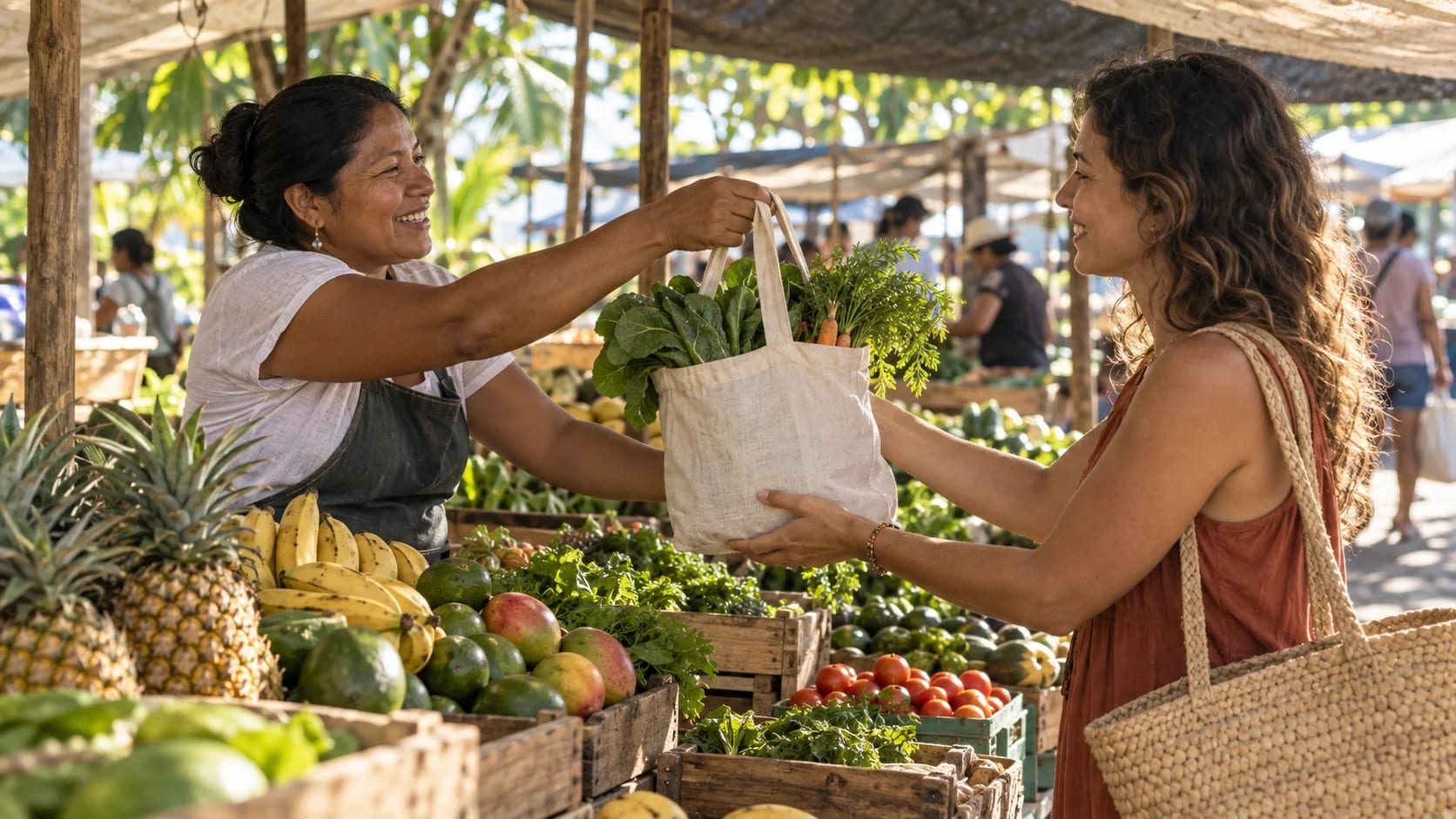
The Santa Teresa farmers market is worth approaching as a short shopping visit with room to browse. You can look for something to eat that afternoon, produce for the next few meals or a small item from a maker. The useful plan depends on where you are staying and what you can store. A kitchen changes what makes sense to buy; so does leaving the next morning.
The market is commonly called the feria orgánica. Local reports place it at Playa Carmen on Saturday afternoons. Treat it as a changing collection of vendors rather than a shop with a guaranteed inventory. A flexible list lets you choose from what is actually on the tables instead of spending the visit searching for an ingredient you assumed would be there.
The reported time and place
Todo Santa Teresa describes the feria on the beach at Playa Carmen, usually around 3–6 p.m. on Saturdays. Santa Baby Rentals’ local account also gives a 3 p.m. Saturday start and uses Playa Carmen Restaurant as a landmark. We checked these pages on October 21, 2026; neither is an organizer’s dated confirmation for your particular visit.
Reconfirm the location and expected start locally before making a special trip. Use the name feria orgánica de Playa Carmen so the conversation concerns this market, rather than another market elsewhere on the peninsula. If someone sends an announcement, check the date and year. A recurring description can remain online after a temporary change.
Arrive with enough time to browse without treating the reported closing time as a promise that each stall remains stocked until then. The market can still be useful if you find only part of your list. Keep the supermarket guide for fixed essentials you need regardless of the day’s vendor mix.
Take one look before buying
Walk through the available stalls once before making larger purchases. Notice which products interest you, what needs refrigeration and what you could use soon. If the market is small, this takes little time and prevents buying a heavy bag at the first table before discovering what else is available.
Keep your first pass practical. You do not need to compare every item or photograph every stall. Identify the few purchases that fit your stay, then return to the vendors with specific questions. If someone is busy serving, wait until the transaction finishes rather than interrupting to ask for a long explanation.
For an unfamiliar ingredient, ask how the seller would prepare it and whether it is ready to use. A short answer can tell you whether it belongs in tonight’s dinner or requires equipment you do not have. Buying a small amount to try is often more useful than taking a large quantity because the display looks appealing.
Choose fruit for the day you need it
Tell the seller when you plan to eat the fruit. Ready today and suitable in a few days are different requests. If you are staying through the week, a mix of ripeness can be practical. If you leave tomorrow, choose only what you can use before departure rather than hoping the next guest will want the remainder.
Ask before handling produce or testing firmness. Some fruit bruises easily, and a vendor may prefer to select it after hearing your needs. If you want to try something new, ask how to open it and which part to eat. Do not assume the fruit in a photograph will be available in the same condition during your visit.
Our self-catering guide helps connect food shopping with accommodation facilities. A fruit purchase is simple only if you have a clean place to prepare it, the right utensil and somewhere to store the remainder. A whole large fruit may be inconvenient in a room with no kitchen.
Understand the unit before comparing a price
A price may refer to one item, a bunch, a bag or a weight. Ask what the number covers before deciding that one table is cheaper than another. A larger-looking bag can contain a different quantity or quality. Compare the amount you will actually use, not just the largest bundle on display.
For packaged products, look at the net amount and whether you can close the container after opening. A small jar may cost more per unit but be a better purchase for a three-night stay. A larger one can make sense for a household sharing meals over several weeks. The useful size depends on the trip.
We do not promise that the feria is cheaper than supermarkets. Local markets can include produce, prepared food and handmade products with very different production costs. Ask the price politely, decide whether it fits your budget and buy the quantity you need. Treating every stall as a bargaining contest can make a simple purchase unnecessarily uncomfortable.
Ask what organic and local mean for the product
The name feria orgánica does not establish a certification for every item on every table. If certification matters to you, ask about the particular product and any documentation the seller can show. If your interest is where food comes from, ask where it was grown or made. Those are related but different questions.
A maker can explain an ingredient or production method without claiming a formal certification. Listen to the specific answer rather than turning a broad market label into a guarantee. For a gift, record the maker’s name and product details so you can describe it accurately later.
Todo Santa Teresa lists produce, coffee, chocolate, honey and crafts among the market’s categories. That is a guide to possible browsing, not a promise that a particular producer attends every week. If you want a dedicated cacao experience, the chocolate-workshop guide covers a separate activity with its own reservation.
Prepared food deserves a short ingredient conversation
Before buying food to eat immediately, ask what it contains and how the seller intends it to be stored. A label such as homemade tells you little about ingredients. If you have a dietary requirement, name the specific ingredient or preparation concern. Do not rely on an item’s appearance or assume a stall can guarantee the separation you need.
Choose a portion you can eat or store appropriately. If you are continuing to the beach for several hours, avoid buying products that the seller says need prompt refrigeration. You can make those purchases at the end and return to your accommodation. That sequence is easier than carrying food through the rest of an afternoon without a storage plan.
Ask whether packaging is included and whether a clean reusable container is suitable. The seller may need a particular container for the product. Accept that answer rather than making a transaction harder in the name of reducing waste. A reusable bag still helps carry several purchases together.
Three useful shopping plans
A room without a kitchen. Focus on something ready to eat, fruit you can handle with the facilities available and a small packaged item you can store. Skip ingredients that require cooking or a large preparation area. Before buying breakfast supplies, check whether the accommodation already provides breakfast.
A rental with a kitchen. Build around one or two meals rather than a whole imagined week. For an illustrative dinner, choose available vegetables you know how to prepare and add the pantry ingredients from another shop if needed. The market does not have to provide every component to make the meal worthwhile.
A gift to take home. Favor something labeled and easy to pack, with storage instructions you can follow. Before buying food for international travel, check the destination’s rules yourself. A seller’s ability to sell an item locally does not establish permission to carry it across a border.
Make time for makers without assuming every item is local
Santa Baby Rentals describes both food vendors and makers around the market area. It also distinguishes ongoing beach stalls from the Saturday gathering. That is a useful reason to ask who made an item and where, rather than assuming that everything sold nearby shares the same origin or belongs to the feria.
For jewelry, clothing or another handmade object, inspect the size and finish before paying. Ask about care and whether the seller can provide contact details for a later question. If you want a custom piece, agree on the delivery date and collection method in writing. A short visit may not leave enough time for an order.
The shopping guide covers wider options beyond the market. You can enjoy browsing without buying at every table. Ask before taking close-up photographs of a maker’s work, and keep the sales area clear for people ready to complete a purchase.
Bags, payment and the return trip
Bring a reusable bag that can separate heavy items from soft produce. Put fragile purchases where they will not be crushed, and carry only what you can manage on the return journey. Buying for a group can make sense if someone has already planned how to bring everything back.
Carry a practical payment option and ask each seller what they accept before placing an order. Cash in smaller denominations can simplify a small purchase, but this guide does not claim that every stall is cash-only or that electronic payments work everywhere. Confirm the currency and total before handing over payment.
Keep your purchases together and check that you have the correct change or payment confirmation. If you plan another stop afterward, think about what the food requires first. A direct trip back with groceries can be the better plan, leaving the beach visit for another time.
Keep the visit flexible
During the rainy season, reconfirm the expected market arrangement and protect purchases from rain. Do not assume that an outdoor listing guarantees every vendor attends in the same place regardless of conditions. If the gathering changes, use the visit as an opportunity only when it still fits your day.
With children, give the outing a simple purpose: choose a fruit, buy something for dinner or look at a maker’s work. Keep children beside you at busy tables and ask before they handle products. A short focused visit can be easier than extending the afternoon until everyone is tired and carrying more than they wanted.
Our recommendation is to go with a modest list, a reusable bag and room for one unfamiliar purchase. Reconfirm the reported Saturday window, then shop for the stay you are actually having. A successful feria visit can be a few useful items and a good conversation, without needing to replace all your grocery shopping.
Shop for the stay you are having
Reconfirm the reported Saturday afternoon feria at Playa Carmen, then take a small flexible list. Ask about origin, quantities and storage at each stall rather than treating the market name as a guarantee for every product.